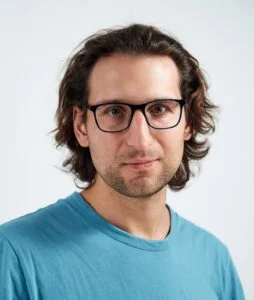

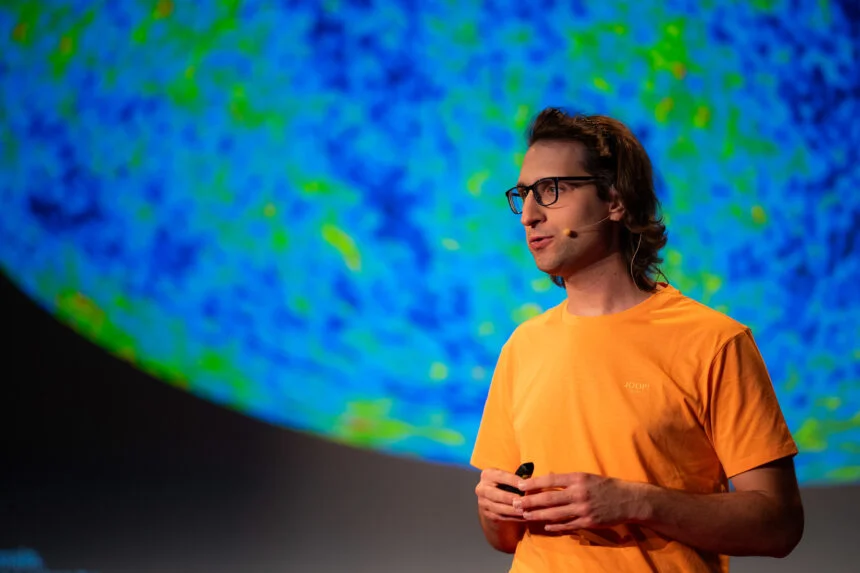
Why is it worth focusing on a narrow area of research? Does luck really favor the bold? Where is there room for sensitivity in physics? We speak with Prof. Michał Parniak from the Centre for Quantum Optical Technologies at the University of Warsaw’s Centre of New Technologies (CeNT) and the Faculty of Physics.
UW Science Daily: Have you always wanted to be a physicist?
Prof. Michał Parniak: Good question. No. In high school, I wanted to be a chemist. At first, my interests and ambitions changed quite often. It wasn’t until college that things began to take shape.
How does reality compare to what we imagine a physicist does?
– The ideas we have when we start college are often tied to fundamental physics – discovering laws we don’t yet know. I work on something a bit different – let’s call it quantum engineering. It’s less about discovering and more about inventing. That suits me better.
What helps you in your work?
– Definitely my colleagues. Everything I’ve written about – and everything that’s been discussed recently – is the result of a team effort, including the people who taught me and the students I work with. I think we’re currently attracting many of the best physics students to our university.
Working with people is incredibly valuable, and we’ve managed to create a very dynamic research environment. In research, having a great deal of freedom is also crucial. Of course, you still have to be realistic – consider what can be funded and what cannot – but in my field, these plans aren’t subject to heavy top-down oversight. We’re not building a $100 billion particle accelerator – just experiments we can fully control ourselves.
We also don’t constantly look over our shoulders to see what others are doing. Of course, staying aware of broader trends matters – what’s important now or what might be important in five years – but that’s about anticipating developments, not following imposed agendas.
The fly in the ointment. What gets in the way of research?
– Funding, of course. It’s never very stable. Things are fine now, but last year was tougher, and it’s hard to plan more than five years ahead. Right now, I’m lucky – I have funding from the Foundation for Polish Science’s International Research Agendas Programme FENG – but if we had this conversation a year ago, I’d be in a difficult position.
What is life like for a researcher in Poland under these conditions?
– A researcher who is active and tries to combine scientific work with practical applications is very busy. But there are plenty of opportunities, and the work itself is fascinating.
You mentioned keeping up with trends. Your work involves quantum computing and optical communication technologies. The term “quantum” also appears in connection with your collaboration with the European Space Agency. Clearly, you’re doing well on that front – since the UN proclaimed 2025 the International Year of Quantum Science and Technology.
– That’s true. I got into quantum technologies just as they were starting to take off, and now we’re at their peak. Whether this will continue is unclear. Within quantum technologies, we try to develop somewhat niche solutions. We strategically choose projects where our expertise gives us a competitive edge globally.
One of your first major projects was a device capable of capturing and storing light as quantum memory – is that correct?
–That’s right.
That was the first step; then there were a few more, and eventually a quantum processor emerged.
– Let me tell the story more fully. After my master’s thesis, I worked on relatively simple quantum technologies – based on atoms and lasers. When I started my PhD, my team and I decided to build a more advanced atomic system called a magneto-optical trap. It lets us cool atoms with lasers, giving us better control and enabling more advanced applications.
We built such a system very quickly and, for the first time, demonstrated a quantum memory protocol for light that worked not just for single photons – as others had done – but across many channels. At the time, we achieved around 600 channels – three times more than a Chinese group demonstrated that same year (using a different method).
Thanks to this record performance, our memory also had additional capabilities. We showed that stored light could be slightly processed.
Think of it like a conventional computer, we have memory and then load data into the processor, where very complex operations take place. We proposed that even if we can’t yet perform arbitrarily complex operations – especially quantum ones – we can still perform certain simple operations without removing photons from memory. So we have a processor for light that can modify that light.
This is already a device that allows us to extract more information from light than was previously possible; it enables us to encode information more densely for any given amount of light. That was the quantum processor we demonstrated.
When did the European Space Agency enter the picture?
– After I left for my postdoc. I spent two years in Copenhagen and returned to lead a research group. That’s when we started a new project. We had a grant that allowed us to purchase some equipment – specifically, four strategically chosen lasers.
So it’s not an astronomical amount after all…
– Yes, exactly. It’s a small investment. But this investment allowed us to conduct a demonstration using a completely new setup. We are moving from a memory-based processor to a much simpler setup – the atoms are excited into specially prepared states using these new lasers. These states are highly sensitive to microwaves. In this way, we simultaneously created a detector and a microwave-to-light converter, which converts microwave energy and enables much more sensitive detection.
We published the results in a prominent journal, Nature Photonics. After that article, the European Space Agency reached out: ‘Hey, listen, it just so happens that quantum sensors (our invention is, in fact, a type of quantum sensor) are one of our development priorities. It looks like you are practically one of only two groups in Europe working on sensors of this type. We would like to collaborate.’
That was more or less the message. The other group is – now our collaborators –scientists from the University of Durham in the United Kingdom.
It started with a few conversations, and eventually we received a contract from the European Space Agency to build a prototype demonstrator of such a quantum sensor. It is not intended to go into space just yet, but it is designed to operate outside the laboratory.
The ESA rates what we are developing at Technology Readiness Level (TRL) 3, where 9 means a system is ready for deployment in space. That is one aspect of the collaboration, but not the only one. Currently, as part of our scientific cooperation with the European Space Agency, we are preparing a joint publication that will serve as a roadmap for the use of this class of quantum sensors in space applications.

The roadmap sounds promising. Let’s translate the language of physics into terms that are more accessible to the average person. We tend to think of physics as something distant, but it is everywhere – in the microwave oven, in the computer. The research you are conducting has the potential for very practical applications. It can be used to develop safer technologies and more secure data transmission systems that are resistant to eavesdropping and interception.
– Yes.
Anything else?
– This aspect of quantum cryptography offers a way to protect against eavesdropping. At present, it is possible to transmit such data over a few kilometers without using our methods. However, over distances of 100 km and beyond, this is not yet feasible. For such ranges, quantum memories are required. Our quantum memory represents a step in that direction.
On the other hand, when we talk about quantum sensors and our research for the European Space Agency, the focus is somewhat different. This work concerns electromagnetic radiation – from radio waves and microwaves to so-called millimeter waves and terahertz waves.
Terahertz radiation can be used to scan through certain materials or, for example, to measure their temperature and reflectivity. These waves are relatively rare; there are perhaps only a few contexts in which we commonly encounter them. However, 5G networks are beginning to approach this frequency range, and they will be essential for the next generation (6G).
Another example is airport security scanners (though not metal detectors), which allow imaging of clothing and objects in a way that is significantly safer than X-ray-based scanning. At airports, X-rays are used only to scan luggage – not people – as direct exposure would be too dangerous.
We are developing terahertz radiation detectors. Thanks to new technologies, they are significantly more sensitive, which allows them to be used in various types of material-analysis devices. They can also be integrated into radars, telecommunications receivers, and satellites.
In the case of satellites, the goal is often to point them toward Earth for observation. This would allow us, for example, to determine who is transmitting signals and what is being transmitted. It would also enable us to measure the reflectivity and temperature of clouds, as well as the temperature of the ground. Such high-precision measurements are crucial for climate research and weather forecasting, as current data is still not sufficiently accurate.
Did you expect the European Space Agency to become involved?
– It was a surprise. On the other hand, though, we did bring it on ourselves a bit. In our paper, I wrote that such a device could be interesting for satellite applications. Unlike various far-fetched ideas, the atomic cells we use – small vacuum glass cells containing atoms – are based on a technology quite similar to that used in the clocks on all GPS satellites. Every GPS satellite must carry a very precise atomic clock.
That’s why it is not so difficult to imagine another type of atomic cell being used in space; it is simply a technology that has already been demonstrated. I mentioned this in the paper, so perhaps that is how I sparked some interest in space applications
You set the events in motion, and… luck favors the bold.
– It’s partly true that things just happen, but of course we try to encourage such applications. That is also part of a scientist’s job – to find practical uses for what we discover.
What don’t we know yet? There was a lot of buzz about the prototype for the European Space Agency. There have also been quite a few articles about your first major projects. So what’s in the works right now? What else is happening?
– We’re not just asking ourselves how to make such a microwave sensor a little better, but how to build one that would be truly unbeatable — one that reaches the fundamental quantum limit of sensitivity. Perhaps we’ll have an answer to that question soon. This is more of a nod to fundamental physics than to applications, although who knows… Such a sensor is much more complex in itself, but also far, far more sensitive.
Quantum technology is a very hot topic, and at the same time, a much-needed one…
– Yes. Although at the same time, especially when it comes to quantum computing – that is, computations and quantum computers – it’s a field that is very prone to drifting away from physical reality. There are press releases about quantum processors promising a million qubits (quantum bits – ed.), even though there isn’t a single one that actually works properly.
So clickbait is sneaking in everywhere.
– Yes. It’s everywhere, especially in quantum computing. At some point, you don’t know who to trust, but I think you can always trust experts working at universities. This ties into the university’s mission – to ensure that the realm of scientific truth is not taken over by pure commercial interests.
To temper business appetites.
– The point is not to get lost in a thicket of empty words, but to focus on what we really have and what actually works. We try to write press releases about our achievements in a way that is both enthusiastic and precise.
You are a recipient of the Frank Wilczek Prize. Is he an important figure to you?
– I was very pleased to receive this award. It was established by the Jagiellonian University and the Kosciuszko Foundation. It is connected to the ties between Professor Frank Wilczek, a Nobel laureate, and the Jagiellonian University. Some of the phenomena that Professor Wilczek studied – although in fundamental physics – related to how matter organizes itself into phases, also appear in the atomic systems I study.
The text was originally published in Polish on the Serwis Naukowy UW website on April 1, 2025.