

Serwis Naukowy UWSerwis Naukowy UWSerwis Naukowy UW
  • Humanities
  • Social Sciences
  • Natural & Exact Sciences
  • Content Usage
Serwis Naukowy UWSerwis Naukowy UW
  • Humanities
  • Social Sciences
  • Natural & Exact Sciences
  • PL
  • Content Usage
Follow US
Copyright © 2026 Uniwersytet Warszawski

Strona główna » An innovative computational model reveals the cause of the disease: Scientists on the trail of epilepsy

Physics

An innovative computational model reveals the cause of the disease: Scientists on the trail of epilepsy

It is one of the most common neurological diseases. Epilepsy affects 1% of the world’s population. Although the condition has been known for thousands of years, we are still waiting for effective drug therapies to be developed and for an answer to the question: what causes epileptic seizures?

Last updated: 2026/08/25
17/02/2025
5 Min Read
Photo by Bethany Szentesi, Unsplash.
SHARE

The ancient “sacred disease”

The first descriptions of epileptic seizures date back thousands of years. Epilepsy was known in many parts of the ancient world, from Mesopotamia and Babylon, through China, to Greece and the Roman Empire. This mysterious condition was believed to be related to demons or gods. It was Hippocrates, in his work “On the Sacred Disease,” who suggested that seizures had nothing to do with magic or gods, and that their cause lay in the brain. Even so, for a long time, epilepsy continued to be treated as the result of a curse, and those affected were stigmatized and isolated from society.

Every year, 27,000 Poles find out that they have epilepsy. Treatment does not always produce satisfactory results. Thirty-eight percent of newly diagnosed adults suffer from a drug-resistant form of the disease. Scientists and doctors agree: the limited number of effective drug therapies results from insufficient knowledge and understanding of epileptic seizures.

How does an epileptic seizure occur?

Scientists decided to investigate the causes of epileptic seizures. How?  Through realistic computer simulations. A Polish-Italian team led by Prof. Piotr Suffczyński from the Faculty of Physics at the University of Warsaw developed an innovative computational model. Using this model, the scientists were able to reproduce and understand the signals observed in epilepsy. They demonstrated that the electrical discharges leading to epileptic seizures are not caused, as long believed, by synapses, i.e., the connections between neurons, but by disturbances in potassium concentration in the extracellular space.

An increased concentration of this element raises the electrical potential across the cell membrane, thereby increasing neuronal excitability. The increase in neuronal activity then leads to further potassium accumulation. This feedback mechanism causes uncontrolled electrical discharges in the brain, leading to characteristic convulsions and loss of consciousness.
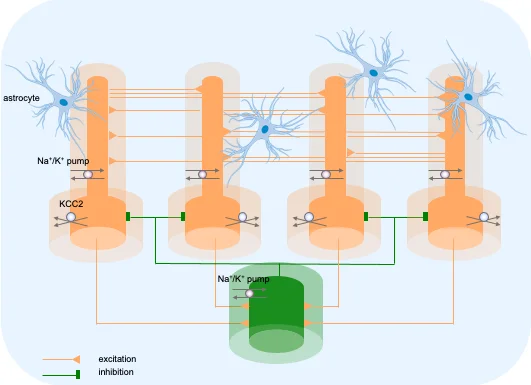
Fig. A biophysically realistic computational model consisting of five cells: one inhibitory and four excitatory cells, glial cells, and the neuronal environment in which ion movement occurs. Visualization by Piotr Suffczyński, source: Faculty of Physics, University of Warsaw.

“Our biophysically realistic computational model consists of five cells: one inhibitory and four excitatory cells, glial cells, and the neuronal environment in which ion movement occurs. Using this model, we were the first to demonstrate the potential mechanism of seizure initiation by inhibitory neurons – the ‘trigger point’ or ‘spark’ that initiates the process is the accumulation of potassium outside the cells,” says Prof. Suffczyński.

The model also shows how the mechanism responsible for stopping seizures works. Researchers emphasize that this process is dependent on the potassium-sodium imbalance and the associated increase in activity of sodium-potassium pumps, which transport sodium and potassium, respectively, outside and inside the cell.

The hope lies in nanoparticles

This discovery by the physicists sets the direction for the search for more effective antiepileptic drugs. Researchers are focusing on how to control extracellular potassium levels in the brain.

Prof. Suffczyński’s team has proposed using nanomaterials for this purpose. Their role would be to mimic glial cells, known as astrocytes, which help regulate neuronal activity.

There are already gold nanoparticles capable of recognizing and absorbing various types of ions, including potassium. However, before nanotherapy can be used in humans, further research is needed, such as studies on its toxicity. The research conducted by biomedical physicists may help many patients. Understanding the mechanisms of the initiation and termination of epileptic seizures will be useful not only in the treatment of epilepsy, but also in other neurological conditions, such as brain hypoxia caused by stroke and migraines.

The text was originally published in Polish on the Serwis Naukowy UW website on February 17, 2025.


Manufacturing fake news: Voltaire in the service of Russian propaganda
Reading Earth’s climate history: The mysteries of solution pipes
The underground language of nature: What springs reveal about climate change and human activity
How to #MakeZbiorKomGreatAgain? Innovative mobility data
Can elves and vampires have dark skin? Counterfactual thinking in philosophy – and on the Internet
TAGGED:epilepsyFaculty of PhysicsUniversity of Warsaw
Previous Article How much do trees earn? Or, what salary does your pine tree deserve?
Next Article Podhale Goralian put to the test: Can the local dialect still be saved?
dr hab. Piotr Suffczyński, prof. ucz.

works at the Faculty of Physics of the University of Warsaw, in the Biomedical Physics Division. His research interests include computational modeling of the nervous system, pathological brain activity in epilepsy, and the problem of consciousness.

UW Science Daily

Center for Cooperation and Dialogue, University of Warsaw

Office: ul. Dobra 56/66, 00-312 Warsaw

Tel.: +48 609635434 • redakcja@uw.edu.pl

Facebook Linkedin Instagram

About us

UW Home page

logotyp-IDUB-PL-poziom-inv

Accessibility statement

Cookie privacy policy

Site map

Copyright © 2026 University of Warsaw

Copyright © 2026 Uniwersytet Warszawski
Manage Consent
To provide the best experiences, we use technologies like cookies to store and/or access device information. Consenting to these technologies will allow us to process data such as browsing behavior or unique IDs on this site. Not consenting or withdrawing consent, may adversely affect certain features and functions.
Functional Always active
The technical storage or access is strictly necessary for the legitimate purpose of enabling the use of a specific service explicitly requested by the subscriber or user, or for the sole purpose of carrying out the transmission of a communication over an electronic communications network.
Preferencje
Przechowywanie lub dostęp techniczny jest niezbędny do uzasadnionego celu przechowywania preferencji, o które nie prosi subskrybent lub użytkownik.
Statistics
The technical storage or access that is used exclusively for statistical purposes. Przechowywanie techniczne lub dostęp, który jest używany wyłącznie do anonimowych celów statystycznych. Bez wezwania do sądu, dobrowolnego podporządkowania się dostawcy usług internetowych lub dodatkowych zapisów od strony trzeciej, informacje przechowywane lub pobierane wyłącznie w tym celu zwykle nie mogą być wykorzystywane do identyfikacji użytkownika.
Marketing
Przechowywanie lub dostęp techniczny jest wymagany do tworzenia profili użytkowników w celu wysyłania reklam lub śledzenia użytkownika na stronie internetowej lub na kilku stronach internetowych w podobnych celach marketingowych.
  • Manage options
  • Manage services
  • Manage {vendor_count} vendors
  • Read more about these purposes
View preferences
  • {title}
  • {title}
  • {title}