


Polling data and modern political history suggest that large electorates tend to divide their support almost evenly. As election day approaches, this balance often becomes even more pronounced. Faced with a binary choice, voters in contemporary democracies frequently split into two strongly polarized camps of similar size. Is this essentially random – like flipping a coin? Or are there underlying mechanisms that pull societies toward this equilibrium? And what matters more: opinion polls or the influence of people around us? Models from the physics of social dynamics offer a way to explore these questions.
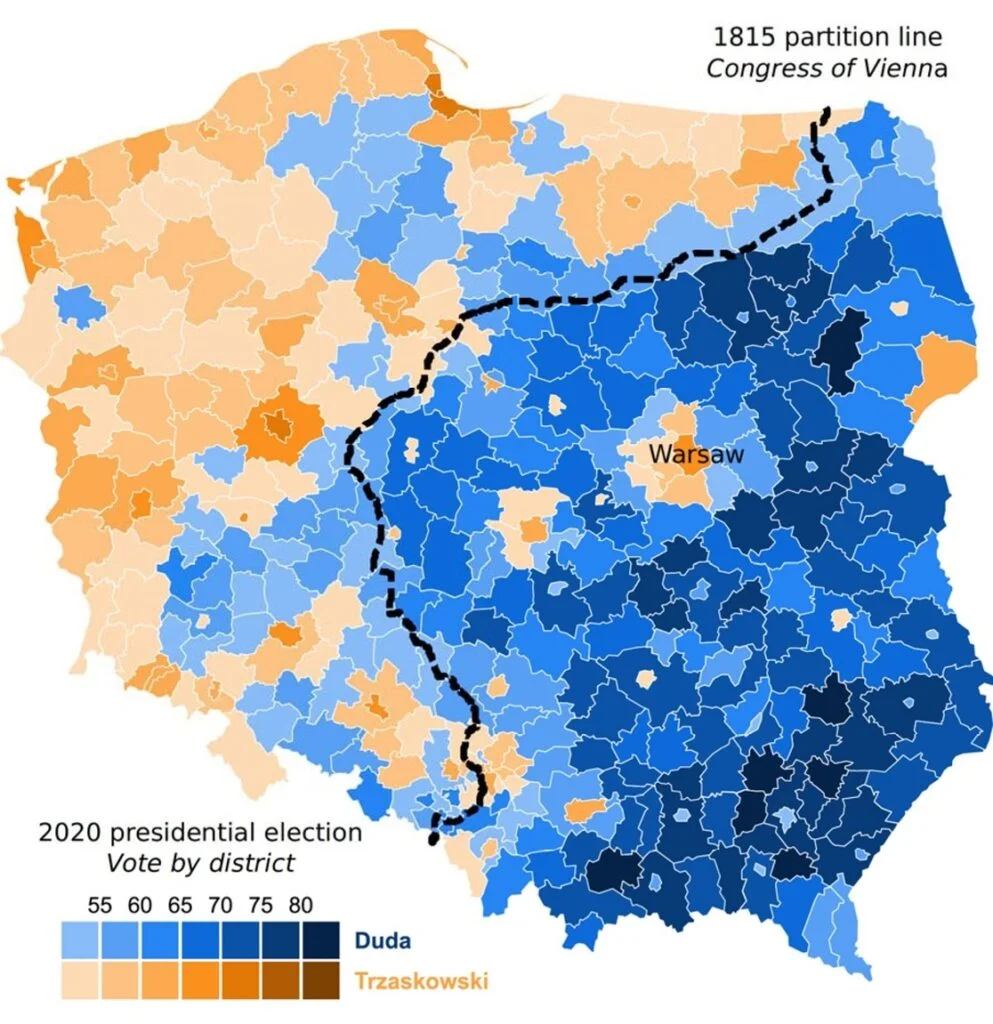
In Poland’s 2020 presidential election, voters in eastern Poland (with the exception of a few large cities) strongly preferred Andrzej Duda, while those in the west largely backed Rafał Trzaskowski. These results suggest that voting behavior is not random but shaped by social context. Voters can be seen as so-called interacting agents, whose opinions are influenced by the beliefs of those around them. However, the impact of one’s immediate environment is only part of the picture – researchers, including scientists from the Faculty of Physics at the University of Warsaw, argue that public opinion polls, which shape the dynamics of social division, may play an equally important role.
When the model falls short – and voters push back against the majority
From a physicist’s perspective, opinion polls act like an external force influencing the system. When this force is incorporated into models of social dynamics, it can produce two polarized political camps that are often geographically distinct. Statistical mechanics – especially the Ising model – provides tools for studying such behavior.
Originally developed to describe ferromagnetism, the Ising model assumes that individual elements (here, voters) can exist in one of two states. Their “orientation” depends both on their neighbors and on external influences. In its classical form, the model predicts that strong interactions between individuals should lead to consensus: most people end up aligning with the same option.
The researchers modified the Ising model to include sensitivity to opinion polls. In the model, voters remain influenced by their neighbors but also tend to react against the average opinion, which can stabilize an almost even split. This counter-reaction stabilizes the system at an almost perfectly even split – close to 50:50. Rather than producing a decisive outcome, elections may therefore reinforce polarization.
“We have shown that in countries with electorates exceeding roughly one million, the influence of public opinion polls can lead to a stable division of society into two camps of similar size. In smaller populations, a tendency toward consensus prevails, as the long-range effect of polls is weaker and local interactions among voters more effectively promote uniformity. This pattern stems from the mathematical relationship between sensitivity to polls and the size of the system,” notes Prof. Piotr Szymczak of the Faculty of Physics at the University of Warsaw.
In this newly identified state, society is ordered at the local level – most people agree with those around them – yet globally it remains deeply divided.
“What is fascinating is that even with strong local social ties, the global influence of polls can reinforce an even division of opinion. The biggest surprise in our research was the stability of this state and the fact that the system self-organizes along historical or geographical ‘dividing lines.’ This can be seen, for example, in Polish election results, which correlate with the borders of the former partitions,” adds Prof. Szymczak.
Tough choices
Politics and physics may seem worlds apart, but they share surprising similarities. Voting preferences shift over time, and physicists ask a fundamental question: what drives these changes?
Their models focus on collective mechanisms rather than individual motivations such as personal beliefs, values, or cultural background. In this framework, election outcomes emerge from social interactions – conversations with family members, coworkers, and friends. At the same time, public opinion polls provide a constant stream of information about the “state of play,” shaping how voters perceive the broader electorate.
As a result, their individual preferences are set against the perceived views of the so-called general public – society at large, the electorate, or their professional circles.
This feedback loop between polls and voter behavior may help explain why political consensus is so difficult to achieve in large societies. Voters respond not only to their own convictions and local influences but also to media coverage of shifting levels of support. The effect can be strong enough to lock the system into a stable equilibrium: two opposing camps of nearly equal size.
Notably, some countries restrict the publication of opinion polls shortly before elections, precisely because of concerns about their influence. Yet the research suggests that this influence is more complex than previously assumed: rather than simply reinforcing the leading candidate, polls may also sustain long-term political deadlock.
With increasing access to large datasets and a better understanding of social networks, researchers are now able to study collective decision-making with greater precision. This opens the door not only to explaining polarization but also to predicting how changes in media ecosystems and communication patterns might shape future elections.
Although we cannot say with certainty whether some voters have always shown a tendency to react against prevailing opinion, one thing is clear: modern democracies show unmistakable signs of an interplay between voters and polls

Voters boxed in by poll numbers
Agent-based models are just one of several approaches to studying electoral dynamics. Others include differential-equation models and statistical analyses, each offering a distinct perspective on how election outcomes emerge. Together, they provide a more comprehensive picture of how complex voting systems behave.
“Beyond the Ising model or social network theory, approaches based on game theory – such as analyses of tactical voting – multi-agent systems, or machine learning methods that detect patterns in large behavioral datasets can also yield valuable insights,” Prof. Szymczak explains. “Still, statistical physics, especially models of phase transitions, may offer a useful way to think about how societies shift between more ordered and more disordered states.”
The article was originally published in Polish on the Serwis Naukowy UW website on March 11, 2025. It was updated in March 2026.