

Serwis Naukowy UWSerwis Naukowy UWSerwis Naukowy UW
  • Humanities
  • Social Sciences
  • Natural & Exact Sciences
  • Content Usage
Serwis Naukowy UWSerwis Naukowy UW
  • Humanities
  • Social Sciences
  • Natural & Exact Sciences
  • PL
  • Content Usage
Follow US
Copyright © 2026 Uniwersytet Warszawski

Strona główna » Can a mouse outsmart us? The surprising ways animals deceive

Biology

Can a mouse outsmart us? The surprising ways animals deceive

They can lead you astray and set traps. When fleeing, they use dodges and feints that even the best soccer players might admire. Recent research by scientists at the University of Warsaw sheds new light on animals’ ability to intentionally mislead others.

Last updated: 2026/05/06
07/03/2025
7 Min Read
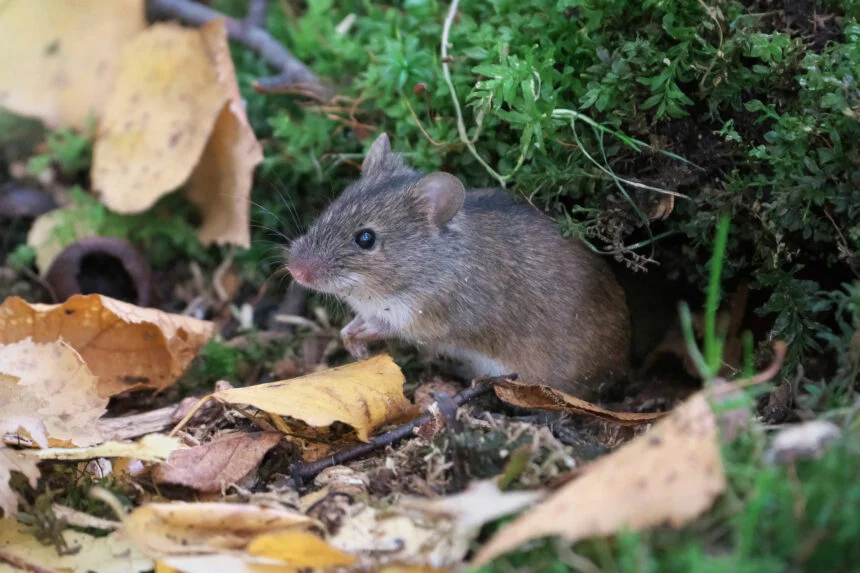
Black-striped mouse (Apodemus agrarius).
Black-striped mouse (Apodemus agrarius). Photo by Andrey Gulivanov / Wikimedia
SHARE

Behavioral deception involves sending false information or concealing the truth. The goal? To benefit the sender while disadvantaging the receiver. This type of deception occurs in many animal species. In most cases, such behaviors are instinctive, genetically determined or learned. But not always.

Some animals, when deceiving others, employ flexible and creative tactics. Researchers refer to this as tactical deception. It is rare. It has been documented mainly among primates and corvids (a group of highly intelligent birds that includes crows, ravens, and jays). The most advanced form of this phenomenon is intentional deception: behavior that appears intended to mislead an opponent.

Among rodents, behaviors that may qualify as intentional tactical deception have so far been documented only in squirrels and rats. According to a study co-authored by Prof. Piotr Bębas and Dr. Marcin Chrzanowski from the Faculty of Biology at the University of Warsaw, this list may now include another group: free-ranging mice.

How do you study deception in free-ranging mice?

The observations were conducted as part of a project investigating how two free-ranging mice species – black-striped mouse (also known as striped field mice; Apodemus agrarius) and the yellow-necked mouse (also known as yellow-necked field mice; Apodemus flavicollis) – respond to competition for food when predator scents are present.

The experiment took place under natural conditions next to a forest outside Warsaw. Researchers installed free-access laboratory-style test chambers – wooden boxes with a floor and a single entrance or exit. Each day, the chambers were stocked with food attractive to free-ranging mice. The animals could visit at any time they wished.

Their behavior was monitored remotely using infrared cameras.

“We were observing the social interactions of free-ranging mice competing for food – both within the same species and between species. That’s when we noticed a previously undocumented defensive behavior displayed by one of the species: deceptive evasion of a pursuer. In short, a free-ranging mouse pretends to flee and tricks the pursuing individual,” the researchers explain.

More precisely, scientists identified two variants of this behavior.

In the first scenario, a free-ranging mouse being chased by another appears to run into the chamber. In reality, it stops just inside the entrance and hides by standing sideways along the wall near the opening – the only entry and exit point. The animal freezes completely, remaining silent and motionless so that the pursuer cannot detect it. When the chasing free-ranging mouse runs past, the hidden individual seizes the opportunity to escape in the opposite direction.

In the second scenario, a free-ranging mouse already inside the chamber detects an approaching rival. It then performs a similar maneuver in order to leave the chamber without encountering the intruder – using the same tactic of freezing near the entrance and slipping away when the pursuer is distracted.

In other words, the pursued animal uses deceptive evasive maneuvers, flexibly adjusting its escape strategy to the situation.

According to the researchers, both types of behavior fit the criteria for intentional tactical deception – a phenomenon rarely documented in animals and never before reported in free-ranging mice.
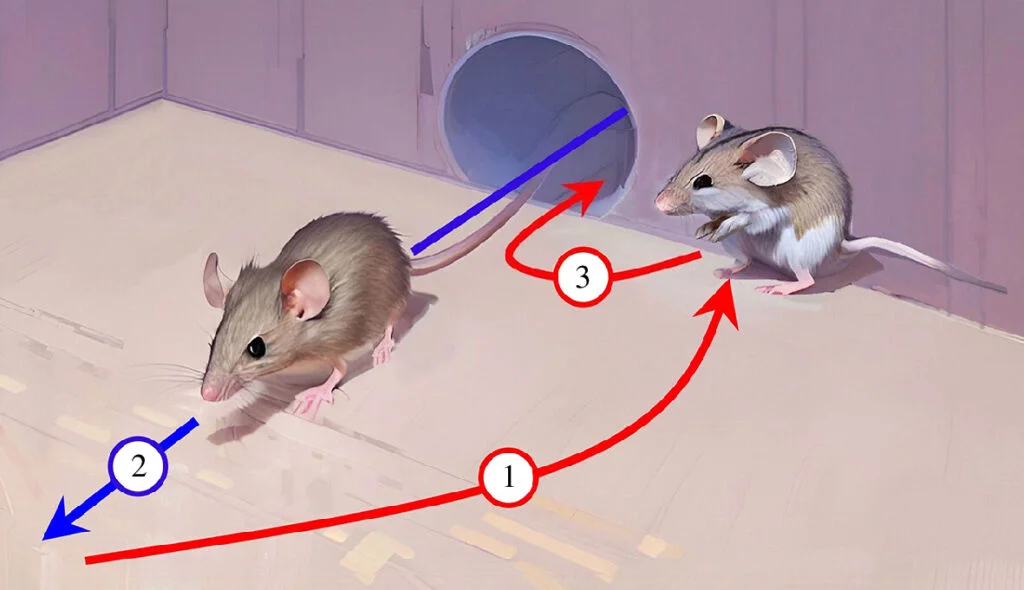
Stages of deceptive dodge. The actions of the chased and chasing free-ranging mice are marked in red and blue, respectively. 1. Hiding: After detecting an approaching rival, the free-ranging mouse inside the chamber moves to a position along the side of the tube. 2. Concealment through immobility and silence: When the chaser enters the chamber, the chased mouse stays immobile and silent. 3. Exploitation of the target’s distraction: The pursued animal uses the pursuer’s momentary distraction to slip out through the entrance.
Stages of deceptive dodge. The actions of the chased and chasing free-ranging mice are marked in red and blue, respectively. 1. Hiding: After detecting an approaching rival, the free-ranging mouse inside the chamber moves to a position along the side of the tube. 2. Concealment through immobility and silence: When the chaser enters the chamber, the chased mouse stays immobile and silent. 3. Exploitation of the target’s distraction: The pursued animal uses the pursuer’s momentary distraction to slip out through the entrance. Source: royalsocietypublishing.org/doi/10.1098/rsos.231692

Proving intentions is difficult

There is, however, an important caveat. as the researchers emphasize, interpreting this behavior as intentional tactical deception is not a proven fact but rather a hypothesis strongly supported by observations.

Drawing conclusions about animals’ mental states is always risky. Intentionality cannot be directly demonstrated – not only in free-ranging mice but in any non-human organism. In fact, the same theoretical limitation applies to humans as well. Intentions can only ever be inferred from behavior and therefore remain, strictly speaking, hypothetical.

“Anthropomorphism can be misleading,” says Prof. Piotr Bębas. “But rejecting it outright can sometimes create a barrier that is too rigid – one that prevents us from recognizing the depth and complexity of animals’ cognitive abilities. Our work opens that door just a little and shows that even small mammals – in this case, free-ranging mice – can surprise us, despite their rather poor reputation.”

“Until recently, hardly anyone even considered the possibility that animals like mice might possess elements of a theory of mind – the ability to attribute mental states to others. We’re beginning to explore that idea,” he adds.

The scientists stress that this is basic research. Yet its implications may extend beyond academic debates about animal cognition. If people begin to recognize how sophisticated animal behavior can be, it may also influence how we treat other species.

“This kind of discovery changes how we see the world,” explains Prof. Bębas. “Humans are not the only beings capable of acting with intention. That raises an important question: if other mammals can act purposefully, should we still treat them merely as objects? Perhaps our findings will encourage a broader discussion about how humans relate to animals.”

The text was originally published in Polish on the Serwis Naukowy UW website on March 7, 2025.

Museums you can listen to: how podcasts helped revolutionize the art world during the pandemic
Do future doctors want to leave Poland? New research from the University of Warsaw’s Centre of Migration Research
Podhale Goralian put to the test: Can the local dialect still be saved?
Life-saving aid. How quickly does solidarity fade in the face of war?
The mysteries of Saqqara: What can this ancient necropolis reveal about us today?
TAGGED:Apodemus agrariusbehavioral deceptionFaculty of Biologyintentional tactical deceptionUniversity of Warsaw
Previous Article Dr. Andrzej Maciałowicz next to the Celtic helmet. Photo by Dr. Bartłomiej Kaczyński The mysteries of a 2,500-year-old Celtic helmet. A spectacular archaeological discovery in northern Mazovia
Next Article On March 11, 2020, the World Health Organization declared the COVID-19 pandemic. In the photo: a doctor touches the hand of a sick loved one through a glass partition. How to predict the next pandemic? Can scientists foresee the future?
dr hab. Piotr Bębas, prof. UW,

 is a biologist and head of a research group on eco-physiology and eco-ethology at the Institute of Experimental Zoology, Faculty of Biology, University of Warsaw. His research focuses on how biological clocks function in insects and on the behavior of small mammals in their natural habitats. A significant part of his work examines how mammals survive and function during winter. He collaborates with Prof. Rafał Stryjek from the Institute of Psychology of the Polish Academy of Sciences, promoting interdisciplinary research on small mammals aimed at describing their natural habits and discovering behaviors that remain unknown to science – especially those that do not appear in animals bred and kept in captivity for many generations.

UW Science Daily

Center for Cooperation and Dialogue, University of Warsaw

Office: ul. Dobra 56/66, 00-312 Warsaw

Tel.: +48 609635434 • redakcja@uw.edu.pl

Facebook Linkedin Instagram

About us

UW Home page

logotyp-IDUB-PL-poziom-inv

Accessibility statement

Cookie privacy policy

Site map

Copyright © 2026 University of Warsaw

Copyright © 2026 Uniwersytet Warszawski
Manage Consent
To provide the best experiences, we use technologies like cookies to store and/or access device information. Consenting to these technologies will allow us to process data such as browsing behavior or unique IDs on this site. Not consenting or withdrawing consent, may adversely affect certain features and functions.
Functional Always active
The technical storage or access is strictly necessary for the legitimate purpose of enabling the use of a specific service explicitly requested by the subscriber or user, or for the sole purpose of carrying out the transmission of a communication over an electronic communications network.
Preferencje
Przechowywanie lub dostęp techniczny jest niezbędny do uzasadnionego celu przechowywania preferencji, o które nie prosi subskrybent lub użytkownik.
Statistics
The technical storage or access that is used exclusively for statistical purposes. Przechowywanie techniczne lub dostęp, który jest używany wyłącznie do anonimowych celów statystycznych. Bez wezwania do sądu, dobrowolnego podporządkowania się dostawcy usług internetowych lub dodatkowych zapisów od strony trzeciej, informacje przechowywane lub pobierane wyłącznie w tym celu zwykle nie mogą być wykorzystywane do identyfikacji użytkownika.
Marketing
Przechowywanie lub dostęp techniczny jest wymagany do tworzenia profili użytkowników w celu wysyłania reklam lub śledzenia użytkownika na stronie internetowej lub na kilku stronach internetowych w podobnych celach marketingowych.
  • Manage options
  • Manage services
  • Manage {vendor_count} vendors
  • Read more about these purposes
View preferences
  • {title}
  • {title}
  • {title}