

Let us travel back some 2,500 years – to a time when Socrates and Plato were active in Greece, while the lands of present-day Poland were covered in vast forests and sparsely populated woodlands.
Archaeological evidence suggests that roughly a thousand years before the arrival of Slavic populations, northern Mazovia was partially settled by communities belonging to the so-called West Balt Barrow Culture. Despite the name, these groups cannot be directly associated with a specific ethnic community linked to the Baltic language family; there is currently no solid evidence for such an identification. The term has nevertheless become established in archaeological scholarship and today serves simply as a label for a relatively modestly developed archaeological culture that existed in northeastern Poland during the latter half of the first millennium BCE.
Material remains attributed to this culture show traditions that reach back to the Late Bronze Age, even though the Early Iron Age had already begun in many other parts of Europe. At roughly the same time – around the beginning of the 4th century BCE – the outermost settlements of the more technologically and socially advanced La Tène culture began to appear in areas near present-day Wrocław and on the Głubczyce Plateau in southwestern Poland. The people associated with this culture – traditionally identified as Celts – arrived there from regions south of the Sudetes and the Carpathians.
The discovery made by Polish archaeologists in 2024 and 2025 indicates that even at this early stage, the La Tène cultural sphere may already have been exerting a strong influence on territories located several hundred kilometers farther north.

A mysterious archaeological discovery
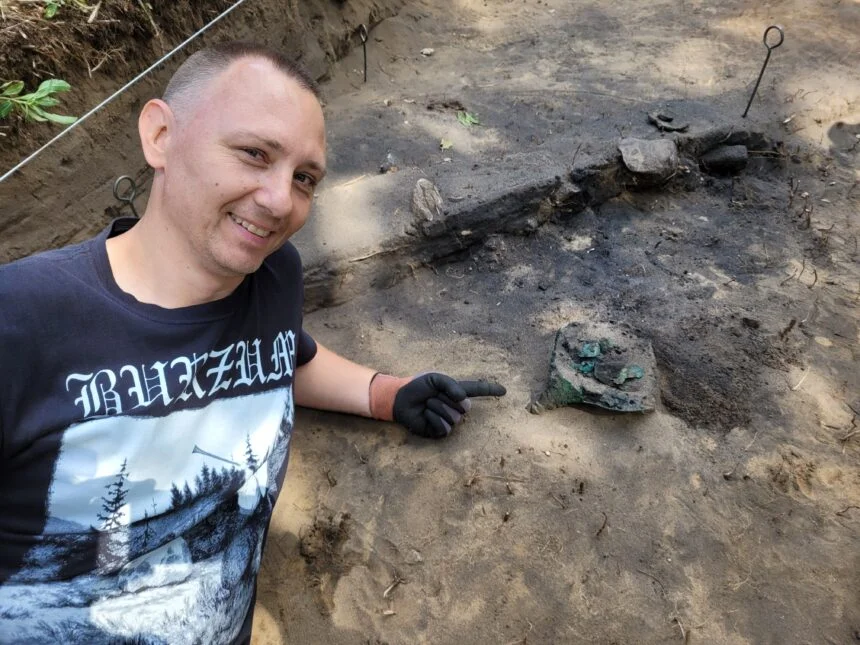
A team of archaeologists from the State Archaeological Museum in Warsaw, led by Dr. Wojciech Borkowski and Dr. Bartłomiej Kaczyński, together with Dr. Andrzej Maciałowicz from the Faculty of Archaeology at the University of Warsaw and student interns from the same faculty, made an extraordinary discovery in 2024 at the site known as Łysa Góra (Polish for “Bald Hill”) near the village of Chorzele in the Masovian Voivodeship.
This location – previously known in archaeological literature as the Rembielin site – had already yielded numerous Early Iron Age artifacts in the 1970s and 1980s. These finds were attributed primarily to the West Balt Barrow Culture but also suggested surprising contacts with Celtic groups living farther south.
The discoveries made in 2024 and 2025, however, exceeded researchers’ expectations. Within a single archaeological context, scholars uncovered bronze ornaments of local origin as well as a remarkable object – a Celtic bronze helmet. In addition, archaeologists found nearly ten iron tools, including axes and scythe, possibly also of southern origin. Numerous bronze and iron elements associated with La Tène dress were also recovered.
Although artifacts of the latter type had already been known from earlier excavations, the discovery of an entire series of iron tools is highly unusual, and the helmet itself is so spectacular that it seems almost unbelievable. Objects of this kind are exceptional even within the Celtic world – let alone hundreds of kilometers away, deep in the forests of the Mazovian–Kurpie region.
The very presence of such an artifact in this location is therefore a mystery – not to mention the circumstances in which it was deposited.
There is little doubt that the helmet – made of thin hammered bronze sheet – served primarily a ceremonial or prestige function rather than a strictly protective one. This was typical for similar objects in the La Tène cultural sphere. It is therefore unlikely that it belonged to – let alone was produced by – a member of the local community. Most likely, the helmet arrived here with its original owner – a member of the Celtic elite living around the turn of the 5th and 4th centuries BCE.
“The helmet was a relatively rare item in the La Tène world at that time, but something completely unknown – and probably incomprehensible – to local communities, which represented a very different cultural model. In Celtic society, such an object was a marker of high, sometimes even the highest, social status. This is confirmed by finds of helmets in so-called chieftains’ graves in Champagne or in elite burials from the eastern Alpine region. It was not an object intended primarily for protection.
Consequently, this helmet does not fit into the local cultural or symbolic context. We have no evidence of such social stratification in northeastern Poland – nothing that would indicate the existence of a clearly distinguished elite within the local population. By contrast, both archaeological evidence and ancient written sources show that Celtic societies were strongly hierarchical,” says Dr. Andrzej Maciałowicz of the Faculty of Archaeology at the University of Warsaw.

Possible interpretations – and growing mysteries
Finds from the Łysa Góra site suggest that the area was inhabited and intensively used during the Early Iron Age. Archaeologists have identified numerous traces of settlement and even possible remains of defensive structures.
Only further excavations and detailed analysis of the site’s stratigraphy – the sequencing of archaeological layers from the oldest to the most recent – will allow researchers to reconstruct its history more precisely.
One fact, however, already appears significant. The helmet and several of the iron tools were discovered within what seems to be a structured deposit, possibly the remains of a ritual activity during which these objects were deliberately placed or dedicated.
Alongside the metal artifacts, archaeologists also uncovered small bone fragments, most likely of animal origin. Many of the objects – including the helmet – show clear traces of exposure to very high temperatures, suggesting that they were placed in a fire or among glowing embers.
At present, it is impossible to determine the exact nature of the ritual involved. Researchers are certain, however, that the objects were not deposited randomly.
This raises an intriguing question: what was a Celt doing deep in this ancient forest, far from the centers of La Tène civilization?
For now, the most plausible explanation points to amber.
Amber from the Baltic region was one of the few valuable materials that Celtic communities could obtain only through long-distance exchange networks.
“The crucial point is that we are dealing with the border area between Mazovia and the Kurpie region,” explains Dr. Maciałowicz. “In Kurpie there are natural amber deposits lying relatively close to the surface. We know that amber was already being extracted as early as the late Neolithic period.”
“It therefore seems quite possible that this resource attracted the attention of Celtic groups to a region located several hundred kilometers from their nearest settlements. Most other goods they could obtain or manufacture locally. We also know that the Celts valued Baltic amber – but until now we believed that their strong interest in it developed only about two centuries later.”
“Until this discovery, we had no evidence of such early direct contacts between representatives of the La Tène culture and the amber-rich North. Our find may therefore demonstrate that the Celts were capable of organizing long-distance exchange networks in this part of Europe several hundred years earlier than previously assumed.”

Archaeologists are only just beginning their work
The discovery near Chorzele is only the beginning of what promises to be a long-term research project. Archaeologists from Warsaw plan to continue excavations at the site, and future fieldwork may reveal additional artifacts and information that will help clarify the circumstances of the discovery in northern Mazovia.
It is likely, however, that the helmet will remain the most spectacular artifact ever found at the site. Its discovery alone represents an unprecedented phenomenon in this region and significantly reshapes our understanding of the northern reach of La Tène cultural activity in Central Europe.
In the future, the finds from the Chorzele area may also help researchers better interpret similar traces of early Celtic activity recorded in present-day Ukraine and Belarus.

The text was originally published in Polish on the Serwis Naukowy UW website on March 6, 2025.


