


The years 2025–2026 have brought a series of shifts in public debate about the internet, particularly around the problematic presence of children online. Following Australia’s lead – which has banned social media platforms for users under 16 – the United Kingdom is now moving in a similar direction.
In June this year, UK Prime Minister Keir Starmer unveiled a detailed regulatory plan aimed at restricting access for younger users to major platforms such as TikTok and YouTube. The proposals also include measures such as a potential “internet curfew” (cutting access after 10 p.m.) and a ban on AI chatbots designed as “romantic companions” (so-called AI companions).
In Poland, a presidential veto of the bill implementing the EU’s Digital Services Act (DSA) has shown that the country still has a long way to go before adopting measures similar to those currently being developed in the UK.
At the same time, the first edition of the “Internet of Children” report, published in March 2025, helped Polish internet researchers shift the terms of the debate. The question is no longer “are children online at all?” but rather “are we doing enough to prevent harm to them there?”
This year’s report therefore moves beyond simply cataloguing the apps children use. Instead, it zooms out to take in the full digital ecosystem they are growing up in – from TikTok and YouTube, to advertising, algorithms, and artificial intelligence, and on to the attention-grabbing systems designed to keep them hooked for as long as possible.
Most importantly, the authors go beyond diagnosis and set out concrete steps to help ensure the internet is no longer a place where children are left to their own devices.
What has changed – and what has stayed the same?
The core assumptions behind the “Internet Children” project remain unchanged. It is a joint initiative of the Institute for Digital Citizenship Foundation, Polskie Badania Internetu (Polish Internet Research), Gemius, the State Committee for Counteracting the Sexual Abuse of Minors Below 15 Years of Age. Its aim is to provide reliable, annual data on children and adolescents’ presence online.
Since March last year, neither the overall number of children online nor the general pattern of their behavior has shifted significantly. What has changed, however, is the tone and momentum of the debate.
[fotografia]
“As for children’s and adolescents’ behavior, it remains unchanged. The timeframe is simply too short to talk about any lasting social shift. And for a shift like that to happen, it doesn’t depend on us alone as the report’s authors – it requires action from the state as regulator first and foremost, and then the combined efforts of schools and parents.
What we did manage to do was spark a broader debate about how much – and in what way – children should or shouldn’t use social media. That, in turn, led to campaigns drawing on our data, such as an initiative by the City of Warsaw or training sessions run by a property management company. There have been quite a few citations, uses of the data, and initiatives inspired by our findings.
That’s encouraging, because it suggests public awareness may be slowly starting to shift. Whether it is actually changing is something we’ll still need to measure. But even putting the issue on the agenda was enough to trigger sustained media discussion. In practice, the report stayed in circulation throughout the year and was regularly cited. That’s an important achievement we can be proud of,” says Prof. Anna Miotk from the Faculty of Journalism, Information, and Book Studies at the University of Warsaw.
The key shift between the first and second editions of the report is the move from asking “are children online at all?” to “how are they online?” A range of collected data allows researchers to reconstruct a detailed picture of the digital behavior and everyday online functioning of younger users.
Most of the data in the report concerns 7–14-year-olds. Focusing on this age group makes it possible to show how children’s digital lives differ both from adults and from slightly older peers.
The main data sources are Gemius’s Mediapanel and Hardware Panel, while advertising exposure data comes from the gemiusAdReal study.
So what do we actually know about the average internet user aged 7–14?
Internet access rate in this group stands at 81%, meaning nearly one in five children is still offline. By comparison, internet use among 15–24-year-olds is as high as 99%. This may already reflect growing parental awareness, although it is still too early to draw firm conclusions.
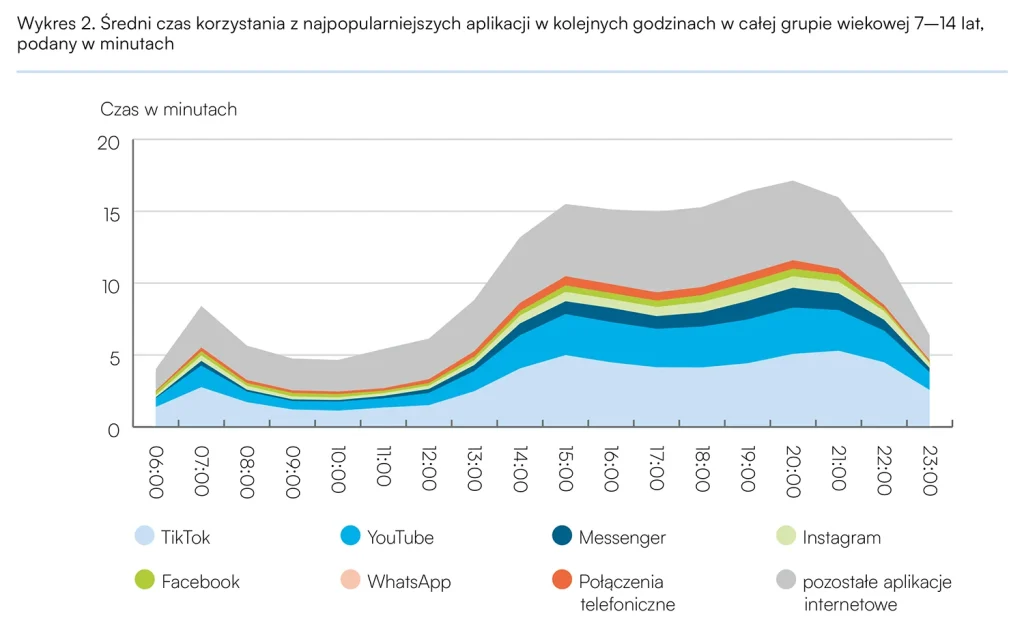
Those who are online, however, are among the most active users. They spend an average of 4 hours and 25 minutes a day online. Between 2 p.m. and 9 p.m., nearly 60% of children aged 7–14 pick up their smartphones, and when they do, they spend about 25–30 minutes of every hour with their screens on. As much as 88% of their online time takes place on mobile devices, primarily smartphones.
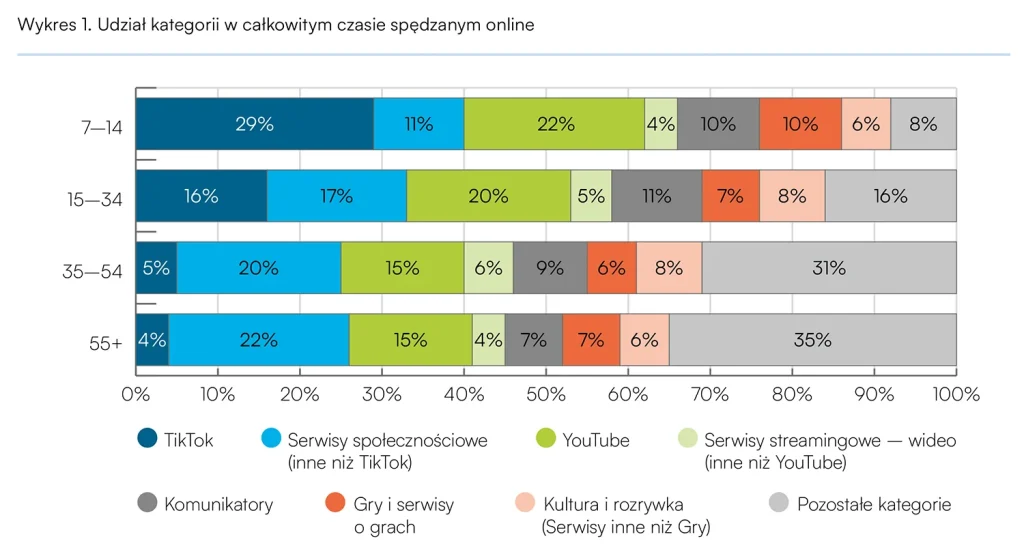
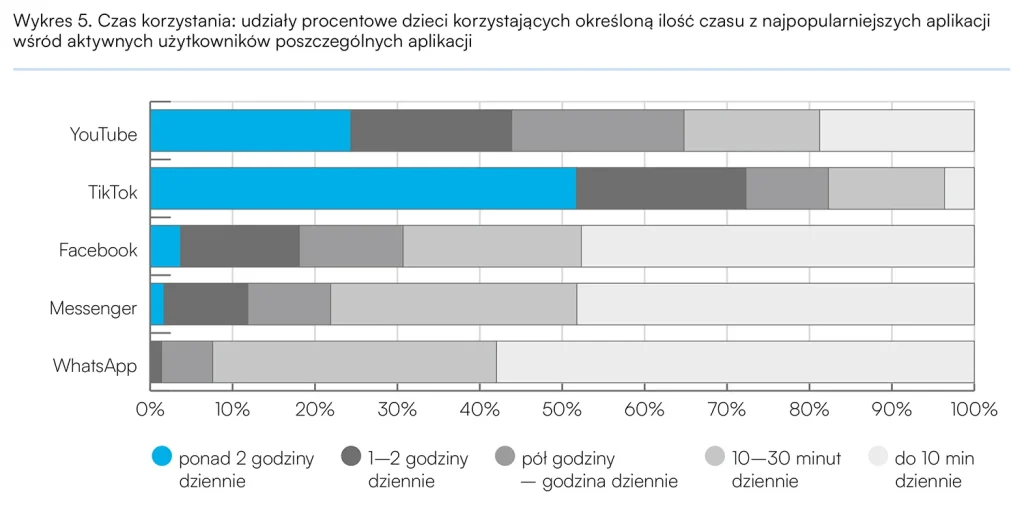
Half of their total internet time is absorbed by just two platforms: TikTok (29%) and YouTube (22%). The remainder is spent on games, messaging apps, and other social platforms. While 69% of children and teenagers access educational content online, it accounts for just 1% of their total time – around six minutes a day.
Between 6 and 8 a.m., more than half of children reach for their phones. About 30% open TikTok at that time, with a slightly smaller share turning to Messenger. School hours are among the least intensive periods of smartphone use during the day.
On a typical month, school hours account for roughly 13% of total smartphone time among 7–14-year-olds. This suggests that the majority of smartphone use takes place outside school, meaning school-based bans alone are not enough to address the broader issue.
What is particularly concerning is that 32% of children aged 7–14 have come across the “erotica” category, which includes adult sexual content. This is roughly in line with the overall internet population. The key difference lies in exposure time: for children it is shorter, at around 10 minutes per day, compared with about 20 minutes in the general online population.
“Younger children tend to have shorter exposure to this kind of content, and sometimes they come across it through ads or redirects. A friend – or even a stranger online – might send it their way.
But what we’re seeing is that there is still a significant number of children who visit adult content sites regularly, and these are not just isolated or accidental incidents. They know these sites exist, and they actively go there to view this kind of material.
And there are virtually no protective mechanisms in place. You can simply type the address of such a site into a smartphone browser, tick a box saying you’re over 18, and watch freely,” Prof. Miotk adds.
Old problems, a new twist
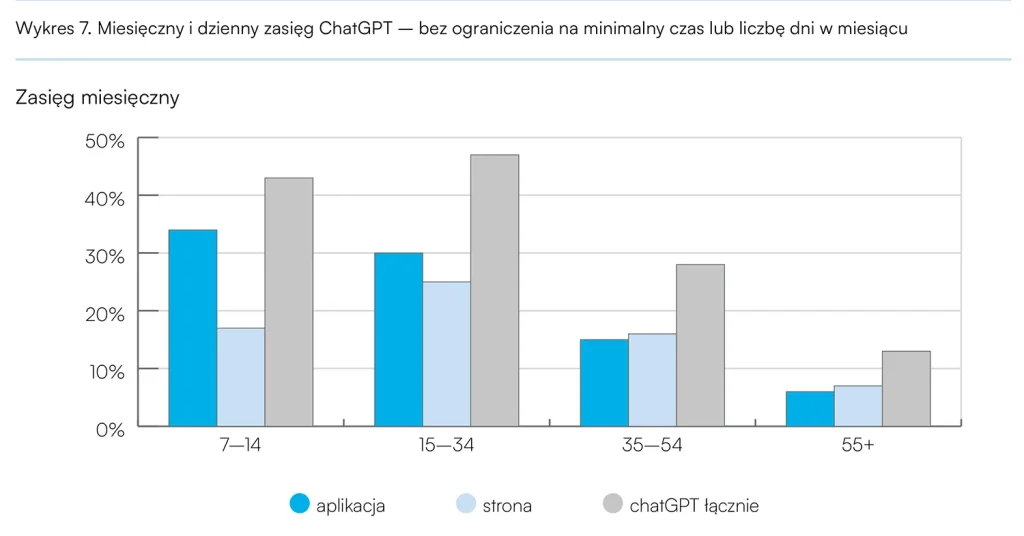
When the first edition of the report was published, children’s interactions with artificial intelligence were not included. Today, it turns out that children and teenagers are already familiar with AI tools to a similar extent as other internet users.
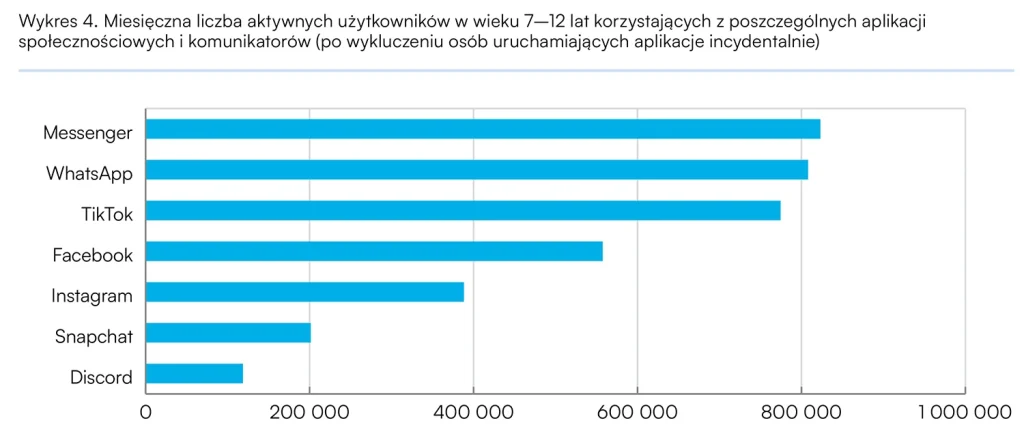
ChatGPT reaches 43% of users, while nearly one in five (18%) uses it actively and on a regular basis. What is particularly concerning – both socially and from a research perspective – is exposure to AI-generated content.
Since we do not have a clear picture of how children spend their time on TikTok or YouTube, it is difficult to say what content they most frequently interact with. However, given the ubiquity of AI-generated content, it likely makes up a substantial share of what they encounter.
The biggest issue here is not so-called “AI slop” – low-quality videos or memes – but sexualized deepfakes. This is not an entirely new problem, but it has taken on a new form. The first edition of the “Internet of Children” report already highlighted that younger internet users are particularly vulnerable to sexual exploitation and are regularly exposed to sexual content – and sometimes even direct sexual advances.
Generative AI has significantly amplified the scale of sexualized material involving children. This includes CSAM (child sexual abuse material): photos, videos, AI-generated images, and other content depicting or implying sexual violence against minors.
According to data cited in the report from WeProtect, the amount of AI-generated material increased by 1,325% in 2025, while the scale of grooming – rose by 192%. INHOPE also recorded a 450% increase in CSAM reports, and the Internet Watch Foundation reported a 127% rise in sexual extortion cases.
Although the two cases are not comparable in terms of their social impact, the data on children’s exposure to alcohol advertising – particularly beer ads – is just as striking. This example clearly highlights the broader problem of children’s unregulated presence online.
“1.2 million children aged 7–14 have been exposed to beer ads in major social media apps. That’s what struck me the most. In the case of TV, there are clear rules protecting children from alcohol advertising – some products can’t be advertised at all, while others are only allowed in specific time slots. Online, by contrast, children are exposed to these ads under the same conditions as adults – on exactly the same footing,” the researcher notes.
Traditional media operate within a long-standing social contract: certain content is off-limits, and children are not meant to see it. That’s also why the red 18+ badge that appears in the corner of a TV screen during certain films has become a familiar, accepted part of the viewing experience.
Online, however, all of this is effectively suspended. The rules no longer seem to apply – as if they had never existed. Beer advertising may be the clearest example, but the same logic plays out across the digital space.
When bans aren’t enough: what can be done?
Thanks to the reports, public awareness – and, in turn, the public debate – is gradually evolving. Still, there is a long way to go. At the same time, the internet is an ever-changing environment, making it difficult to imagine a single piece of legislation that could permanently resolve all of its structural problems.
A decade ago, when concerns about the harms of social media platforms were only just beginning to surface, many of today’s challenges – such as the rapid rise of generative artificial intelligence – were not even on the horizon.
“Law isn’t something fixed – it evolves as circumstances change. So even if, in an ideal world, all these proposals were implemented, new issues and new areas in need of regulation would inevitably keep emerging. That said, a satisfactory balance is still achievable. In the case of TV and children’s content, things are actually fairly well regulated – even if the occasional slip-up still happens,” says Prof. Miotk.
That is why the researchers behind the report put forward a broad range of solutions. On the one hand, these include recommendations aimed at policymakers, such as establishing an independent body responsible for children’s online safety, and strengthening the effectiveness of existing child protection regulations.
On the other hand, they are directed primarily at platform owners – for example, limiting the use of addictive design features such as infinite scrolling, autoplay, and notification systems, as well as restricting profiling and advertising targeted at children and adolescents.
“The first step should be a catalogue of digital services, where platforms are classified both by safety level and age suitability. To draw an analogy, it would work like TV content ratings: this is 16+, this is 18+, this is, say, 12+. We should also demand – as citizens, as a state, and through our elected representatives – that platforms take responsibility for the content they host.
In our report, we set out a broad set of principles for ethical design. The key ones include turning off infinite scroll – in other words, bringing back solutions from the early internet, such as page-based navigation. Another is non-manipulative interface design, so users can actually choose what they see and have more control over algorithmic decisions. And then there is algorithm design itself – so that it doesn’t polarize or disinform, but instead ensures that time spent on platforms is genuinely valuable for users,” the researcher summarizes.
As noted earlier, children’s digital daily life starts very early. Between 6 and 8 a.m., around 30% of them open TikTok, with slightly fewer checking Messenger. In the latter case, it’s hard not to think of class group chats, messages from friends, or that early-morning check-in to see what’s happened before the school day even begins.
This clearly shows why bans alone are not enough. The internet is no longer a separate place children “enter” after school – it is woven into their mornings, relationships, downtime, boredom, learning, and social life. Access to specific apps can be restricted, but it is hard to pretend the digital world can simply be cut out of children’s everyday reality.
That is why the question is no longer just how much time children spend online. What matters more is the kind of online world they are growing up in – whether it is a space designed with their safety, age, and vulnerability in mind, or an environment governed by a single principle: keeping users engaged for as long as possible.
If children are to grow up in the internet as well, then the internet cannot be left to its own devices – especially when it comes to those least able to defend themselves against it.
The text was originally published in Polish on the Serwis Naukowy UW website on June 19, 2026.