

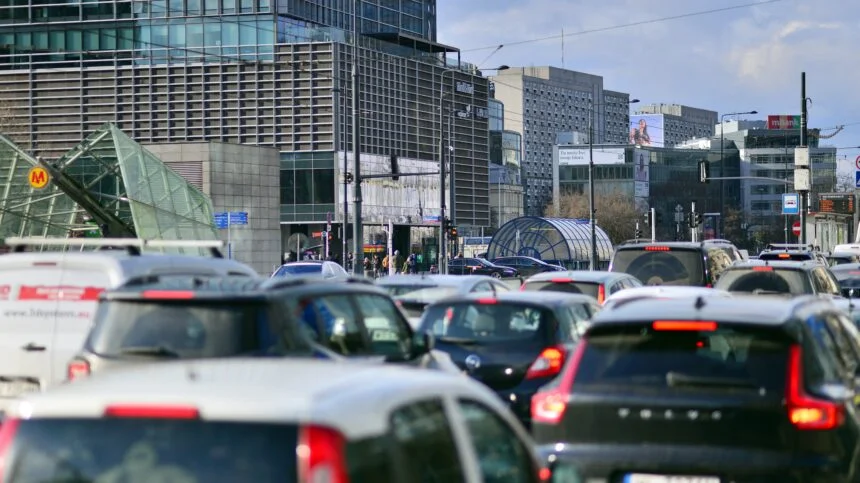
A quick glance at any map showing air quality across the continent reveals that Poland is a large red hotspot. According to a report by the European Environment Agency (EEA) from August 2024, cities in Poland rank among the most polluted in Europe. For example, the annual average concentration of one of the main components of smog – PM2.5 particulate matter – in Nowy Sącz (a city in the Lesser Poland region, southern Poland) is 24 μg/m³ (micrograms per cubic meter). By contrast, in one of the cleanest cities in the EU – Faro, Portugal – it is 3.7 μg/m³. The World Health Organization (WHO) recommends that the annual average concentration of PM2.5 should not exceed 5 μg/m³.
One of the main culprits is road transport. Large volumes of vehicle exhaust contain not only particulate matter but also harmful nitrogen oxides, carbon monoxide, and ozone. These pollutants are toxic to human health and have a devastating impact on the environment. Research by the European Environment Agency (2022) shows that the growth of carbon dioxide emissions from the transport sector has not slowed over the past decade – unlike emissions from energy supply and industry, which have shown a declining growth trend. According to the report, in 2019 approximately one-quarter of all CO₂ emissions in the European Union came from transport. Of this, 71.7% originated from road transport. Between 1990 and 2019, greenhouse gas emissions from the transport sector increased by 33.5%.
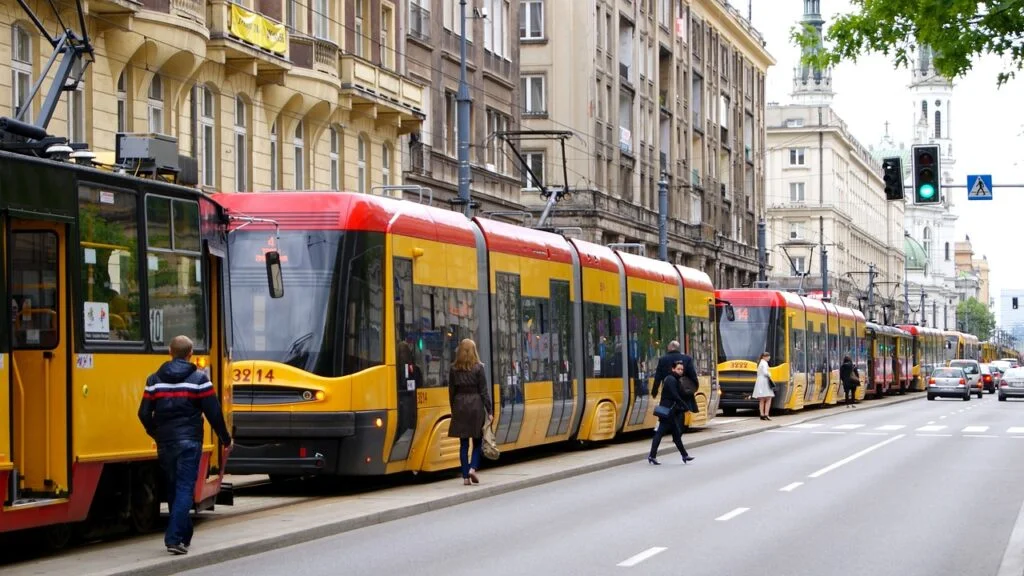
The conclusion is clear: something must be done about the excessive number of cars in Polish cities. One possible solution is to promote public transportation as an alternative to private car use. This idea is reflected in the hashtag #MakeZbiorKomGreatAgain (Make Public Transport Great Again), popularized by a Polish member of parliament (“zbiorkom” is colloquial Polish shorthand for public transport, from zbiorowa komunikacja). The more people who choose public transportation for commuting to work or school, the fewer cars on city streets – and thus lower emissions. But how can this shift be achieved?
How can we reduce vehicle emissions?
There is no single universal solution. When designing urban policies that encourage more sustainable mobility, it is essential to consider local conditions and needs. This includes not only infrastructure but also people’s attitudes and beliefs. What we know and think about pollution and its impact on quality of life strongly influences transportation choices.
This assumption guided a team of researchers working within the international CoMobility (Co-designing Inclusive Mobility) project. Over more than three years, the team compiled a dataset (published in 2024) on the relationship between air quality and individual transportation behavior.
The project aimed to answer a key question: what can be done to encourage city residents to choose alternatives to cars?
The team consisted of experts from a wide range of disciplines: physics, chemistry, computer science, transport engineering, economics, sociology, anthropology, and psychology. The project focused on human attitudes, beliefs, and mobility behavior. It was led by Prof. Anna Nicińska from Digital Economy Lab (DELab UW) and the Faculty of Economic Sciences at the University of Warsaw.
What did the CoMobility project study?
Researchers examined the relationship between air quality, pollution levels, and noise in the vicinity of three public elementary schools in Warsaw: School No. 34 on Kruczkowskiego Street (central Warsaw; dense urban fabric and strong public transport access), School No. 218 on Kajki Street in Wawer (a low-density, suburban district with limited public transport concentrated along main roads), and School No. 377 on Trocka Street in Targówek (a district with high-rise housing and strong access to metro and buses). Students at these schools are young enough that they do not travel independently; parents accompany them on their daily commute.
The analyses were conducted between 2021 and 2023. Researchers measured air quality, noise pollution, and meteorological conditions. They used sensors measuring nitrogen dioxide, ozone, and particulate matter, as well as noise sensors and basic weather stations.
One air-quality sensor was placed near the street where parents dropped off or picked up children. The second was installed in a quieter area of the schoolyard. Because the devices were low-cost, there were concerns about measurement accuracy, so readings were validated using so-called samplers that measured nitrogen dioxide levels and helped detect discrepancies.
The study also analyzed traffic near schools during morning and afternoon peak hours – when parents were bringing or collecting children. Researchers observed behaviors such as parking, reversing, engine idling, and the duration of these actions.
The fieldwork was complemented by surveys of parents. These included questions about household structure, car ownership, commuting methods, reasons for transport choices, mobility beliefs, and full daily travel patterns. Parents also completed travel diaries documenting their trips and time use. These self-reports were compared with alternative mobility scenarios and estimated travel times.
How toxic is the commute to school?
The project resulted in a dataset designed for further interdisciplinary research on mobility in European cities. Its novelty lies in incorporating data often omitted in traditional transport studies. As Prof. Nicińska explains:
“Traditionally, aside from age group, gender, and destination, travel diaries do not account for the fact that other variables may be significant. Our data allows us to include not only urban infrastructure but also individual characteristics, attitudes, and beliefs. For selected locations, we can also link them to detailed air quality metrics.”
The authors have already drawn preliminary conclusions. One proposed solution is to increase access to local services:
“To reduce transport demand and pollutant emissions, it is worth analyzing missing services within a radius of approximately 1–1.4 km from residences. Expanding these services can change mobility behavior more effectively than expanding transport networks. Most of our research shows that for parents of young children, acceptable walking distance decreases, while willingness to use a car increases,” explains the researcher.
In this context, the researchers highlight a structural issue in Warsaw: underdeveloped networks of nurseries, kindergartens, and schools in newer residential areas. According to Prof. Nicińska, expanding these facilities, carefully planning their locations, and designing pedestrian-friendly infrastructure should be a priority for city authorities. The city should also ensure more frequent and faster public transport in peripheral districts, as well as safe sidewalks and cycling infrastructure. By contrast, building more express roads tends to increase car dependency.
The researcher also emphasizes road safety:
“Parents driving their children to school are often afraid of one another. We need to break this cycle of fear. If car drop-offs are considered necessary, they must not compromise the safety of routes to school for other children. This would help increase the number of eco-friendly trips.”
At the same time, she stresses that while improving safety is crucial, it alone will not solve the problem of high vehicle emissions. Policymakers must also focus on changing transportation behavior and implementing measures that actively reduce car use.
The dataset opens new research opportunities, particularly for building aggregated traffic models for Warsaw based on a deeper understanding of mobility choices – without overly restrictive assumptions about the factors shaping them.
The article was originally published in Polish on the Serwis Naukowy UW website on April 10, 2025.


