

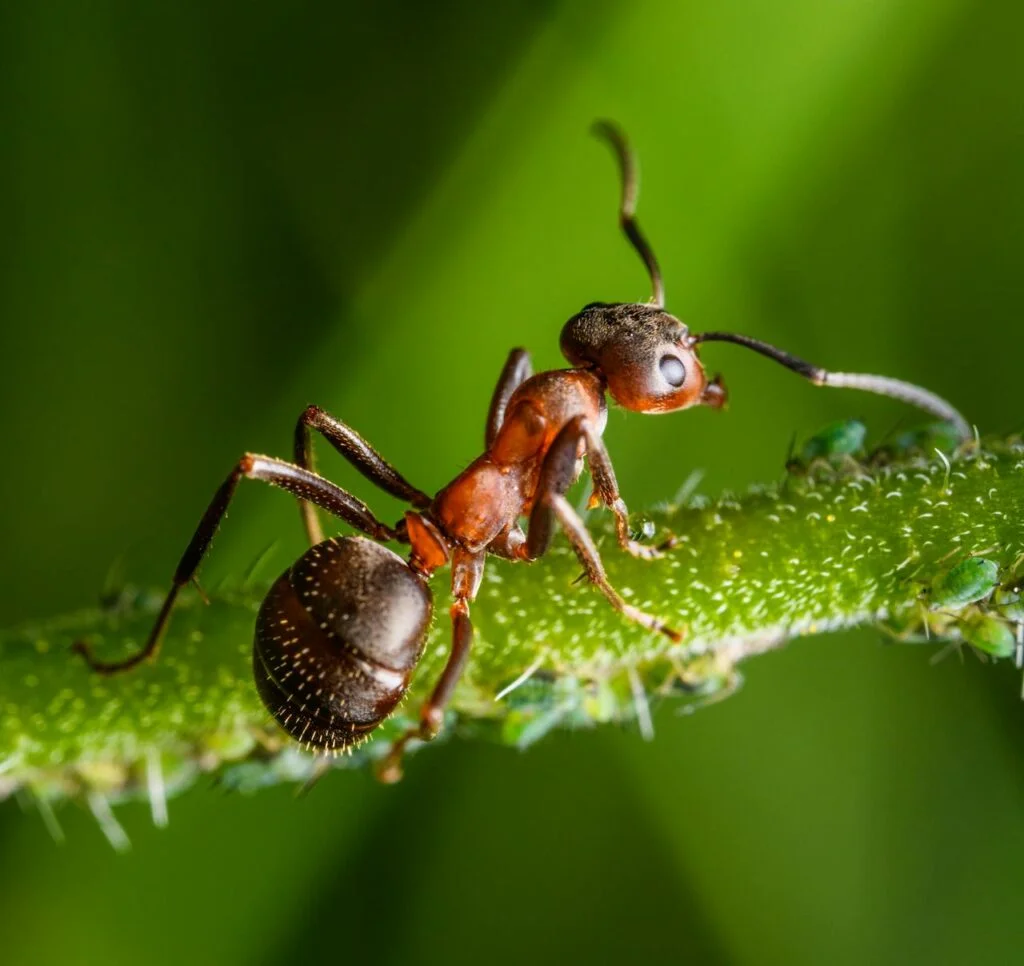
Scientists have long known that ants and fungi often form complex interactions. The recent popularity of the TV series The Last of Us has brought one dramatic example into the spotlight: the parasitic fungus Ophiocordyceps unilateralis, which invades an ant’s body and alters its behavior. Researchers from the University of Warsaw recently discovered an entirely new species of fungus from the Trichomeriaceae family in a town near Warsaw – found, remarkably, in the cheek pouch of a Formica polyctena ant. Now, scientists from the Faculty of Biology at the University of Warsaw and the University of Warsaw Botanic Garden have shown that ant’s nests themselves may serve as ideal habitats for certain species of Mucoromycota fungi.
A world within the anthill
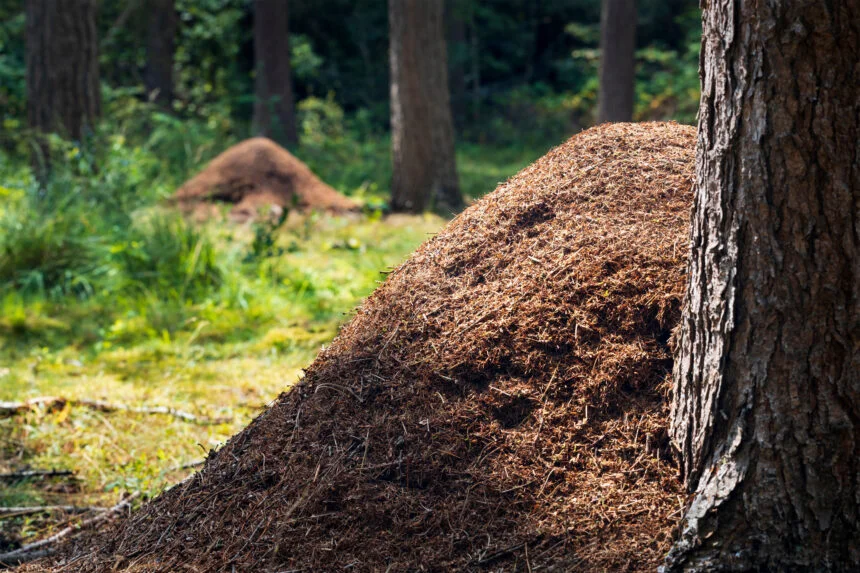
Formica polyctena is one of the red wood ant species commonly found in mixed and coniferous forests across temperate regions. It plays an important role in forest ecosystems by feeding on leaf-eating insects and helping to keep their populations in check. These ants build large, long-lasting nests in the form of mounds that can reach up to two meters in height. To build them, the ants collect forest litter such as pine needles, bark fragments, and small twigs. A single anthill can house more than a million ants.
The anthill serves many important functions. Above all, it provides safety, protecting ants and their larvae from predators and harsh weather, but it also creates a unique microenvironment – one with conditions very different from those in the surrounding forest.
“An anthill differs from its surroundings primarily in terms of its resources. It contains accumulated organic material in the form of pine needles, leaves, twig fragments, and other insects collected by the ants as food. In ant’s nests, we see a much higher concentration of organic compounds compared to the surrounding environment,” explains Michał Kochanowski, one of the study’s authors.
The anthill also maintains a distinctive microclimate. Compared with the surrounding forest floor, temperatures inside the mound are much more stable. During the ants’ active season – from spring through fall – the nest maintains temperatures ranging from roughly a dozen degrees Celsius to around 30°C, creating ideal conditions for colony development. In winter, the temperature inside remains above freezing. On top of that, the nest contains large amounts of resin, which may inhibit the growth of some microorganisms.
And ants are not the only residents. Anthills are home to specialized nematodes, arthropods, bacteria, and fungi. These organisms – known as myrmecophiles – can have different relationships with the ants: mutualistic, parasitic, or simply based on coexistence.
Uninvited lodgers
It was these interactions between ants and fungi that inspired the researchers behind a 2024 study. Because red wood ants build their nests from forest litter, the team suspected that Mucoromycota fungi involved in its decomposition might also be living inside the mounds.
Their goal was not only to confirm this, but also to determine whether the fungal communities inside anthills differ from those in the surrounding forest litter. Until now, very little had been known about the relationship between red wood ants and these fungi.
“We studied the fungal community in the anthill to compare it with the fungal community found outside it. We wanted to see whether the ants, through their activity, can shape the environment in a way that stimulates the growth of certain fungal species while limiting the growth of others. In other words, does the presence of mounds in the forest litter affect the fungal diversity of the forest ecosystem?” says Kochanowski.
To investigate, the scientists collected samples from both the ant mounds and the surrounding forest floor in four pine forests in the Mazovia region in August and October 2020. At each site, they collected three kinds of material: samples from the center of the mound, from its surface, and from the surrounding forest litter. The fungi were then cultured in the lab by placing the prepared samples onto microbiological media in Petri dishes. The scientists first identified the fungi based on their physical traits (a process known as morphological identification), then confirmed the results using molecular techniques (DNA sequencing).
Ecosystem engineers
The study revealed that anthills host a diverse range of Mucoromycota fungi – and that these fungal communities differ significantly from those in the surrounding forest litter. Some fungi, such as Entomortierella lignicola and the group Absidia sct. cylindrospora, were more abundant inside the nests. Others, including Umbelopsis curvata and Podila verticillata-humilis clade, were found mainly in the surrounding litter.
As the scientists note, this suggests that ant nests may serve as a microhabitat favored by certain fungal species adapted to the specific conditions inside anthills. The findings also support the idea that ants act as “ecosystem engineers” – organisms that modify their environment in ways that create opportunities for other species. By building and maintaining their nests, ants may be increasing the biodiversity of the forest ecosystem.
What role these fungi play in the life of the ants remains unclear. For now, researchers can only say that the organisms coexist within the anthill ecosystem – but they already have some ideas.
“We believe that the decomposition of organic matter accumulated in the nest by fungi and bacteria, along with the associated heat release, may be crucial for the ants’ functioning, especially during transitional periods, such as early spring. These are poikilothermic animals – their activity depends on temperature. This allows them to warm up and become more active,” says the researcher.
The text was originally published in Polish on the Serwis Naukowy UW website on April 11, 2025.