

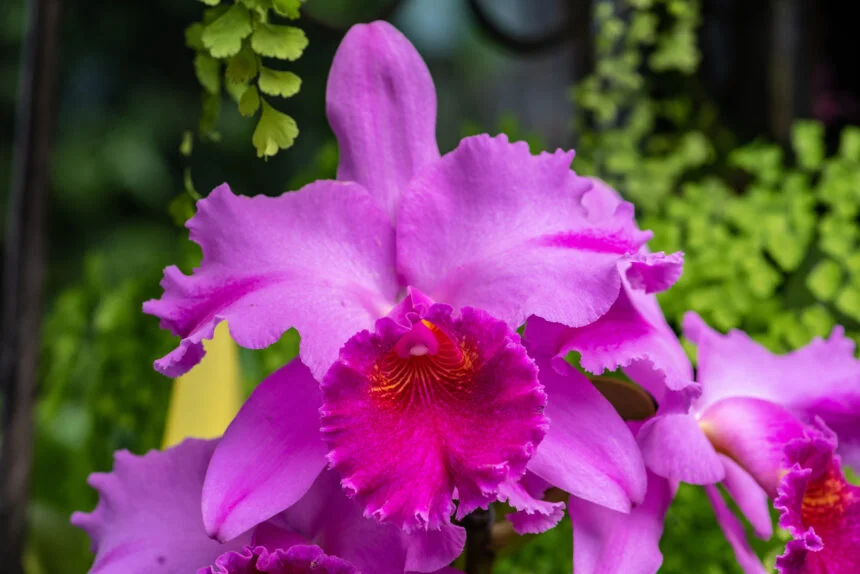
The Orchidaceae – commonly known in Poland as orchids – is one of the largest plant families in the world, comprising over 25,000 species across roughly 800 genera. They occur nearly everywhere, though their greatest diversity is found in tropical rainforests. Reflecting this richness is a complex classification system used by botanists.
One of the most important subtribes within this family is Laeliinae, a group of closely related genera known for their striking, often elaborate flowers. Among them is the so-called “queen of orchids,” Cattleya – a familiar sight in flower shops, with blooms that look almost otherworldly. Yet even seasoned houseplant enthusiasts may not realize just how fascinating orchid reproductive strategies are in the wild.
Members of the Laeliinae subtribe are pollinated by a wide range of animals, including moths, craneflies, Diptera flies, birds, butterflies, and – most importantly – members of the order Hymenoptera, such as bees. This diversity of pollinators is mirrored in the flowers themselves. Most Laeliinae species possess specialized nectaries (structures that produce nectar) and use a variety of strategies to attract visitors.
Until recently, it was thought that these orchids relied exclusively on food-based pollination strategies, primarily offering nectar. However, an international team of researchers – including Prof. Małgorzata Stpiczyńska from the University of Warsaw Botanic Garden – has shown that several genera of Neotropical orchids (from Central and South America, as well as southern Mexico and the Caribbean) also provide other types of rewards, such as waxes and resins.
These findings, published in the journal The Science of Nature, suggest that our understanding of orchid pollination needs to be revised.
Orchid research
The study of orchid reproduction focused on populations of Laelia gloriosa growing in marshy forests within the city limits of Guatapará in southeastern Brazil. During the flowering seasons, researchers recorded pollinators, pollination mechanisms, and how often insects visited the flowers. Observations were carried out both in the field and on plants later cultivated in an orchidarium. Each day, monitoring took place from 8:30 a.m. to 5:30 p.m., adding up to a total of 180 hours. Visiting insects were documented using a digital camera.
The research had two main goals. First, to identify pollinators and better understand how pollination occurs. Second, to examine flower morphology – the structure and shape of the flowers – and how it has evolved to match their pollinators as closely as possible.
In addition, histochemical analyses were performed to detect specific chemical compounds and determine whether the flowers offer rewards to visiting animals. Combined with studies of floral scent, these results provide valuable insight into the relationships between orchids and their pollinators.
Rewarding pollinators
Pollination is the process that allows plants to reproduce, which is why pollinators play a crucial role. In fact, flowering plants and their pollinators often form remarkable relationships.
“Most flowering plants reward their pollinators with nectar, whose composition is typically adapted to the preferences of specific visitors – especially in species with highly specialized pollination systems, that are visited by a relatively narrow group of animals. Many pollinators, such as members of the order Hymenoptera (including bees), collect pollen as a rich, energy-dense food source. However, in the vast majority of orchids, pollen is not accessible to pollinators, but orchids may produce essential oils that are collected by males of the so-called orchid bees. These insects use them to produce their own pheromones. Some flowers also provide fats that serve as food for larvae (in both certain orchids and, more rarely, in other plant families), as well as waxes used for nest building,” explains Prof. Małgorzata Stpiczyńska.
As the researchers found, members of the Laeliinae subtribe – like representatives of another orchid subtribe, Maxillariinae – offer pollinators a waxy material. Female bees of several species collect waxes and resins and use them to build nests. The reason is simple: waxes and resins are hydrophobic and therefore water-resistant, and resins often contain antifungal and antimicrobial compounds that help protect the nest from pathogens.
This is a clear example of mutual benefit: insects help plants reproduce, while plants provide the resources pollinators need to survive.
Floral deception
The relationship between flowering plants and their pollinators is a rich and fascinating area of research. Botanists are especially interested in how plants adapt to specific pollinators – and how quickly they can shift strategies when environmental conditions change and new pollinators become available.
Plants can even select their visitors to some extent. They do this by adjusting the chemical composition of their scent or nectar, sometimes adding secondary metabolites with psychoactive effects. But this kind of manipulation is only part of the story. Orchids, in particular, have taken things a step further – they are masters of deception.
“Floral deception involves mimicking rewards such as nectar or pollen, or resembling nearby nectar-producing plants to mislead pollinators. Some orchids also imitate the appearance or scent of female insects, others mimic insect breeding sites. For example, species in the genus Dracula produce flowers that resemble fungal fruiting bodies in which Diptera flies lay their eggs.” adds Prof. Stpiczyńska.
Why is caring for pollinators so crucial?
The findings of this international research team shed new light on how orchids flower and are pollinated – processes that are still not fully understood. Many orchid species are rare and threatened with extinction, and their survival often depends on pollinators. These pollinators, in turn, are increasingly vulnerable, particularly in the face of climate change. This makes efforts to protect biodiversity more important than ever.“The paper, published in The Science of Nature, is part of a broader study on pollination biology, secretory systems, and the presence of floral rewards in members of the Laeliinae subtribe. Another paper on this topic, covering nearly 40 species, was published in 2025 in BMC Plant Biology. In this research, I particularly value my long-standing collaboration with Professor Emerson Pansarin from Brazil, as his presence on the team allows us to collect data on pollinator activity in their natural habitat,” concludes the scientist.
The text was originally published in Polish on the Serwis Naukowy UW website on April 25, 2025.
It was updated in April 2026.