
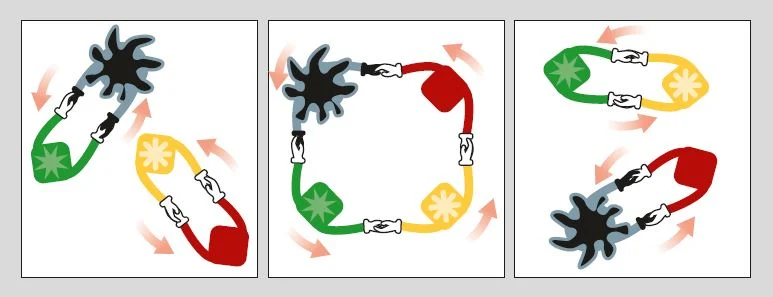
The chemical reaction used to produce perfumes and fragrances – as well as medicines, plastics, green fuel additives, and plant protection products – is known as olefin metathesis. Advances in this reaction have transformed modern chemistry and were recognized with the 2005 Nobel Prize in Chemistry. In explaining the award, the Royal Swedish Academy of Sciences uses the metaphor of a dance to describe metathesis. Why? Because the reaction involves the exchange of double bonds between carbon atoms (C=C). Imagine a crowded dance floor: two atoms of carbon dance together, connected via a double bond—in other words, they “hold hands” – then they invite a pair of another carbons, dance in four for a while, next break, and reconnect with different atoms, forming new dancing C=C pairs. Metathesis means a double exchange. For the process to take place, however, a catalyst is needed – in this case, an organic ruthenium complex.
Catalysts are substances that speed up chemical reactions, making it possible to produce compounds more efficiently while reducing energy consumption and waste. Although chemists already have a range of olefin metathesis catalysts at their disposal, many still suffer from important drawbacks. One common problem is that they lose activity at elevated temperatures. Scientists at the University of Warsaw discovered that a modification of an existing catalyst can significantly improve its thermal stability and, as a result, enhance both the efficiency and selectivity of chemical reactions.
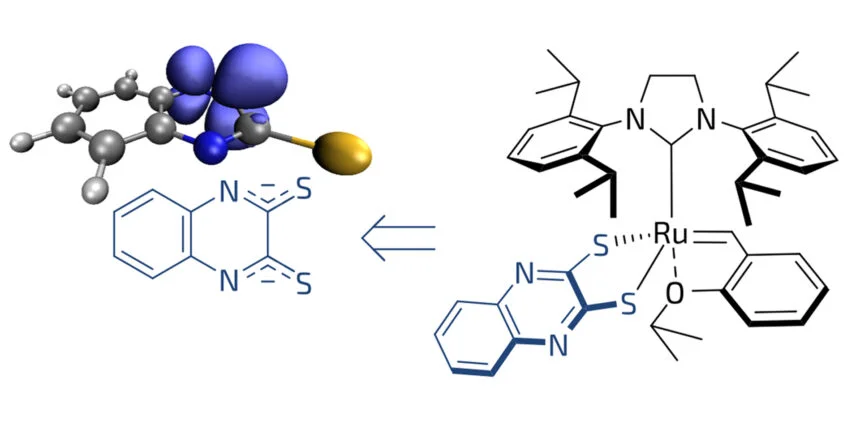
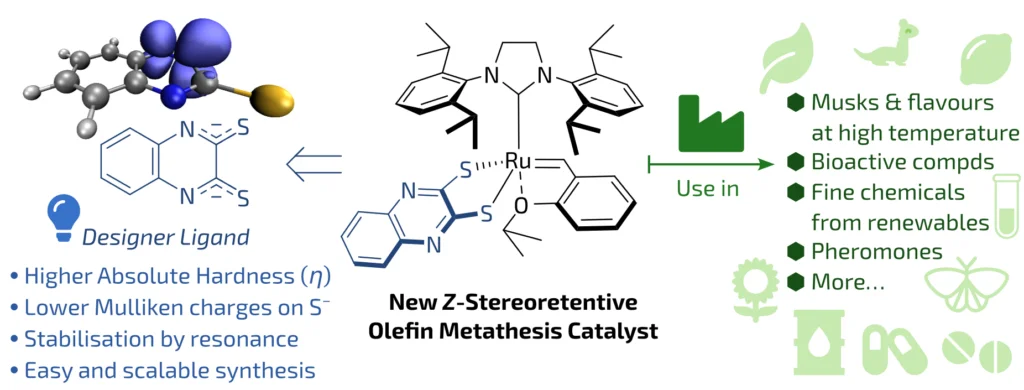
Their innovation involves introducing a novel quinoxaline-derived ligand into a ruthenium (Ru3) complex. A ligand is a molecule that binds to a central metal atom, forming a chemical complex. It can be thought of as the handle that holds a metal knife blade. In this case, the quinoxaline-derived ligand allows the “ruthenium knife” to cut double bonds more precisely and reliably. The newly developed catalyst remains stable even at temperatures as high as 150°C – conditions under which many existing catalysts rapidly lose effectiveness. And that is only one of its advantages.
Metathesis made easy
Let’s return to the chemical dance floor. A carbon-carbon double bond (C=C) is like two dancers holding hands tightly – the partnership is stable and difficult to break. The catalyst acts like a choreographer introducing a new routine: the partners separate, switch places, and form new pairs. In chemical terms, new molecules with different carbon-carbon bonds are created.
The challenge is that the molecules do not always pair up in exactly the desired way, which can significantly affect the properties of the final substance. The newly formed bonds can adopt either Z-geometry (zusammen, meaning “together,” where the key groups are positioned on the same side) or E-geometry (entgegen, meaning “opposite,” where they are located on opposite sides). Why is this so important?
In nature, some organic compounds are made up of exactly the same elements connected in the same order, yet differ in the way those atoms are arranged in space – that is, in their geometry. These differences can profoundly influence a substance’s physical and chemical properties, such as state of matter or heat of combustion, as well as its biological characteristics, including smell.
Fatty acids provide a well-known example. In one geometric form, they are beneficial nutrients commonly found in vegetable oils; in another, they are linked to obesity, diabetes, and cardiovascular disease.
Another example is civetone, a naturally occurring compound with Z-geometry that gives musk its characteristic scent. Historically, civetone was obtained from the glands of the African civet, but for ethical reasons it is now produced exclusively through chemical synthesis. Until recently, however, this process remained impractical because it generated large amounts of waste, making production expensive. The new catalyst developed by chemists at the University of Warsaw makes it possible to produce pure Z-civetone from inexpensive vegetable oils, such as rapeseed oil, at much lower cost.
More broadly, the catalyst offers much greater selectivity in forming carbon-carbon double bonds with Z-geometry. In practice, this means it produces the desired compound without contamination from the unwanted E isomer.
Medicines, perfumes, and pheromones
The new catalyst can also be used to synthesize other macrocyclic musks – key ingredients in the perfume industry. At the same time, by enabling the valorization of vegetable oils, it opens the door to the production of environmentally friendly and affordable plant protection agents that could eventually compete with conventional pesticides. Although the underlying chemical reactions have been known for years, the solution developed by scientists at the University of Warsaw could make the manufacture of these expensive compounds both simpler and more cost-effective.
“The catalyst we developed can be used to produce so-called fine chemicals, including pharmaceuticals (APIs, or active pharmaceutical ingredients), natural and biologically active compounds, perfumes such as unsaturated macrocyclic musks, other fragrance ingredients, and insect pheromones used in pheromone traps – non-toxic plant protection products employed in modern agriculture. Several similar catalysts are already known, and some are even commercially available, but they are either sensitive to moisture and so-called polar functional groups or less stable at higher temperatures than our catalyst. In addition, ours can be synthesized more easily,” says Prof. Karol Grela.
Bringing a new catalyst to market
Although chemical processes can sound abstract, they often lead to very concrete, real-world applications. Ruthenium catalysts are already used in the production of medicines, perfumes, flavorings, and more sustainable agricultural products. One example is pheromones used in crop protection, which so far have been significantly more expensive than conventional pesticides. Currently, protecting one hectare of farmland with pheromones costs around €250, while standard pesticide treatments range from €50 to €150 per hectare. The environmental and health impacts of pesticide use, however, are much harder to quantify.
There is hope that this imbalance may gradually shift, thanks in part to innovations such as the new ruthenium catalyst developed by scientists at the University of Warsaw.
This transition would take place through commercialization of inventions, or the sale of patents to industry, allowing them to be implemented on a large scale. It is neither a quick nor an easy process. However, it is possible that the University of Warsaw’s ruthenium compound will soon find applications in the production of medicines or perfumes used worldwide.
“We plan to license this catalyst to leading companies in the pharmaceutical, fragrance (FnF), and agrochemical industries. We are also considering licensing the invention to specialized companies that manufacture and distribute catalysts. Negotiations are being conducted by the University of Warsaw’s Centre for Technology and Knowledge Transfer and are subject to confidentiality agreements,” Prof. Grela adds.
The text was originally published in Polish on the Serwis Naukowy UW website on June 25, 2025.
Read more:
Grzesiński, Ł.; Nadirova, M.; Guschlbauer, J.; Brotons-Rufes, A.; Poater, A.; Kajetanowicz, A.; Grela, K. Preserving precise choreography of bonds in Z-stereoretentive olefin metathesis by using quinoxaline-2,3-dithiolate ligand Nature Communications, 2024, 15, 8981. (https://doi.org/10.1038/s41467-024-52876-4).