
Serwis Naukowy UWSerwis Naukowy UWSerwis Naukowy UW
  • Humanities
  • Social Sciences
  • Natural & Exact Sciences
  • Content Usage
Serwis Naukowy UWSerwis Naukowy UW
  • Humanities
  • Social Sciences
  • Natural & Exact Sciences
  • PL
  • Content Usage
Follow US
Copyright © 2026 Uniwersytet Warszawski

Strona główna » A dance of light and electricity: Extraordinary properties of a liquid crystal

Chemistry

A dance of light and electricity: Extraordinary properties of a liquid crystal

Liquid crystals have long powered the screens of televisions, phones, and watches. But in recent years, scientists have been uncovering entirely new kinds of liquid crystalline phases – often with remarkable properties. Now, a team of scientists from the University of Warsaw and the Military University of Technology has developed a liquid crystal that changes color when exposed to electrical pulses. This breakthrough could lead to more energy-efficient and precise display technologies, and may even help scientists explore one of the biggest questions of all: how life on Earth began.

Last updated: 2026/05/12
26/06/2025
8 Min Read
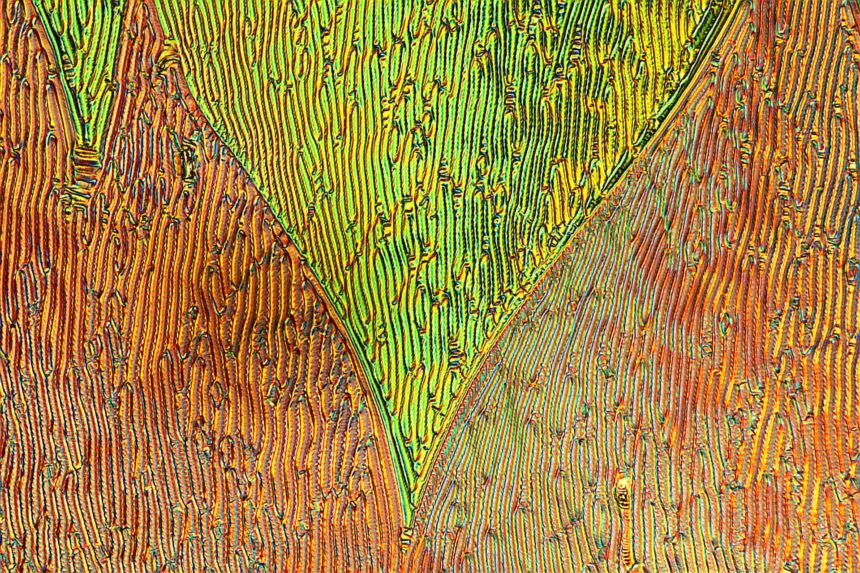
Domain texture of the newly discovered phase (image from a polarizing microscope).
Domain texture of the newly discovered phase (image from a polarizing microscope). Source: Military University of Technology/University of Warsaw
SHARE

When chemists talk about crystals, they are referring less to the material itself and more to the way its molecules are arranged. Think of it like LEGO bricks, carefully stacked in a pattern that repeats in all three dimensions. This highly ordered structure gives crystals – beyond their hardness – distinct shapes and properties that can change depending on the direction you look at them. Salt, diamond, and rock crystal are all classic examples.

But not everything we casually call a “crystal” actually fits the definition. A glass from your grandma’s “crystal” set, for instance, doesn’t have a crystalline structure at all. It’s simply glass enriched with lead oxide and finely cut to mimic the sparkle of real crystal.

What’s less widely known is that crystals can exist in different spatial arrangements. In materials physics, these are known as phases.

There is also a special class of materials called liquid crystals. The name may sound contradictory, but it captures their unusual nature quite well: they flow like liquids, taking the shape of their container, yet at the same time retain an ordered molecular structure. Liquid crystals have been studied intensively for over a century, and yet new types of phases are still being discovered. A team from the Faculty of Chemistry at the University of Warsaw, working in collaboration with the Military University of Technology (WAT), is among those exploring these new frontiers.
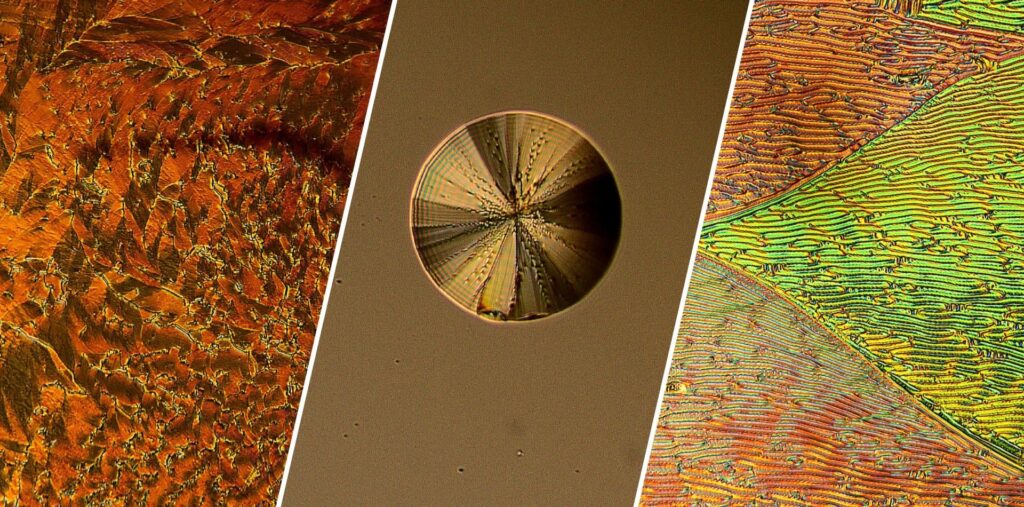
Examples of the texture of the new liquid crystalline phase: a) disordered material between two glass slides, b) a droplet of the material suspended on a glycerol substrate, c) domain texture of the newly discovered phase (polarized light microscopy image).
Examples of the texture of the new liquid crystalline phase: a) disordered material between two glass slides, b) a droplet of the material suspended on a glycerol substrate, c) domain texture of the newly discovered phase (polarized light microscopy image). Source: Military University of Technology/University of Warsaw

Right-handed or left-handed twist?

Scientists have named this new structure the “heliconical ferroelectric nematic phase.” The term “heliconical” refers to its twisted, helical structure – a spiral, spring-like form that emerges spontaneously in this phase.

The new liquid crystal has two key properties: it is both chiral and ferroelectric. Chirality simply means that an object cannot be superimposed onto its mirror image – it comes in “right-handed” and “left-handed” versions.

In chemistry, and especially organic chemistry, the shape of a molecule is of great importance. A useful way to think about chirality is as if we had two keys for a lock with identical teeth, but one of them is twisted in the opposite direction. The keys are theoretically the same, yet only one will open the door. This is exactly how it works in nature. 

Individual proteins can recognize one version of a chiral molecule, while the other –although chemically identical – may be ineffective or even toxic. A tragic example is thalidomide, widely used in the 1950s as a sedative and anti-nausea drug for pregnant women. One chiral form of the drug’s active substance relieved nausea, while the other caused severe birth defects in fetuses. As a result of both mirror-image forms being mixed in the medication, around 12,000 children were born with serious limb malformations.

Life on Earth always uses only one “version” of chiral molecules – for example, exclusively L-amino acids (from Latin laevus, meaning “left”) and D-sugars (from Latin dexter, meaning “right”). The reason for this preference remains an open question. One hypothesis suggests that, early in Earth’s history, a slight imbalance gave one form an edge, and it simply prevailed.

That’s why materials that spontaneously develop chirality – like this newly discovered liquid crystal – are so important. They may help us understand why nature made that choice in the first place. Observing this in the heliconical ferroelectric nematic phase is remarkably simple – the fluid material randomly “chooses” its handedness.

Chirality is only part of the story. The second key feature is ferroelectricity – the ordering of molecular dipole moments (electric charges at the ends of molecules). This makes the material extremely responsive to external electric fields.

While both properties are known separately in different crystals, the scientists have, for the first time, observed them combined in a single liquid crystalline phase that is simultaneously fluid, ferroelectric, and helically twisted. Such a combination of properties in a liquid had never been observed before and results from strong electrostatic interactions between molecules.

One of the most striking consequences is optical: the material can reflect light of a specific color, and that color can be changed easily using even a weak electric field.
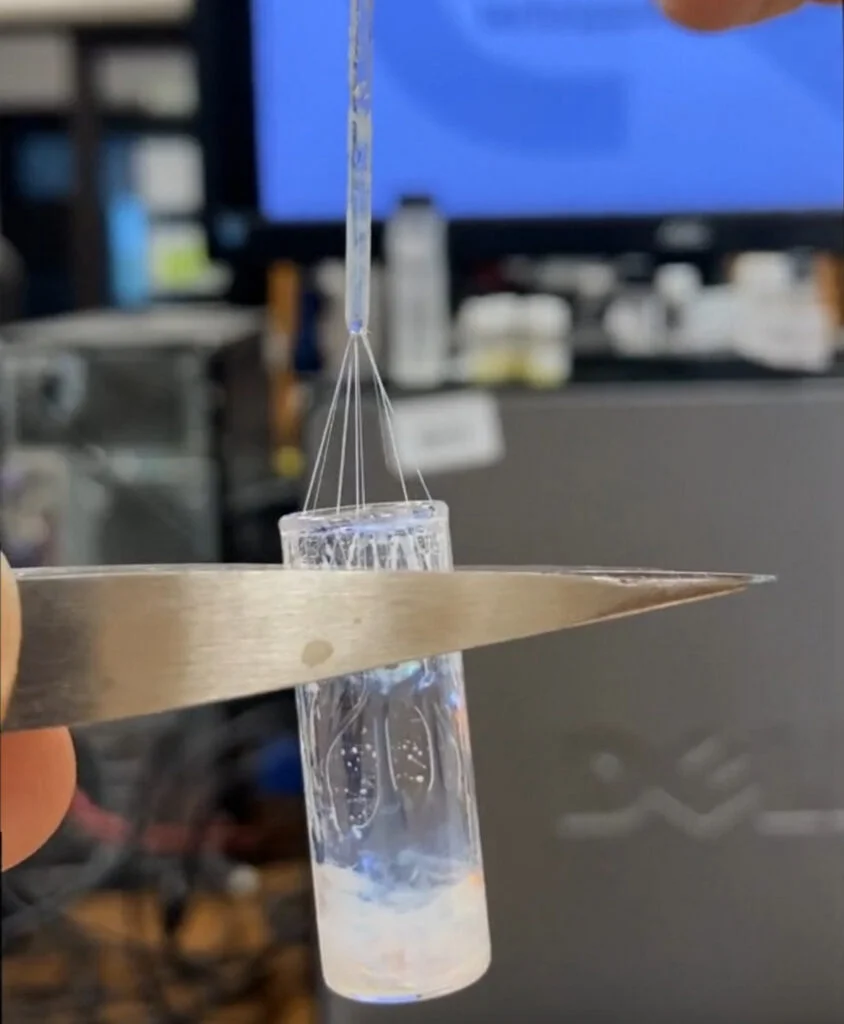
One of the properties of the heliconical ferroelectric nematic phase is its ability to form stable filaments.
One of the properties of the heliconical ferroelectric nematic phase is its ability to form stable filaments. Source: Damian Pociecha/University of Warsaw

The versatility of the new material

“The newly discovered liquid crystalline phase combines two fascinating phenomena: spontaneous breaking of mirror symmetry – leading to chirality – and ferroelectric ordering of electric dipoles, all within a single liquid state,” explains Prof. Damian Pociecha. He adds that the discovery is not only a major step forward for soft matter physics, but also opens the door to new applications in electro-optical technologies.

These technologies are already deeply embedded in everyday life, including in various types of displays. Thanks to the high sensitivity of the heliconical ferroelectric nematic phase to weak electric fields, precise image control with minimal energy consumption will be possible.

In practice, this could translate into a new generation of cameras, and optical components such as lenses, and even… window blinds that would precisely adjust the level of indoor shading without compromising visibility or transparency.
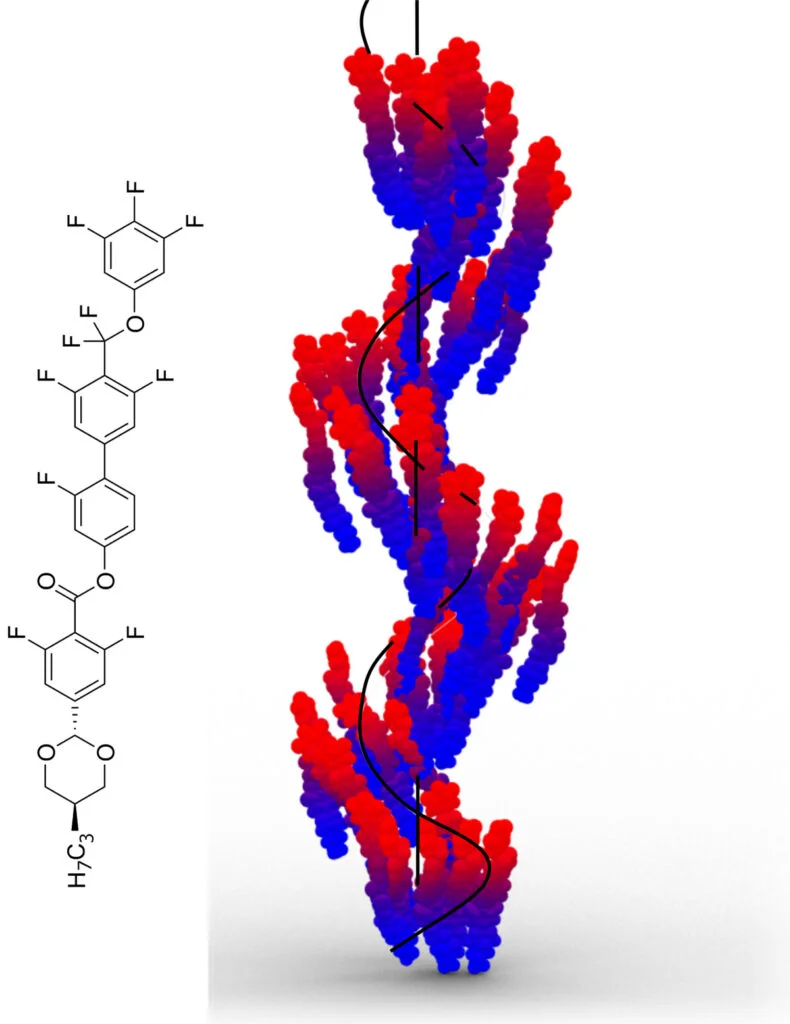
The chemical formula of the liquid crystalline compound under study and a schematic of the structure of the newly discovered ferroelectric chiral nematic phase (NTBF).
The chemical formula of the liquid crystalline compound under study and a schematic of the structure of the newly discovered ferroelectric chiral nematic phase (NTBF). Source: Damian Pociecha/University of Warsaw

What’s next?

The discovery of a ferroelectric chiral liquid crystalline material by Polish scientists was published in the prestigious journal Science and quickly caused a sensation in the field of chemistry. Since the original publication in June 2024, research on this new type of ferroelectric nematic phase has progressed rapidly.

Independent teams around the world have confirmed the existence of this structure. To date, more than 60 new compounds capable of forming this phase have been synthesized, including materials that operate over broader temperature ranges – bringing them a step closer to real-world applications.

The text was originally published in Polish on the Serwis Naukowy UW website on June 26, 2025.
Research University: Five questions for computer scientists Professor Wojciech Czerwiński
A routine church renovation led to a groundbreaking discovery in Cegłów
The police are on their way… to Facebook: Armchair detectives in action
Ethiopian homilies preserved for centuries: What they might tell us about a world long gone
It had an extraordinarily long neck – and an apparent preference for what is now Poland. Researchers are still asking: why?
TAGGED:chiralityFaculty of Chemistryferroelectricityheliconical ferroelectric nematic phaseLaboratory of Physicochemistry of Dielectrics and Magneticsliquid crystalsMilitary University of TechnologyphysicochemistryUniversity of Warsaw
Previous Article Ruthenium catalyst with the quinoxaline-derived ligand. Chemistry with less “chemistry”: How scientists at UW improved a Nobel-winning reaction
Next Article We breathe what we drive: How daily choices affect the health of our children
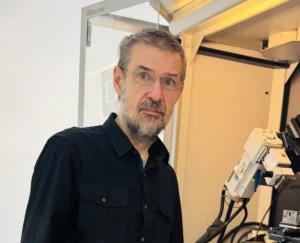
Prof. Damian Pociecha
dr hab. Damian Pociecha, prof. ucz.

is a chemist working in the Laboratory of Physicochemistry of Dielectrics and Magnetics at the Faculty of Chemistry, University of Warsaw. His research interests focus on the physicochemistry of liquid crystals. He is a co-author of several hundred scientific publications in prestigious international journals and the recipient of numerous awards, including the Maria Skłodowska-Curie Scientific Prize in Chemistry in 2024.

UW Science Daily

Center for Cooperation and Dialogue, University of Warsaw

Office: ul. Dobra 56/66, 00-312 Warsaw

Tel.: +48 609635434 • redakcja@uw.edu.pl

Facebook Linkedin Instagram

About us

UW Home page

logotyp-IDUB-PL-poziom-inv

Accessibility statement

Cookie privacy policy

Site map

Copyright © 2026 University of Warsaw

Copyright © 2026 Uniwersytet Warszawski
Manage Consent
To provide the best experiences, we use technologies like cookies to store and/or access device information. Consenting to these technologies will allow us to process data such as browsing behavior or unique IDs on this site. Not consenting or withdrawing consent, may adversely affect certain features and functions.
Functional Always active
The technical storage or access is strictly necessary for the legitimate purpose of enabling the use of a specific service explicitly requested by the subscriber or user, or for the sole purpose of carrying out the transmission of a communication over an electronic communications network.
Preferencje
Przechowywanie lub dostęp techniczny jest niezbędny do uzasadnionego celu przechowywania preferencji, o które nie prosi subskrybent lub użytkownik.
Statistics
The technical storage or access that is used exclusively for statistical purposes. Przechowywanie techniczne lub dostęp, który jest używany wyłącznie do anonimowych celów statystycznych. Bez wezwania do sądu, dobrowolnego podporządkowania się dostawcy usług internetowych lub dodatkowych zapisów od strony trzeciej, informacje przechowywane lub pobierane wyłącznie w tym celu zwykle nie mogą być wykorzystywane do identyfikacji użytkownika.
Marketing
Przechowywanie lub dostęp techniczny jest wymagany do tworzenia profili użytkowników w celu wysyłania reklam lub śledzenia użytkownika na stronie internetowej lub na kilku stronach internetowych w podobnych celach marketingowych.
  • Manage options
  • Manage services
  • Manage {vendor_count} vendors
  • Read more about these purposes
View preferences
  • {title}
  • {title}
  • {title}