

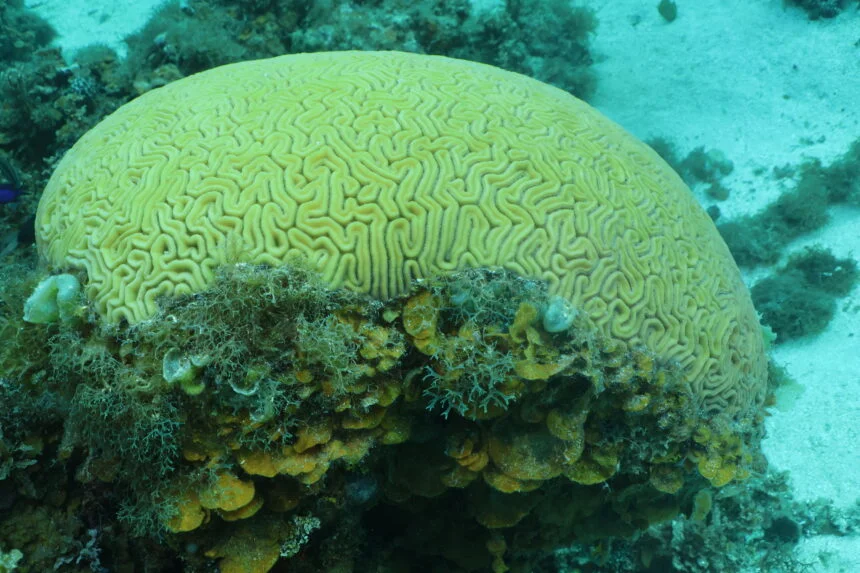
Corals are remarkable animals in many ways – and not just because of their spectacular appearance. By building reefs, they perform a wide range of vital ecological functions. Coral reefs protect coastlines by acting as natural breakwaters. The biodiversity of marine fauna and flora – and thus the stability of entire food chains – largely depends on them.
Corals are also extraordinarily long-lived organisms. Some can survive for around 500 years or even more, placing them among the oldest living organisms on Earth. Their longevity stems from sophisticated mechanisms of adaptation to changing environmental conditions – mechanisms refined over millions of years. These abilities allowed corals to survive the great mass extinctions in our planet’s history.
Today, however, rising temperatures and other effects of climate change are again threatening coral populations. Scientists are searching for ways to counter this threat, and a detailed understanding of coral adaptation mechanisms may prove crucial.
An innovative approach to research: practice before theory
For many years, researchers believed that modern reefs functioned very differently from prehistoric reefs when it came to adapting to environmental conditions. Several arguments supported this view.
First, scientists noted that reefs in the Paleozoic era were formed primarily by sponges rather than corals – somewhat related, but distinct organisms. Second, it was assumed that Paleozoic reefs lacked the ability to cement themselves together, meaning they could not attach to the substrate to form a rigid reef framework. Finally, ancient reefs were thought to be far less diverse in structure and shape than modern reefs.
These arguments were valid – at least from the perspective of species classification. However, they did little to explain how reef-building organisms actually adapted to harsh environmental conditions millions of years ago.
Scientists from the Faculty of Geology at the University of Warsaw decided to reverse this perspective. Instead of relying primarily on theoretical models, they began studying coral reefs directly in their natural environment.
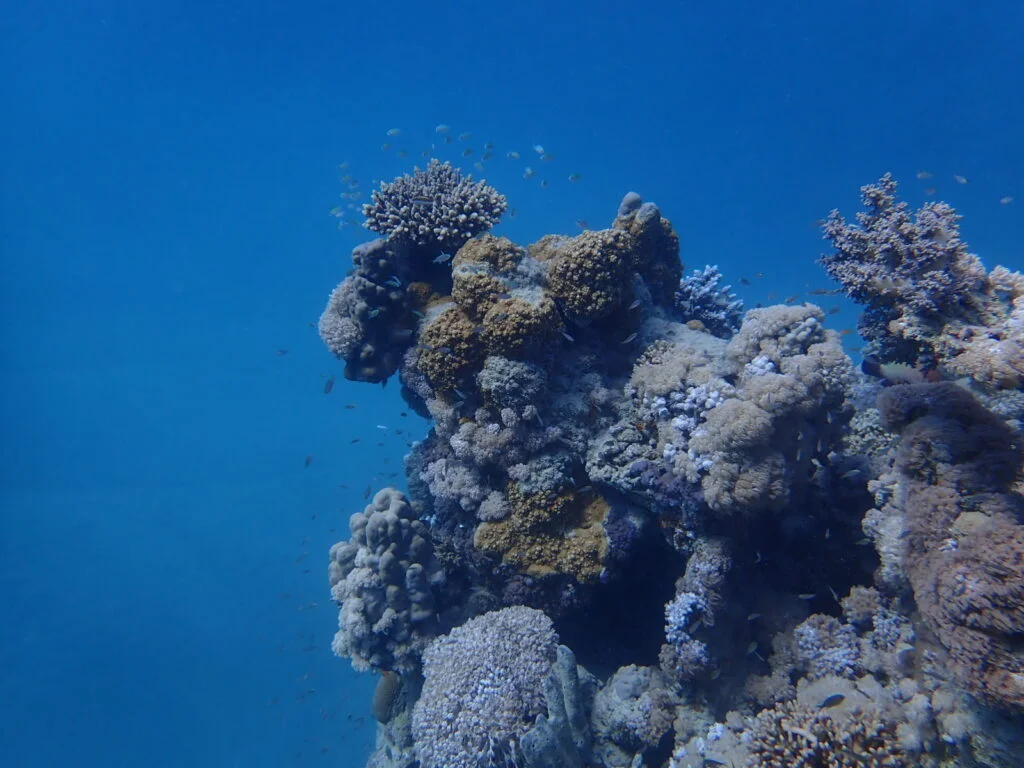
“The overwhelming majority of paleontologists studying Paleozoic reefs have never seen a reef in real life. I’ve been diving for over 10 years, and my familiarity with fossil corals allowed me to observe aspects of their anatomy and ecology from a comparative perspective. That gave my research a different starting point.
“Until now, scientists studying Paleozoic reefs have mainly used stromatoporoids—sponges—as tools for reconstructing ancient environments, treating corals as a secondary element. I approached it differently. I didn’t start with the question ‘What built Devonian reefs?’ but rather ‘How did corals build Devonian reefs?’
“While observing the diversity of coral colonies during my dives, I also began asking how environmental conditions influence their shape. I noticed something else as well: although not all types of modern coral colonies appear in the fossil record, every type that existed in the Paleozoic era still exists today,” says Prof. Mikołaj Zapalski.
Millions of years apart – similar survival mechanisms
A team of scientists from the Faculty of Geology compared corals from the Devonian period with modern corals, focusing on how they adapt to environments with limited access to light.
The results were striking. Although modern and Paleozoic corals belong to different species, their strategies for coping with difficult environmental conditions are remarkably similar.
Analysis of Devonian coral skeletons revealed that as access to light decreased, the colonies changed shape: they became less branched and more flattened, forming structures that function much like coral “solar panels.” Corals still use this strategy today. The deeper a reef grows – and the less light it receives – the flatter and less branched the coral colonies become.

Hope for the future
The research conducted by scientists from the University of Warsaw is innovative not only because of its different starting point and research questions, but also because of the broader goal it sets. The team plans to conduct a detailed comparative analysis of the adaptive mechanisms of ancient and modern reefs in order to better understand how corals respond to environmental change.
This objective is also part of the National Science Centre grant “Functional ecology of Paleozoic coral ecosystems – recent as a key to the past,” led by Prof. Zapalski.
“Only after we demonstrate more broadly that fossil corals exhibit the same adaptive mechanisms can we draw stronger analogies with modern corals,” explains Prof. Zapalski. “Current research suggests that the major coral extinction in the late Devonian period, about 372 million years ago, was most likely caused by rising temperatures and the breakdown of the symbiosis between corals and algae – the very same mechanism that threatens modern corals today.”
The text was originally published in Polish on the Serwis Naukowy UW website on February 21, 2025.