

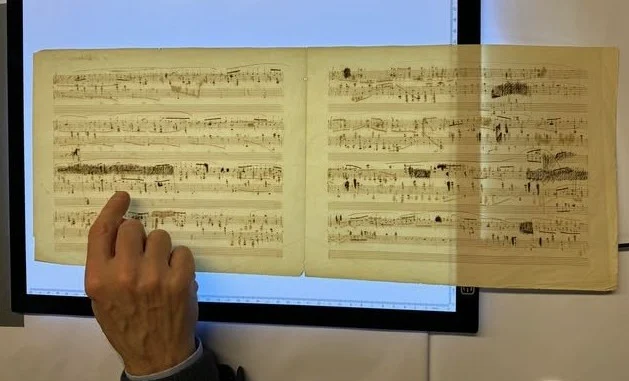
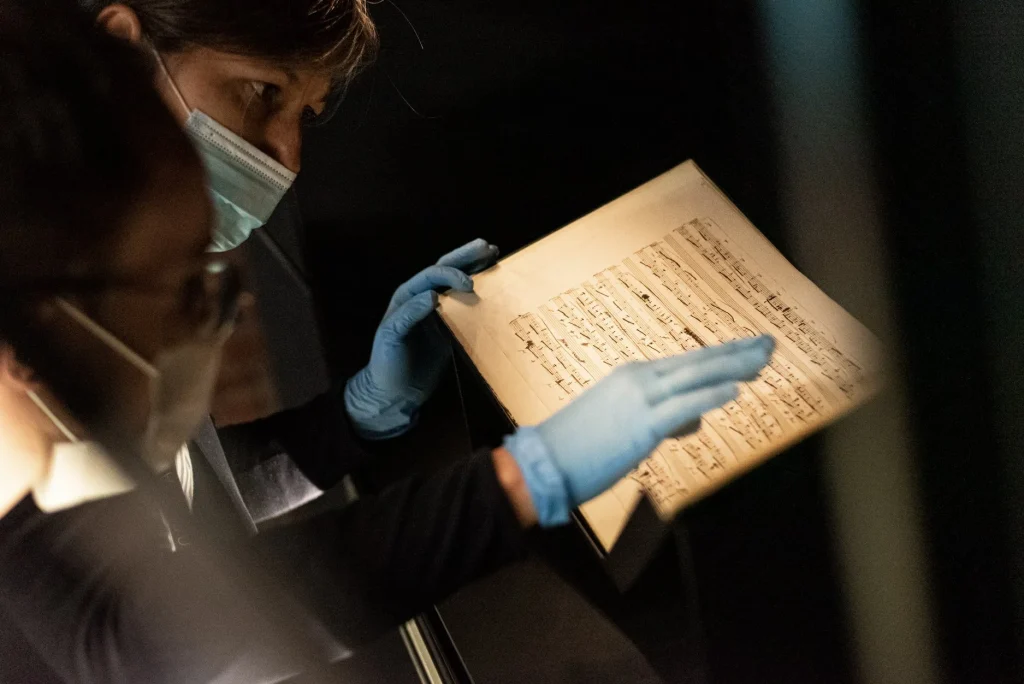
Photographs of it arrived in Poland first – then, eventually, the manuscript itself. The owner at the time granted permission only for microscopic examination, so the entire weight of the authentication process rested on meticulous, close-up analysis carried out by a team of three experts.
One researcher assessed the paper’s structure and color; another examined the ink and how it interacted with the surface; a third focused on the musical notation itself. At one point, they all reached the same conclusion: authentic.
“It’s a treasure,” the then Minister of Culture, Hanna Wróblewska, later declared at a press conference. As cinematic as it may sound, it really happened in late 2024 at the Fryderyk Chopin Institute in Warsaw. The subject of the expert analysis was the autograph manuscript of Frédéric Chopin’s Ballade in F minor, Op. 52.
A long journey to Poland
“We were told we’d only have a few hours with the manuscript – just enough time to form an initial assessment of its authenticity. I focused on the ink, while an experienced conservator, Agata Lipińska from the National Library, examined the paper. Professor John Rink from the University of Cambridge – one of the foremost experts on Chopin – studied the musical notation itself. The whole process was observed by the owner’s representative, a lawyer, a conservator and collections curator, as well as Dr. Artur Szklener, director of the Fryderyk Chopin Institute,” says Prof. Barbara Wagner from the Faculty of Chemistry at the University of Warsaw.
Only two manuscripts of this Ballade are known to exist. The one that entered the collection of the Fryderyk Chopin Institute in early 2025 has had a long and winding journey. After the composer’s death in 1849, Chopin’s sister passed it on to his friend Joseph Dessauer – also a pianist and composer. In 1933, the manuscript resurfaced in a secondhand bookshop in Lucerne, discovered by American collector Rudolf F. Kallira. A few decades later, several black-and-white photographs were taken – the only record of its existence at the time. For decades, the document was not seen by researchers or conservators, which, in Professor Wagner’s view, ultimately worked to its advantage.
“Over the years, conservators trying to preserve historic objects have experimented with a wide range of methods – many of which have not stood the test of time.”
“Back in the 1960s and 1970s, there was a real fascination with chemistry. The prevailing belief was that if you understood chemical reactions, you could essentially control how they altered paper. To improve the appearance of manuscripts, various bleaching agents were used, including the once widely popular water-soluble compound chloramine T. It was a highly involved process – repeated chemical baths, hours of rinsing, and then neutralizing any remaining chloramine with sodium thiosulfate, followed by yet more rinsing. The goal was usually quite simple: to lighten paper that had naturally yellowed with age. The problem was that if those chemicals weren’t fully removed, the reactions they triggered could end up causing long-term damage.”
“Today, conservators are far more cautious with wet treatments, and a more restrained, almost purist approach has taken hold. Any intervention is weighed very carefully before it’s carried out. There’s also a growing awareness that better technical solutions may still emerge in the future, so we try to leave room for those possibilities. Even our sense of aesthetics has changed – an immaculate, bright white sheet is no longer considered a benchmark of successful conservation,” explains Prof. Wagner.
For that reason, and drawing on decades of accumulated experience, all the experts agreed that the manuscript had, fortunately, escaped those earlier conservation practices. Safely stored away in a vault for years, it had been largely untouched – until the decision to sell it finally brought it into the hands of researchers.
Treasure hunters
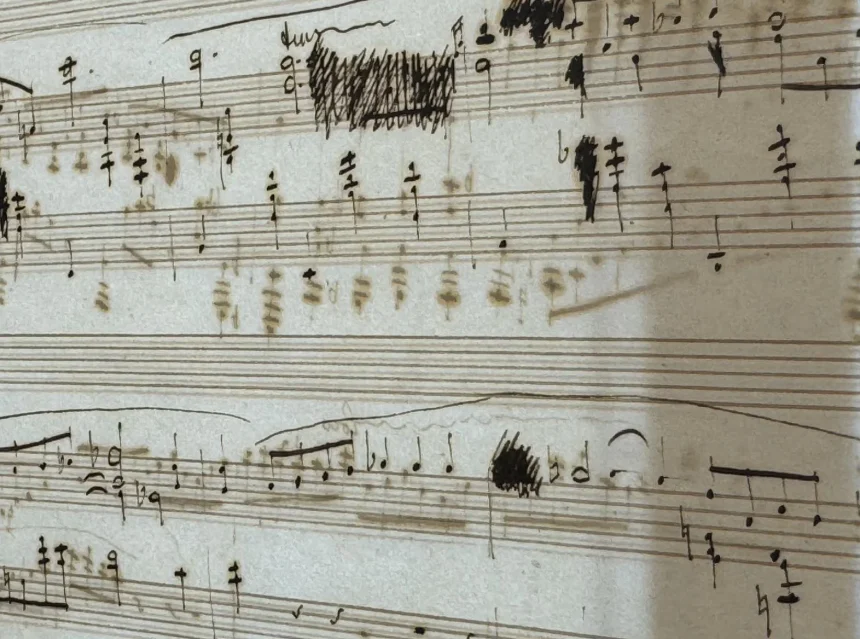
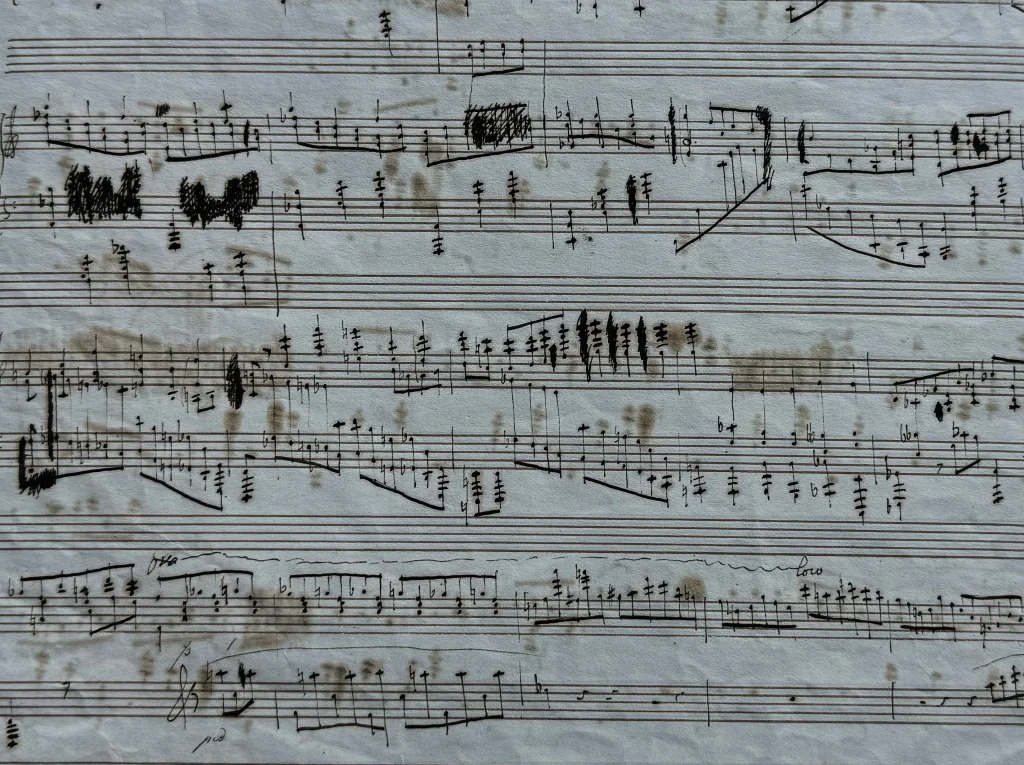
A portion of the manuscript had been heavily crossed out, yet beneath the erasures the original notation remained visible. It revealed that Chopin later recopied the initially composed piece in a revised time signature – that is, with a reworked rhythmic framework altering how the measures are grouped and where the metric accents fall within the composition.
“Musicologists examining the manuscript were essentially looking at two versions of the melody – and they were absolutely delighted,” recalls Prof. Wagner.
It was not only the score of a composition, but also a record of the composer’s creative process. At the press conference marking the acquisition of the document, both versions of the Ballade were performed.
For musicologists, both the content and the compositional process served as confirmation of authenticity. And what did the chemist’s analysis look like?
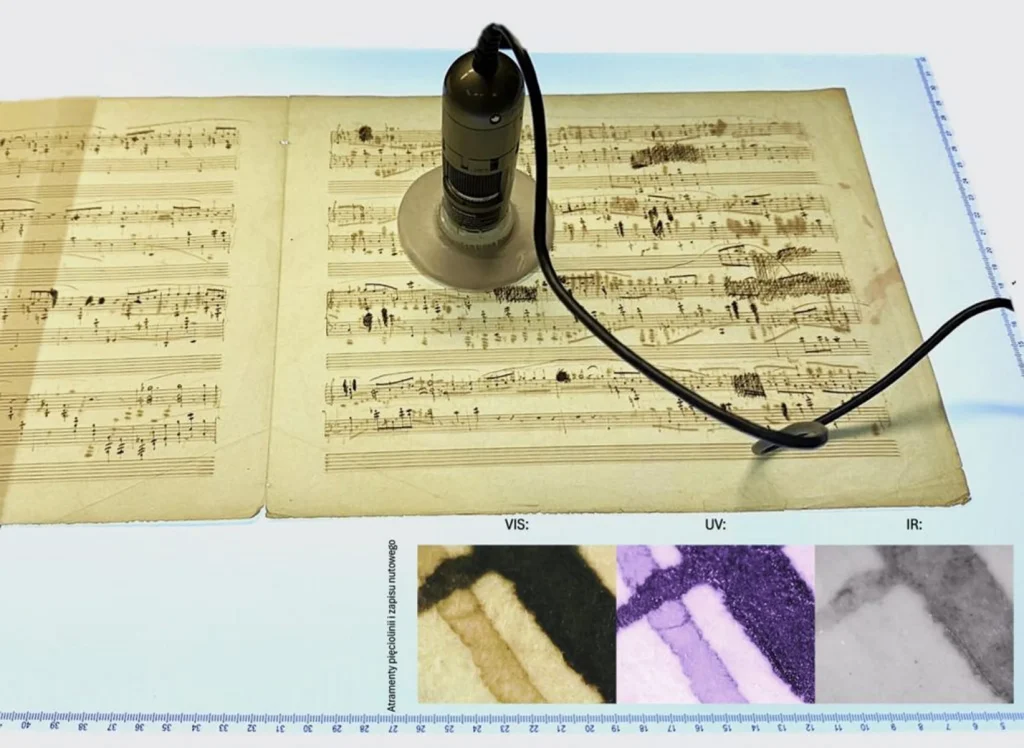
“The object under study was a musical manuscript on well-preserved, cream-colored paper, covered with musical notation and staff lines drawn in two shades of brown ink. The paper is well-sized, which ensured that the ink shows no signs of spreading within the paper structure and remains clearly legible. The manuscript is so valuable that the owner at the time agreed only to macroscopic and microscopic examination during the assessment. I therefore brought a portable digital microscope equipped with lamps emitting light at different wavelengths, along with a light table.”
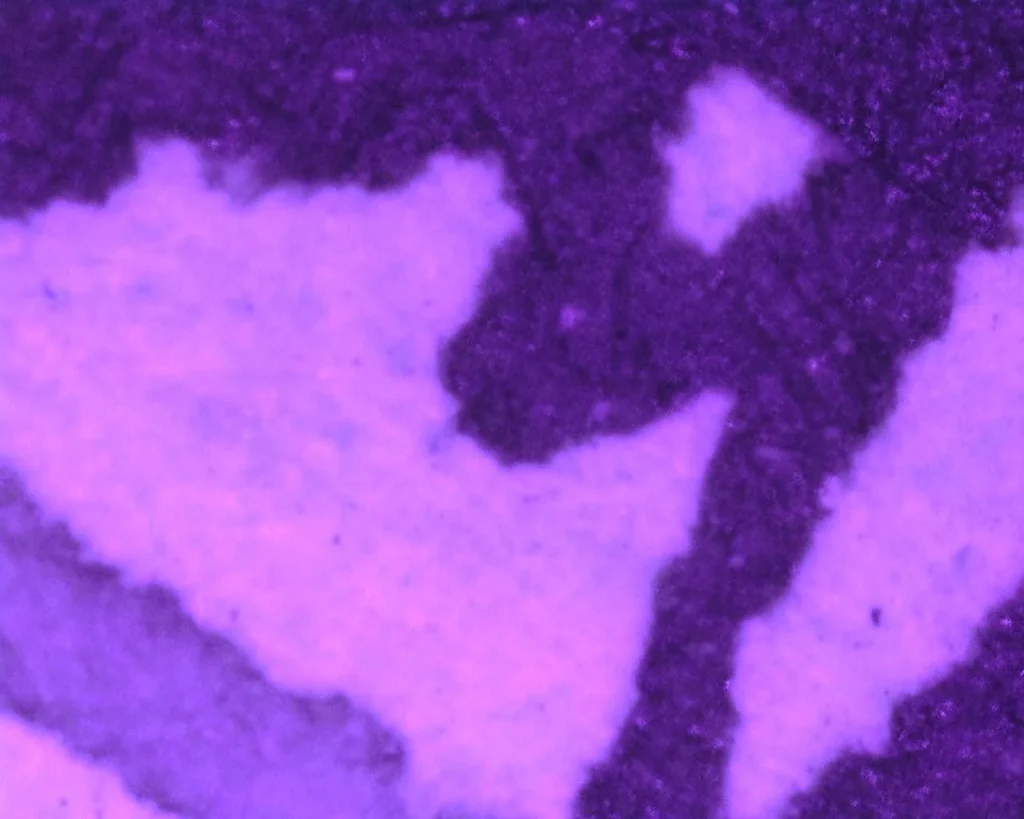
“I examined the ink under a microscope and documented it across three regions of the electromagnetic spectrum – visible light (VIS), ultraviolet (UV), and infrared (IR). This allowed me to confirm that two different inks were used, each responding differently under varying wavelengths. The staff lines were drawn with a plant-based ink containing a small amount of inorganic salts, while the musical notation itself was written in the most widely used ink in Europe at the time – iron gall ink,” explains the chemist.
Iron gall inks (more broadly, metal–tannin inks) were used for writing on paper supports well into the second decade of the 20th century. Their composition was often improvised, but they were always based on aqueous solutions of iron salts and plant extracts derived from galls. Galls are growths that form on the leaves, twigs, or fruit of various oak species. They develop after the gall wasp (Cynips gallea tinctoria) lays its eggs inside the plant tissue, providing a protective chamber for its larvae, which later emerge as adults. Galls can contain up to 40% tannins, which is why tannin-rich extracts – obtained by heating galls in water – were historically used in ink production. In some cases, aqueous extracts from bark or other parts of locally available plants were also used.
“Mixing these plant extracts with transition metal salts – most commonly iron, but quite often copper as well – produced a suspension of black particles in solution, which effectively became the ink. The viscosity was then adjusted with a binder, most often gum arabic. Because the ingredients and their proportions varied so widely, iron gall inks could differ quite significantly both in color and in how they affected the writing surface over time,” says Prof. Wagner.
Macroscopic observations indicated the presence of iron gall ink in the manuscript, which would be consistent with its presumed date of origin.
Inks requiring close monitoring
“These were among the most widely used inks in European history, but their chemical composition could vary quite significantly. Not all historical inks were properly balanced in terms of stoichiometry (that is, the quantitative ratios between their components – editor’s note) – and in that respect, Chopin’s manuscript appears to be a typical example of inks that are not chemically inert with respect to the writing support, as clearly visible in the images. You can see pronounced browning of the paper in areas covered with ink, as well as these color changes bleeding through to the reverse side of the musical notation, and especially in places where corrections or blot-like overwriting obscure the original notation. Similar effects, resulting from the long-term interaction between ink and paper, can be observed throughout the entire manuscript,” notes the scientist.
Ink that is not chemically well-balanced can lead to the deterioration of documents through processes known as “ink corrosion.” Over the long term, this may even result in the complete destruction of the paper in areas affected by such inks. For this reason, a four-level conservation risk scale has been developed to assess manuscripts.
“Macroscopic examination of the ink was carried out under visible light, or white light. The changes induced in the paper by the ink point to a level II risk of ‘ink corrosion’ for the manuscript. In addition, we identified irregular stains ranging from pink to light cherry in color on the pages, resembling an aniline dye commonly used in stamp inks,” Prof. Wagner reports.
A level II ink corrosion risk indicates the early stages of structural weakening in the paper. Discoloration – typically yellowish to brownish – can be seen around ink lines, showing that the substrate is beginning to lose strength in inked areas. This calls for the manuscript to be placed under continuous conservation monitoring.

Two Chopins are better than one
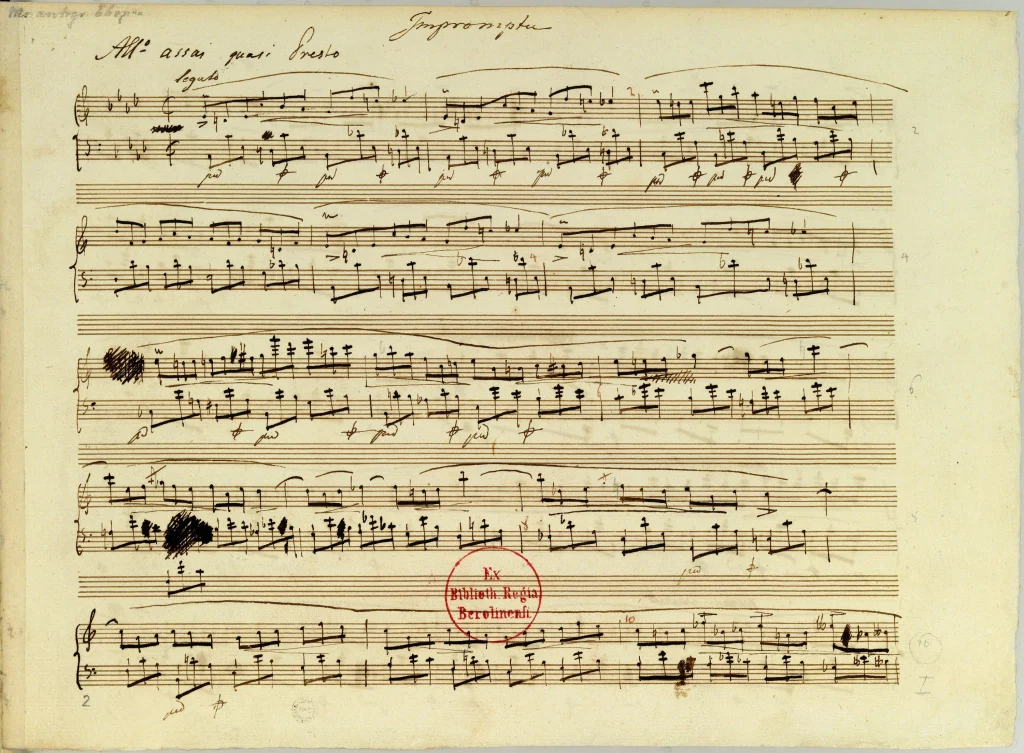
For Prof. Wagner, this was the second time in her career that she had examined an authentic Chopin manuscript, though of a different work. A few years earlier, she had studied the autograph of the Impromptu in A-flat major, Op. 29 at the Fryderyk Chopin Institute, using X-ray fluorescence spectroscopy (XRF).
“It’s a non-invasive technique that records the elemental composition when the spectrometer is brought into contact with the surface of the object being examined. Put simply, you place a probe directly on the page and read the signals emitted by the elements present at that spot. That allows us to compare the composition of different areas and see whether they match or differ. Conservators are especially fond of these kinds of non-invasive methods because they’re safe for cultural heritage objects,” Prof. Wagner says.
As the chemist notes, XRF does have its limitations: it is not very sensitive to light elements – aluminum, for instance, is only poorly detected, while sodium is essentially invisible. As a result, some characteristic information is lost.
As with the Ballade, the analysis of the Impromptu made it possible to distinguish between the different inks used by Chopin, those added by an editor who later annotated the score, and the ink of the staff lines. It also confirmed that during conservation treatments in the 1960s, a conservator reinforced the writing on the first page with a brown watercolor wash.
Further analysis revealed the presence of barium throughout the manuscript, which turned out to be the result of a treatment with barium hydroxide in methanol applied during a subsequent conservation process in the 1990s – a then-standard procedure used to raise the pH of paper.
In short, the document held no secrets for the researchers.
The “paper strip library”
The second tool Prof. Wagner reached for in her study of Chopin’s Impromptu was indicator paper strips. These are pieces of filter paper impregnated with a complexing agent, used by conservators since 2005. When they come into contact with iron in its +2 oxidation state, they change color. For conservators, this reaction provides a visual diagnostic signal confirming the presence of potentially aggressive iron gall ink – the type of ink responsible for pitting and long-term degradation of paper.
“It turned out that these indicator papers capture almost the entire elemental profile of the ink, even though not every element influences their color response. I honestly don’t know why no one had looked into this before. We combined the method with XRF analysis – we take the tests from exactly the same spot on the object and then analyze them in the lab, which allows us to directly compare both sets of data,” explains the chemist.
This is how indicator papers became the foundation of a broader research project. Since 2014, Prof. Wagner, together with the Central Archives of Historical Records, has been systematically using them to analyze ink composition in historical manuscripts. They make it possible to compare ink recipes used across different periods and locations, ultimately helping to determine the provenance of documents, assess their condition, and predict the rate of degradation. It is a tool that allows researchers to read history not only through written words, but also through the very material those words were written on.
The text was originally published in Polish on the Serwis Naukowy UW website on August 21, 2025.