
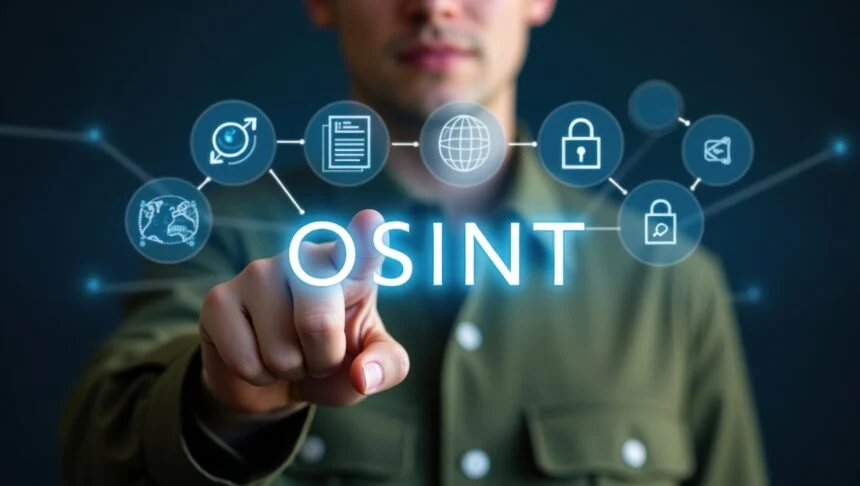
“Rather than trying to debunk every false claim with yet another correction, we should equip people with the habits and tools they need to verify information quickly and independently. OSINT (open-source intelligence) can help turn these practices into everyday fact-checking – practical skills that anyone who uses the internet can put to use,” notes Dr Piotr Lewulis of the University of Warsaw’s Faculty of Law and Administration.
In the column below, a lawyer and forensic science researcher explores how science can help fight disinformation.
“An investment opportunity endorsed by leading politicians? A “miracle diet” promising weight loss after drinking salt water? A “foolproof” method for detoxifying poisonous mushrooms? Sounds too good to be true? It probably is.”
“Fact-checking remains one of the key tools for countering information manipulation—from correcting politicians’ claims and exposing new tactics used by criminal groups to combating organized disinformation and foreign propaganda. When carried out systematically and professionally, fact-checking can improve the overall quality of the information we encounter. At the same time, the term “fake news” is imprecise and highly politicized. EU policy generally uses the broader concept of disinformation to refer to false or misleading content spread with the intention to deceive or secure economic or political gain, and which may cause public harm.”
How effective is fact-checking?
“Research suggests that warning labels identifying content as false can reduce both belief in it and willingness to share it. Meta-analyses also indicate that fact-checking generally improves factual accuracy, although its effects vary and may be weaker when corrections conflict with people’s prior beliefs, ideology, or existing knowledge. Moreover, improvements in factual accuracy do not necessarily translate into corresponding changes in attitudes, decisions, or behavior.”
“That should come as no surprise. The way we process information is shaped by well-documented cognitive biases and other patterns of reasoning. Then there is the power of ‘compelling narratives’: those who produce disinformation offer ready-made stories that may be inconsistent or outright false, yet still form persuasive, self-reinforcing belief systems. As the Council of Europe noted in its 2017 report, Information Disorder: Toward an Interdisciplinary Framework for Research and Policy Making, such narratives are difficult to counter simply by saying, ‘That’s not true.’”
Can you tell what’s really credible?
“Whatever its broader strategic value to society, fact-checking also has important practical value for individuals. People who understand the importance of approaching information critically are a natural audience not only for institutional fact-checking initiatives, but also for efforts to develop practical skills for independently verifying information in everyday life.”
“In other words, we need ‘everyday fact-checking’: a set of simple techniques for quickly and critically evaluating the information we encounter.”
“A Stanford University study offers a telling example. When professional fact-checkers, historians, and university students were asked to evaluate the credibility of online information, the fact-checkers were generally faster and more accurate. One of the key strategies they used was lateral reading: leaving an unfamiliar website to check what other, independent sources say about it. Historians and students, by contrast, were more likely to rely on features of the website itself and could therefore be misled by sites that appeared credible.”
“If we want to make information retrieval and verification part of the basic skill set people need to navigate today’s information environment, it is worth remembering that the underlying principles are hardly new. They overlap with methods long used in crime science, forensics, and investigative practice – fields concerned with the detection and investigation of crime and with the collection, examination, and evaluation of evidence.”
“Searching for, analyzing, and verifying information are fundamental elements of investigative work. This points to an important connection: everyday fact-checking can draw on tools and techniques developed within open-source intelligence (OSINT), which involves collecting, evaluating, and analyzing information from publicly available sources in order to draw informed conclusions.”
Verification starts with publicly available data
“Analyzing publicly available data is now a routine part of criminal investigations. Research conducted at the Department of Criminalistics at the University of Warsaw’s Faculty of Law and Administration and at the University’s Center for Forensic Science illustrates how these methods can be used both to help identify perpetrators of online crimes and to answer more everyday questions: Which operator is associated with a particular phone number? What publicly available registration information is available for a web domain? Which bank is associated with a given account number? What information is available about an entity registered in the National Court Register (Poland’s official register of companies and organizations – editor’s note)? What publicly documented professional connections does a person have? Which country is an IP address associated with? Where and when might a photograph have been taken?”
“These are just a few examples of questions that can be explored using publicly available information. But collecting information is only part of the process. Just as important is knowing how to assess the reliability of both the sources and the information they provide. Here, too, insights from criminalistics, investigative practice, and security studies can be useful, particularly established approaches to evaluating source reliability and information quality.”
“In everyday life, these checks need to be quick and intuitive. Two or three simple verification steps are often enough to identify obviously unreliable information.”
“This is hardly a new idea. Fact-checking communities have long recognized the importance of educating the public. What I find particularly promising, however, is the possibility of bringing different disciplines together—including criminalistics and investigative practice—to develop basic skills for independently assessing and verifying information, both online and offline.”
“Such a cross-disciplinary approach may prove increasingly important in the years ahead.”
The text was originally published in Polish on the Serwis Naukowy UW website on August 28, 2025.