


Thousands of tiny molecular machines – each just a few nanometers in size – are constantly at work inside every living organism. They drive the fundamental biological processes that together make up what we call life. Take myosins, for example: they are responsible for muscle contraction, moving along actin filaments in sarcomeres, the functional units of muscle tissue, and generating the force that powers movement in the body. Scientists have been working on building synthetic versions of these molecular machines for only about 20 to 30 years. And while we are still at the beginning of this journey, the first major breakthroughs are already here. One of them is the development of an artificial molecular machine that operates more efficiently than its biological counterpart,” says Dr. Wojciech Danowski.
The power of molecular motors
Although this field is still in its early stages, its potential applications are becoming increasingly clear. One of the most promising is the precise delivery of drugs and active compounds to specific sites in the body – for example, directly to cancer cells – while leaving healthy tissue unharmed. Other possible uses include smart materials, membranes, absorbents, and thin-film filters designed for energy-efficient separation processes such as molecular sieving.
An innovative way to control molecular motors
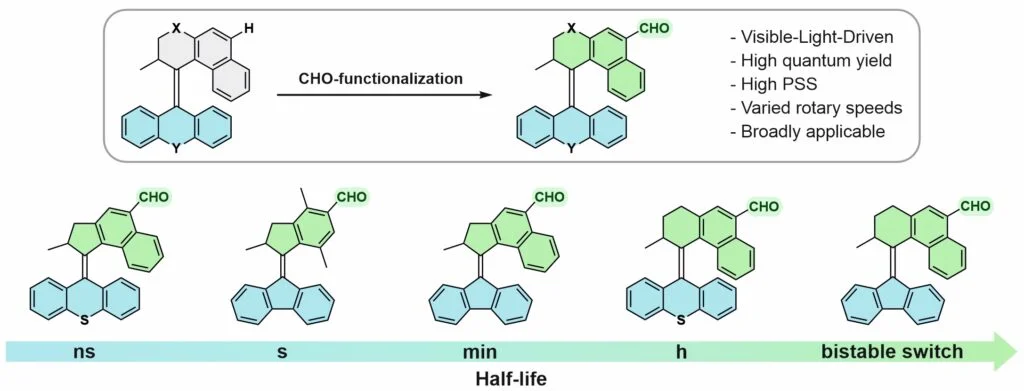
A molecular motor works on a simple principle: one part rotates relative to another around an axis. The stationary component, known as the stator, is typically anchored to a surface, while the moving part – the rotor – rotates freely. The axis connecting them is a fragment of the molecule, such as two carbon atoms connected by a double bond (an alkene). Until recently, these nanoscale motors were driven mainly by UV light. Now, Dr. Wojciech Danowski shows they can also be powered effectively by radiation in the visible light range.
“Replacing UV light with visible light significantly extends the lifetime of molecular machines, improves their efficiency, and, in biological applications, reduces toxicity while allowing light to penetrate tissues more safely. Anyone who has ever spent too much time in the sun knows how harmful UV radiation can be,” says the University of Warsaw researcher.
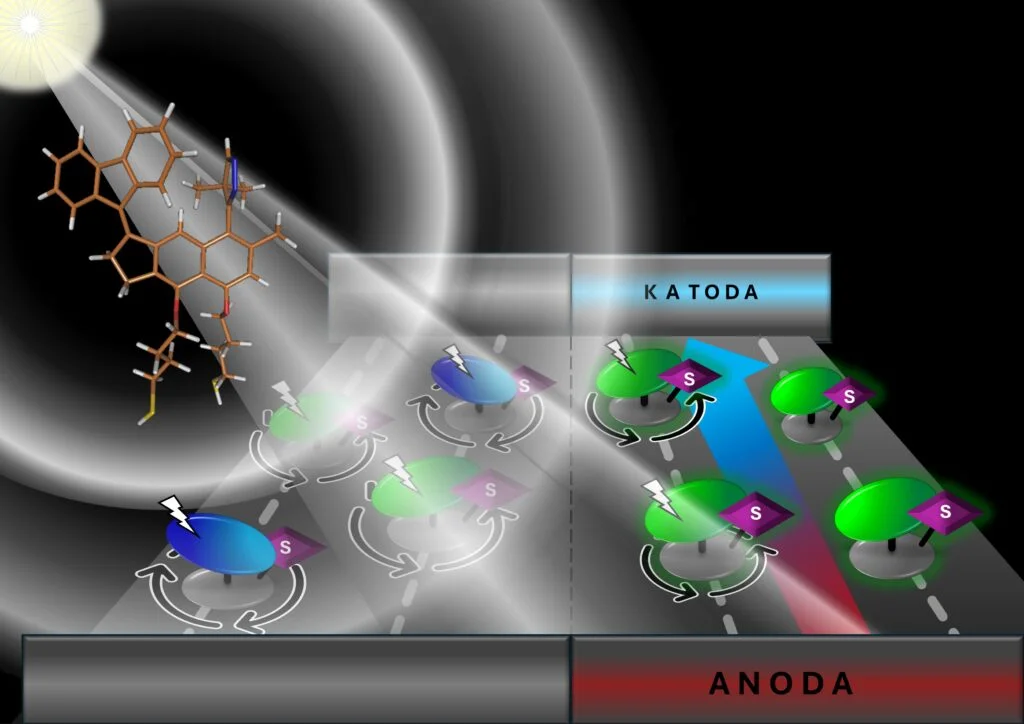
Another milestone in unlocking the full potential of molecular machines is expanding their functionality to include remote control of their operation. In her research based on quantum chemical simulations, Dr. Joanna Jankowska has shown that an external electric field can steer the direction of a molecular motor’s rotation. This effect is tied to chirality – a property of molecules whose mirror images cannot be superimposed – like left and right hands.
“This is a major step forward because changing chirality is not something chemistry easily allows. It usually requires full-scale chemical intervention – adding a reagent, carrying out a quantitative reaction, and then removing it. In our work, we redesigned the motor so that its direction of rotation can be switched with an electric field pulse. This is the first time it has been achieved without chemical modification,” emphasizes Dr. Jankowska.
The groundbreaking research
Using physical stimuli to control molecular motors opens up entirely new prospects for their practical applications. Light-driven motors differ significantly from chemically controlled ones, primarily due to the irreversible nature of photochemical processes at the microscale. In contrast, classical chemical reactions tend to be reversible and governed by equilibrium, which makes it more difficult to design unidirectional nanomachines. Photochemical processes are not subject to these limitations, enabling exceptionally high unidirectionality and precision of motion – only one error in tens of millions of rotations.
“Still, the biggest hurdle is moving this technology beyond the lab and into real-world use. For now, we mainly work under tightly controlled conditions, but the potential applications are broad – from medicine and materials science to smart energy systems. We’re only at the very beginning of this path, but the direction is clear,” says Dr. Danowski.
The ability to reverse the rotation of a molecular motor using an electric field is a genuine breakthrough, allowing fast, remote control without any physical contact or chemical intervention.
“If something rotates clockwise, the natural question is: can we make it rotate counterclockwise instead – just as you would with a toy or a machine? That curiosity was really the starting point for this work: a sense that it simply had to be possible somehow. Scientifically, it turned out to be challenging, but I believe we managed to achieve it,” concludes Dr. Jankowska.
The text was originally published in Polish on the Serwis Naukowy UW website on May 19, 2025