


How many children with their eyes fixed on their phones did you pass on your way to work today? Or perhaps none – because you were looking at your own screen?
As parents, teachers, and everyday observers, we rarely get a real glimpse of what unfolds behind the glowing screens of children’s smartphones. What does this digital world look like, where younger users spend more and more of their time? And what kind of content are they actually encountering there? The “Internet of Children” report, published in March 2025, sheds light on these questions, drawing on extensive research into how children and adolescents engage with the online world.
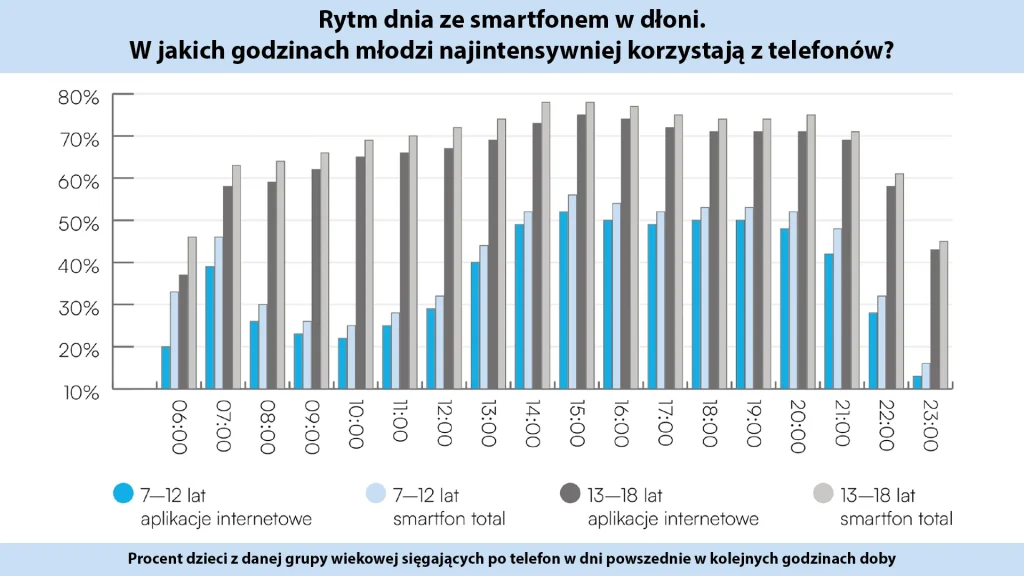
On average, children and adolescents spend over four hours a day online (Q4 2024 data). Among 7–14-year-olds, it is 4 hours and 29 minutes, while 15–18-year-olds spend 4 hours and 28 minutes a day online. Which apps dominate children’s screen time? Which platforms engage them the most? And how does their online world differ from our own?
A public awareness campaign launched by the City of Warsaw featured a provocative message: “You wouldn’t leave a child alone in a strange city.” Based on findings from the Internet of Children report, the campaign appeared on posters across Poland and encouraged adults to think differently about children’s online safety. At the same time, public debate increasingly turned toward calls to ban smartphones in elementary schools.
The experience of the Netherlands, which introduced such a ban in 2024, points to several positive outcomes. Studies have reported improved concentration, better academic performance, and lower levels of stress and social comparison among students. However, researchers at the University of Birmingham reached different conclusions. In a study involving 30 schools, they found no significant differences in academic achievement, mental well-being, classroom behavior, or sleep quality between schools that had introduced phone bans and those that had not. The researchers argue that no single measure can fully address the issue, particularly given that children and adolescents spend most of their time online outside school.
The Internet of Children report likewise suggests that the scale and complexity of young people’s online lives require broader, systemic responses, including action by policymakers.
Poland offers an interesting example of how pressure can be exerted on global technology platforms. Rafał Brzoska, founder of InPost, successfully pushed Facebook to remove false content about him – at least temporarily, under a court injunction – demonstrating that coordinated legal and economic pressure can influence the decisions of major digital platforms.

What, where, when, and how: A guide for parent
Internet of Children. A Report on the Monitoring of the Presence of Children and Adolescents on the Internet is a publication produced through collaboration between the Institute for Digital Citizenship Foundation, the University of Warsaw, Polskie Badania Internetu (Polish Internet Research), the State Committee for Counteracting the Sexual Abuse of Minors Below 15 Years of Age, and Gemius.
Researchers analyzed detailed data from the fourth quarter of 2024, focusing on two age groups: children aged 7–14 (roughly corresponding to primary school) and adolescents aged 15–18 (secondary school students). They also identified a particularly vulnerable subgroup: children aged 7–12. Although these users are, in principle, not allowed to access most social media platforms – such as TikTok, Instagram, or Snapchat – in practice, many of them do.
“Reports on children’s presence on certain types of websites, including pornography sites, had already appeared in Poland. But about a decade ago, we still knew very little about the influence of social media platforms on their users. At the time, they were widely praised for their potential to support communication and marketing. Over time, however, it became clear that they can also have harmful effects, such as exposure to inappropriate content, cyberbullying, and contact with predators. Although most platforms set a minimum age of 13 in their terms of service, the data in our report show that much younger children are also using them,” notes Prof. Anna Miotk from the Faculty of Journalism, Information, and Book Studies at the University of Warsaw.
Digital violence leaves no bruises
The research behind the report combined two complementary methods. First, it used desk research, analyzing data from existing reports and studies. Second, it drew on data from the Mediapanel measurement, which tracks website traffic as well as the use of mobile apps and streaming services. With parental consent, children and adolescents aged 7–18 participate in the panel component of the study. They are given specially prepared smartphones or install a research app on their computer or tablet. These devices then record digital behavior, including the websites they visit, the apps they use, and how much time they spend on them. Scripts embedded in websites and web applications also provide additional data.
The report aimed not only to build a comprehensive dataset, but also to interpret the findings in depth and develop concrete recommendations that could, if implemented, lead to real change.
The authors set out not just to confirm what many already suspect – that spending long hours in front of screens can be harmful to health – but, more importantly, to show how broad and complex the risks facing children online really are. These risks go far beyond exposure to violent or sexual content and include the hidden mechanisms that monetize children’s attention, time, and emotions.

The data highlights the scale of the problem. Nearly one in two young people (according to a report published by NASK, Poland’s National Research Institute for cybersecurity and digital policy) has encountered cases of friends being mocked or attacked online. One in three has experienced humiliation or ridicule and has received a nude or semi-nude image of someone else. Polish youth (according to the Youth Skills report) are the most exposed to hate speech in a comparison of six countries. More than a quarter of young users admit to watching trashstreams.
Even more concerning are the figures on sexual violence. The estimated likelihood of experiencing some form of online sexual violence during childhood in Poland is 69% (according to the international organization WeProtect). In 57% of cases, this involves receiving sexual content from an adult. 51% of respondents report being asked online to engage in sexual activity, 30% say they were asked by an adult to keep such interactions secret, and 21% have had sexually explicit images shared without their consent.
Even seemingly harmless online activities can be part of a larger system. Watching videos, playing games, or scrolling through apps all feed into a model that turns every second of a child’s attention into profit. As researchers note, children are increasingly becoming “free raw material for translation into behavioral data.”
“We know children are online. We know the scale is enormous. We know that, because of how social media algorithms work, they are likely to encounter harmful content with potentially devastating effects. We also know that children may be approached by predators looking for victims,” adds Prof. Miotk.

Pornhub is among children’s favorite websites. And yes – this is really happening.
In the fourth quarter of 2024, more than half of children aged 7–14 (51.3%) visited at least one adult website. In the older group (15–18), the share was even higher – 53.8%. Most of this traffic comes from smartphones rather than home computers, which are more often subject to parental control. On average, children spend between 10 and 14 minutes a day on such sites.
“What surprised me when I looked at the data was Pornhub’s place among the ten most visited domains. I assumed that with such high levels of use among children, access to the site would be very easy. In reality, it often works just like alcohol-related websites – click ‘I am 18’, and you’re in. Everything is immediately accessible. What also stood out to me was how strategic children are: they rarely use home computers, which are usually monitored, and instead turn to smartphones. At the same time, there are tools that allow parents to monitor phone activity, block websites, and limit screen time,” the researcher says.
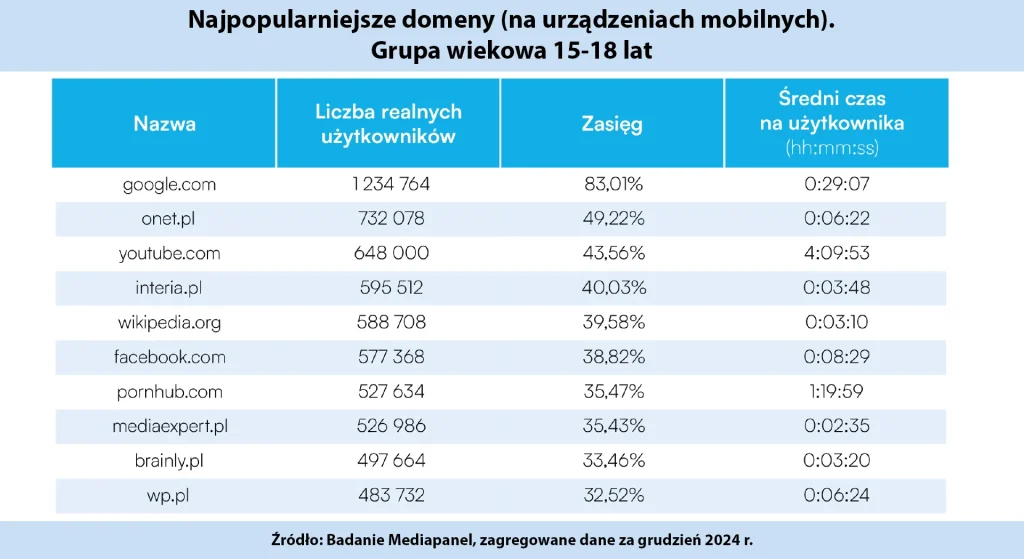
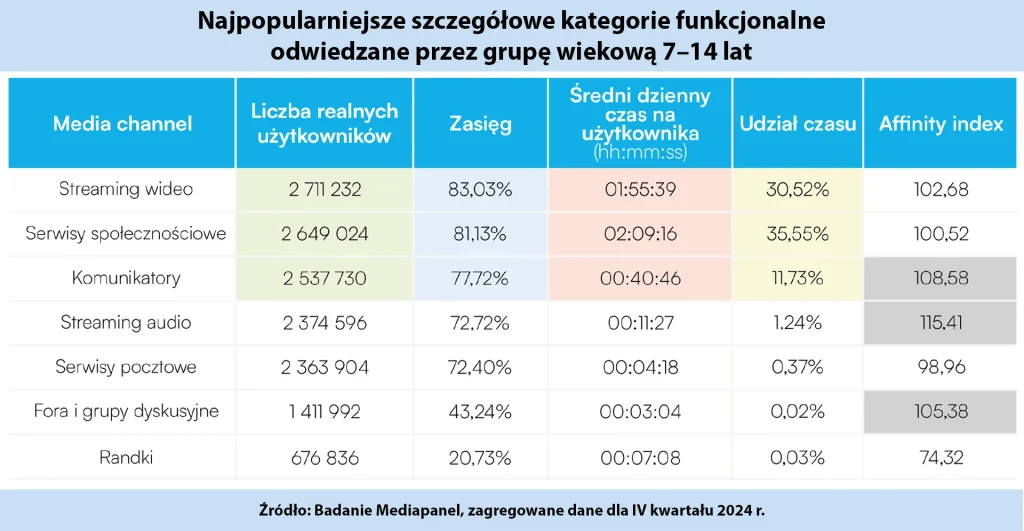
However, this is only a small snapshot of what the report reveals. Among the youngest users, sexual content ranks third among the most popular content categories. Unsurprisingly, education comes first, with platforms such as Wikipedia used by 94.8% of users aged 15–18 and 95.2% of those aged 7–14.
The second most popular category is culture and entertainment, led by video games and closely followed by music. YouTube and TikTok stand out across all age groups and devices as the biggest time sinks. In December 2024 alone, users spent an average of more than 24 hours on these platforms – 1 day, 12 hours, and 28 minutes on YouTube, and 1 day, 18 hours, and 17 minutes on TikTok. On mobile devices, time spent on TikTok exceeded YouTube by more than 10 hours.
The report also provides detailed data on the youngest users, offering a rare insight into how deeply they engage with specific apps. In terms of total users, YouTube leads the ranking with nearly 1.5 million active users under the age of 13 – defined as those who open the app for at least two minutes on four separate days per week.
However, when it comes to attention intensity, TikTok clearly dominates. Children open it on average 17 times a day (compared to 9 for YouTube) and spend around 2 hours and 11 minutes on the app daily – more than 2.5 days per month. Notably, one in three children aged 7–12 opens TikTok more than 20 times a day.
“This level of engagement is closely linked to how the platforms are designed. On YouTube, you choose a video, and then you’re shown a list of recommendations below, which encourages continued viewing if you have time. With TikTok, the effect is even stronger. Its ‘Reels’ mechanism automatically delivers the next video as soon as the previous one ends, which makes it highly addictive,” Prof. Miotk notes.

Simple steps, complex challenges
The worst possible takeaway from the report would be the idea that children should simply be cut off from the internet and smartphones, the researchers stress. First, that is unrealistic. These devices are now everywhere and play a central role in almost every area of life. Second, the digital world also has its positive side. During the pandemic, for many people it became a space for connection and support.
So the solution is not simply to impose restrictions on children – adults also need to examine their own habits. They may use different apps or spend less time on YouTube or TikTok, but their own digital lives are still measured in hours each day. Instead of focusing solely on limits, the discussion should shift toward responsibility and leading by example.
“If a child sees a parent endlessly scrolling while repeatedly saying that smartphones are harmful, the message becomes inconsistent. It’s like smoking while telling your child that smoking is bad,” Prof. Miotk emphasizes.

Act now. Before we lose control
As artificial intelligence – especially large language models powering today’s chatbots – continues to advance, an increasingly urgent question emerges: does technology still serve us, or have we already started serving it? This is one of the defining challenges of our time.
Still, there are concrete steps that can be taken now. The researchers behind the report outline more than a dozen recommendations. Some focus on regulation, including the implementation of the European Union’s strategy to more effectively combat child sexual abuse material, as well as EU Directive 2011/93/EU on combating the sexual abuse and sexual exploitation of children. They also call for integrating information, digital, and media literacy into education and training systems, along with teaching digital hygiene from an early age.
Other measures involve better enforcement of existing rules. For example, cooperation with mobile operators and internet service providers could help develop mechanisms to flag phone numbers used by children, improving safeguards for younger users.
Equally important are public awareness campaigns, digital education across all age groups, and clear standards for child protection in the digital space – particularly in advertising and marketing. The authors also call for continued research to monitor emerging threats.
“In China, there is a separate version of TikTok that, to some extent, serves government communication goals – otherwise it wouldn’t be allowed – but it also aims to promote more educational content. On the one hand, there are efforts to encourage more positive use of platforms; on the other, there is growing pressure to limit their harmful effects. The example of Rafał Brzoska showed that such pressure can be effective when someone has enough influence and resources. Finally, we need to raise awareness about harmful content and the range of risks the internet can pose – and how to respond to them. This is a key moment, as media education is now being introduced in schools,” Prof. Miotk concludes.
With each passing year, the challenges will grow – and become harder to address. Dazzled by technological breakthroughs, we risk missing the moment when control slips away. And the problems we fail to solve today may return tomorrow with even greater force.

The text was originally published in Polish on the Serwis Naukowy UW website on August 7, 2025.