

We humans are all members of the same species, yet we can be strikingly different from one another. We perceive the world differently and react to the same situations in entirely different ways. How we respond to the world around us comes down to personality. We don’t typically attribute human-like personality patterns to animals – yet behavioral ecologists agree that, much like us, animals display distinct and observable behavioral patterns, reflected in the varied ways they perceive and respond to the world around them.
A team of scientists from the Department of Hydrobiology and the Masurian Centre for Biodiversity and Education KUMAK at the Faculty of Biology, University of Warsaw, conducted an experimental study on tadpoles. The team set out to examine whether consistent behavioral patterns could be observed under specific conditions – and whether those patterns would persist after the tadpole transformed into a young frog. Do experiences acquired in youth last a lifetime? Can lived experience shape an individual’s development more powerfully than the information encoded in their genes? These questions apply just as much to us as they do to these small creatures. And that should come as no surprise.

What a tadpole learns…
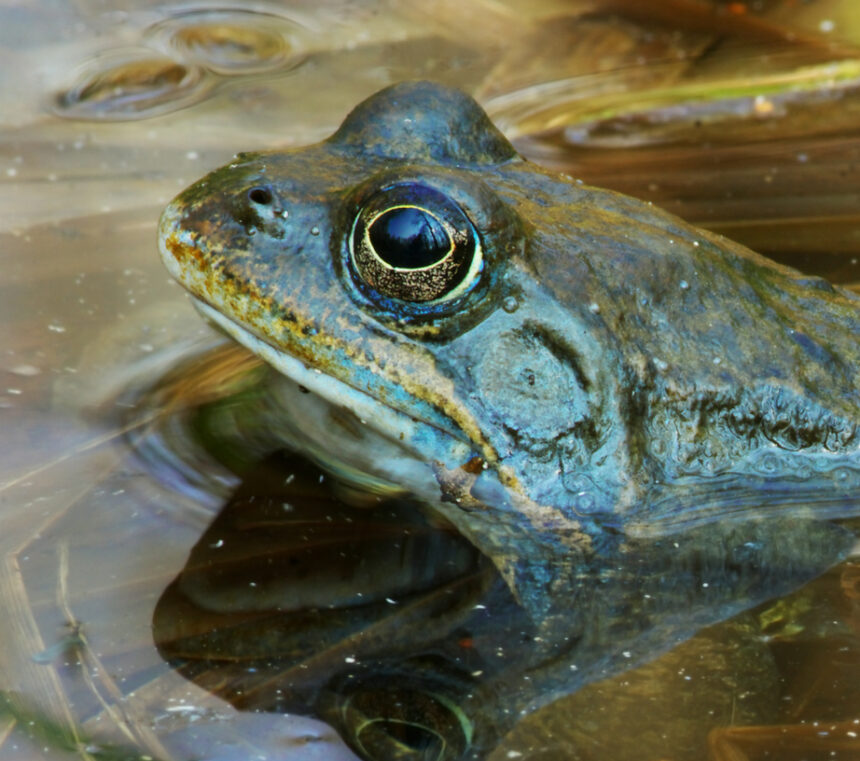
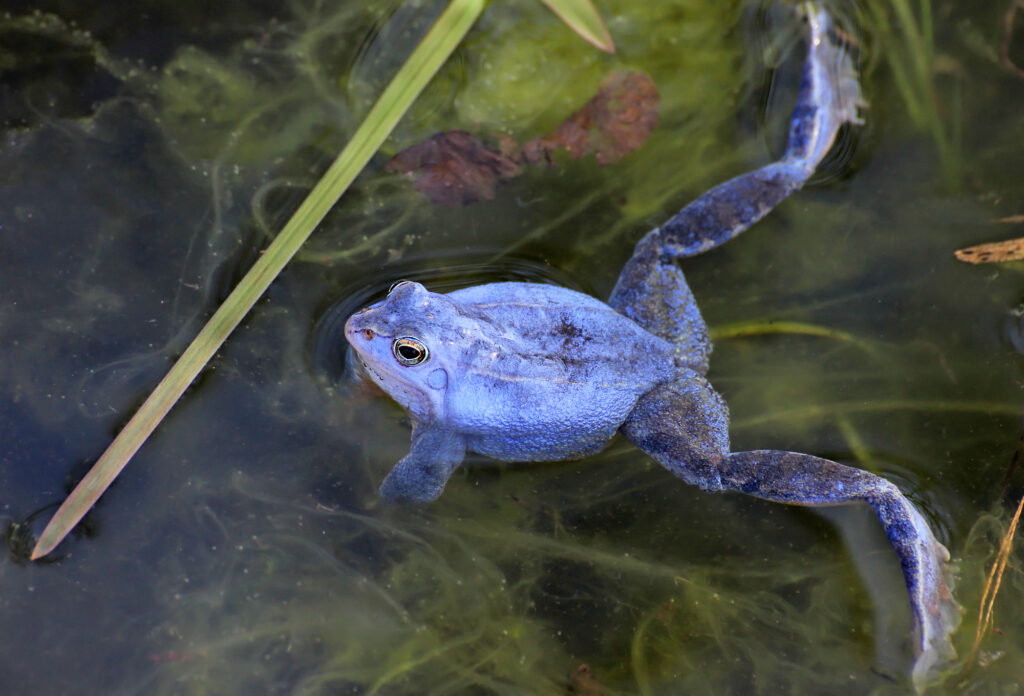
The experiment began in early spring 2019. The scientists caught five adult male and five adult female moor frogs (Rana arvalis) just as the amphibians were entering their breeding season. The individuals paired up, and – as is typical for this prolific species – soon produced abundant offspring. The spawn was transferred to the laboratory; the adult frogs were released back into the wild.
“Having well-known amphibian populations in the immediate vicinity of KUMAK Centre made it easier to monitor environmental conditions and kept the day-to-day fieldwork running smoothly. The tadpoles were temporarily kept outside, under conditions designed to be as close to natural as possible. After metamorphosis and the final experiments, the young frogs were quickly returned to their own habitat,” explains Anna Zaborowska of the Masurian Centre for Biodiversity and Education KUMAK.
So what did the core experiment actually look like? After hatching, the tadpoles were divided into control groups: the first would remain unaware of any lurking threats throughout the experiment, while the second was exposed to stimuli signaling various dangers associated with predator presence. The threat stimulus came in the form of the “scent” of predators – primarily dragonfly and beetle larvae – that had been present in the pond where the eggs were laid. Initially, these were chemical signals (kairomones dissolved in water – substances secreted by predators that serve as warning cues for tadpoles), but later in the study, the stimuli included the direct physical presence of a live predator.
Behavioral differences – the tadpoles’ personalities – were observed across eight “arenas”: specially prepared containers into which four “naïve” tadpoles (from the first control group) and four predator-aware tadpoles were introduced. Their activity was recorded on camera to capture differences in response. Environmental changes were introduced in three phases: the first in clean water, the second with kairomones added, and the third with a live predator present (alongside a control group exposed to neither chemical cues nor direct predator proximity).
The next key phase of observation came approximately two to three days after the tadpoles completed their metamorphosis into froglets. The scientists set up the “arenas” again – this time filled with soil – placing each young frog inside with a paper cup as shelter. They then timed how long each frog took to voluntarily leave the safety of its “bunker” through a small opening. That time became the measure of its “boldness.”
The choice of species was no accident, and conducting the experiment in the immediate vicinity of KUMAK allowed the team to attend not only to the welfare of the study subjects, but also to the methodological integrity of the research. Once the experiment concluded, all frogs were released at the same site where their parents had been caught less than half a year earlier.
“We chose the moor frog for this study because it is a species commonly found in the region – although recent years have not been kind to amphibians, and moor frog populations on the Masurian lakes are declining due to drought and the drying up of water bodies. It is an early-spring species, which means fieldwork can begin as soon as spring arrives. Its reproduction is explosive in nature – all individuals enter the breeding season simultaneously, and all the young, the tadpoles, undergo metamorphosis at roughly the same time. This allows us to monitor whether ‘our’ tadpoles, kept in semi-natural conditions, are developing at the same rate as other individuals of the species in the area,” Zaborowska explains.

…a frog forgets
The study tracked three core variables: how bold and how active the tadpoles were, and how bold they became as young frogs after metamorphosis. In total, the researchers analyzed footage of 49 individuals – those that successfully completed metamorphosis before the experiment concluded.
When it came to tadpole personality – boldness and activity levels – both proved highly responsive to changing conditions. Tadpoles exposed to a predator, for instance, spent more time in the open areas of the arena and froze in place when kairomones were introduced. Yet in no case could any of those traits be detected in the frogs those tadpoles became.
The main conclusion the scientists cautiously draw from the experiment is that behavioral differences – tadpole personality, in other words – function as a kind of adaptive mechanism: one that emerges at a specific developmental stage in response to threat, and then disappears at metamorphosis. Put simply, tadpoles acquire certain behavioral traits in response to their circumstances, and shed them once those circumstances no longer apply. Every tadpole facing a threat adopts some strategy, settling into a more or less motionless state – a consistency of behavior that was not observed in threat-free conditions, and that vanished entirely at metamorphosis. The tadpole’s experiences, it seems, left no trace on the frog.
This finding lends support to the Adaptive Decoupling Hypothesis – a concept that, while not originally concerned with personality traits specifically, but with species traits more broadly, proposes that metamorphosis serves as a mechanism for breaking the genetic and developmental links between traits. The transformation of a larval form into an adult that bears virtually no resemblance to it – a process found across a vast range of animal species – effectively runs two almost entirely separate developmental programs in a single organism, one after the other. The fact that tadpole personality traits do not carry over into the frog stage fits squarely within that framework.
One finding did catch the scientists off guard: body size had no effect on tadpole behavior. The team had expected larger tadpoles to take more risks, reasoning that their size would make it easier to escape the small invertebrate predators used in the experiment. That turned out not to be the case. Whether the tadpoles simply weren’t sufficiently “motivated,” or whether they had difficulty identifying the type of threat they faced, remains an open question.
A mirror in the pond
This kind of research inevitably raises a few questions. Should we even be using the word “personality” when talking about tadpoles – or should it always appear in quotation marks? Can observing the behavior of moor frog tadpoles actually tell us something about ourselves? And finally – does the development of behavioral traits follow the same rules in humans as it does in tadpoles?
Psychologist Samuel Gosling explored the extent to which animal personality could be described in terms of the Big Five, a psychological trait model that identifies five core dimensions of human personality: neuroticism, extraversion, openness to experience, agreeableness, and conscientiousness. Behavioral ecologists, however, have taken a different path. They define animal personality as consistent, measurable behavioral differences between individuals – without venturing into the internal emotional states or cognitive processes that might lie behind them. What this process shares with human personality development is a certain inevitability: the emergence of individuality. We tend to speak of the interaction between genes and environment, but development is far more than that. Genetic information, information passed from parents outside of genes, random processes, and finally an individual’s own experiences – all of these shape the way animals perceive and respond to their situation. And all of it unfolds over the course of each individual’s lifetime.
In that light, talking about tadpole personality doesn’t sound like an abstraction at all. The findings of this study suggest that in certain respects, humans and animals are not so different. Research centers are also increasingly working to bring this awareness to wider audiences.
“The Masurian Centre for Biodiversity and Education KUMAK has been operating for about a year in its current form – before that, it was a field station of the Faculty of Biology at the University of Warsaw. The Centre, as it has been for many years, serves as a research base, but its activities are now much broader. Staff from many UW faculties come here for workshops, seminars, and conferences, and we operate practically year-round. We monitor changes resulting from active nature conservation efforts – work carried out as part of a project focused on small-scale water retention and the deepening of drying ponds. The Centre currently runs extensive educational and outreach activities. We participate in local and national initiatives related to climate change prevention, biodiversity protection, and environmental education. On site, there is an exhibition dedicated to the nature of the Masurian Lakes region, highlighting the particular importance of small water body and wetland ecosystems. The educational exhibition is not just about exhibits – it also features aquariums and terrariums that serve an educational function while supporting local populations of endangered species, in cooperation with the Regional Directors for Environmental Protection. We are involved in projects related to nature conservation and climate change, including the EU project ‘EcoReady Masuria,’” the scientist explains.
Recognizing individual differences in needs and behavior can significantly improve the effectiveness of conservation efforts – consider bold and shy eels, or sea trout trying to push their way through a fish ladder at a dam. And if we allow ourselves to recognize that every animal lives its life – with whatever awareness is available to it – in its own unique way, that should help us change how we relate to them. It may even be one step toward redefining our relationship with nature, of which we are, after all, a part.

The text was originally published in Polish on the Serwis Naukowy UW website on July 11, 2025.