


Tanystropheus lived around 240 million years ago. It remains one of the great enigmas of the Triassic period. Although paleontologists have had access to complete skeletons of Tanystropheus for over a century, its lifestyle is still unclear. For decades, researchers have also debated the function of its extraordinarily elongated neck. Scientists from the Faculty of Biology at the University of Warsaw – Dr. Mateusz Tałanda and Adam Rytel, MSc – have joined this discussion.
Although Tanystropheus was not the only reptile to evolve a long neck, it stood out because of how this feature developed.
“Throughout evolution, we see strong selective pressure to elongate the neck. But Tanystropheus faced constraints similar to those seen in modern mammals,” says Dr. Tałanda.
What does that mean? With few exceptions, mammals have exactly seven cervical vertebrae – the bones that make up the neck. They can’t change that. Attempts to increase it during evolution tend to cause severe developmental problems, often resulting in death before birth. A similar limitation may have applied to Tanystropheus.
Adding more vertebrae was not an option
“They couldn’t change the number of cervical vertebrae, but they still had to lengthen the neck. Giraffes did this by elongating individual vertebrae. Tanystropheus did the same – but it also incorporated some vertebrae from the torso into the neck,” explains Dr. Tałanda.
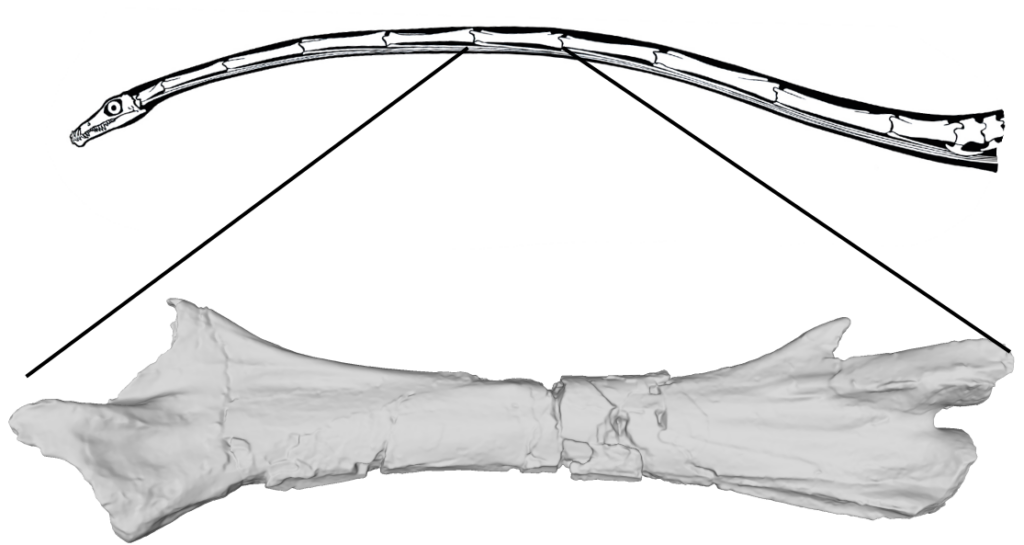
In other words, the extreme neck length in Tanystropheus resulted from a combination of two processes: the elongation of individual cervical vertebrae and the transformation – or functional reassignment – of some dorsal (back) vertebrae into the cervical region. Other reptiles typically evolve longer necks simply by increasing the number of cervical vertebrae. Tanystropheus, by contrast, stretched them to an extreme. This unique structural solution makes it difficult to find any modern equivalent.
Its distinctiveness becomes even clearer when compared with related reptiles. Research shows that although Tanystropheus and other tanystropheids shared a broadly similar arrangement of neck vertebrae, Tanystropheus underwent a significant expansion of the front part of the neck, leading to its maximum elongation.
“The vertebrae of Tanystropheus were extremely elongated. They resemble a long tube and are hollow inside. A hundred years ago, when researchers didn’t yet have complete skeletons, they mistook them for long bones. They were so altered that they no longer looked like vertebrae. Some even thought they were finger bones from a flying animal. Tanystropheus pushed its anatomy to the extreme – and we still don’t know why,” says Dr. Tałanda.

What was such a long neck for?
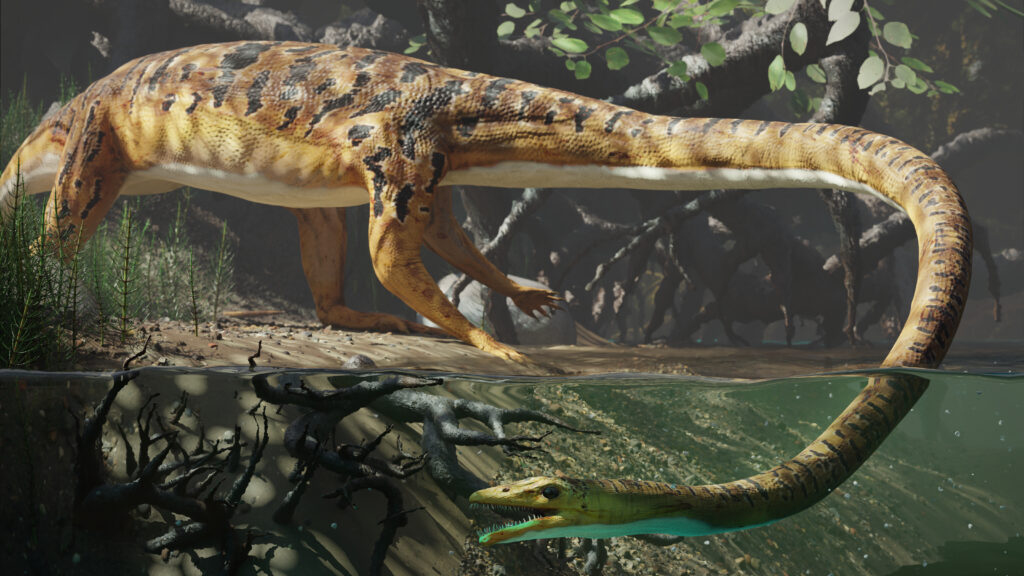
There are several hypotheses. The elongated neck may have served important adaptive functions, crucial for survival – perhaps aiding in hunting or other specialized behaviors. Fossilized remains of fish and cephalopods have been found near the abdominal regions of Tanystropheus specimens. However, this does not necessarily mean the animal was fully aquatic.
“Tanystropheus likely obtained its food from the water, but when you look at its limbs, you don’t see clear adaptations to an aquatic environment. That’s surprising,” Dr. Tałanda notes.
Because no modern animals have necks elongated to this extent – or in quite the same way – it is difficult to determine exactly how Tanystropheus functioned or why its vertebrae were modified so dramatically. Several interpretations have been proposed.
“One hypothesis suggests the animal could reach far using its neck like a fishing rod. Another proposes that it held its neck away from its body, making fish – which detect disturbances in the water – perceive the threat as more distant. A third idea is that Tanystropheus kept its head motionless in the water and ambushed fish. At this point, we can’t determine which is correct,” explains Dr. Tałanda.
Individual Tanystropheus fossils have been found in China, Switzerland, and Italy. In Poland, however, researchers have uncovered remains of some of the largest known individuals – reaching up to seven meters (about 23 feet) in length. Moreover, in Miedary (a village in southern Poland, in the Silesian region), where excavations are ongoing, bones belonging to multiple animals have been discovered in one location.
Why Tanystropheus seems to have favored the area of present-day Poland is yet another piece of the puzzle. For now, like much about this extraordinary reptile, it remains an open question.
The text was originally published in Polish on the Serwis Naukowy UW website on March 18, 2025.