

Centuries ago, such textiles adorned priests and rulers alike. Robes made from richly decorated fabrics were a clear sign of status and power. In a world where acquiring such garments far exceeded the financial means of most families, even a fleeting glance at them made it immediately clear who was who.
At present, these delicate materials either crumble to dust at the slightest touch or are carefully preserved under the watchful eye of conservators.
Just like cathedral builders, skilled craftsmen once devoted their entire lives to perfecting the art of dyeing. Producing chasubles or royal robes was a complex, multi-stage process. The place of origin, the techniques used, and often even the true colors of these works remain unknown to this day. When archaeologists or art historians seek answers, they must turn to a completely different field – analytical chemistry.
Thanks to this work, the past begins to reveal its layers. The stories told by historical textiles extend far beyond individual objects – they speak of continents, major historical transformations, and ultimately of shared cultural heritage.
Tracing the colors of history
When a sample of historical or archaeological fabric arrives at the Laboratory of Structural Research of the Faculty of Chemistry, University of Warsaw, the analytical team led by Prof. Magdalena Biesaga begins a long, multi-stage process. Before the material reveals its secrets, it must undergo a series of highly precise analyses.
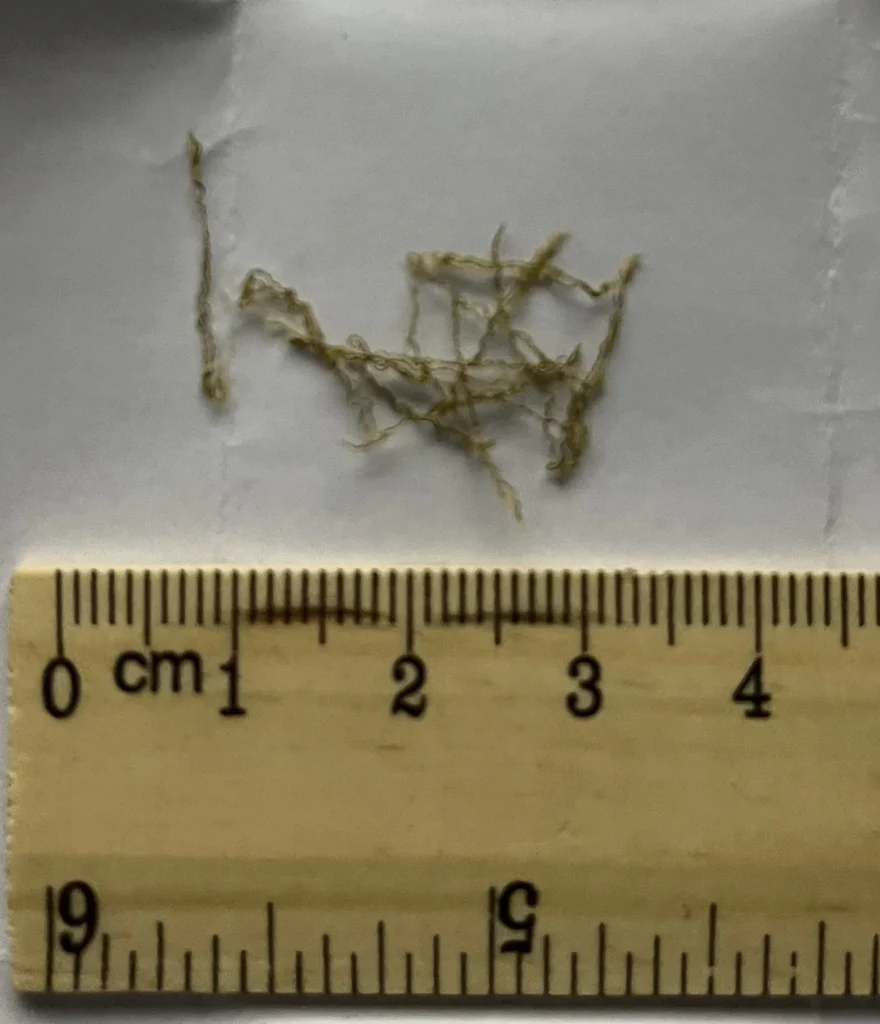
A sample is usually just a tiny fragment of a historic textile – for example, a chasuble, a tent, sometimes even slippers, dresses, waistcoats, or banners – weighing no more than 10 mg. At times, it is little more than a barely visible thread or fluff, bearing no resemblance to the splendor of the garments of which it was once a part.
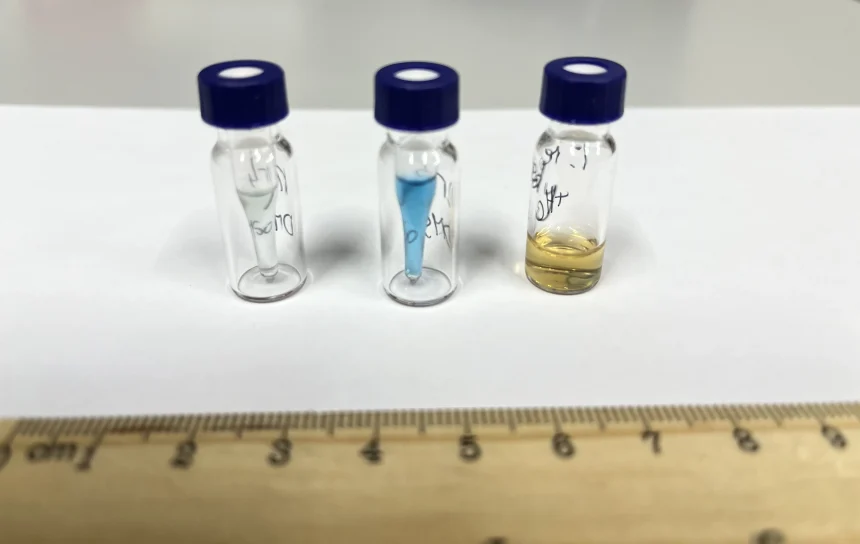
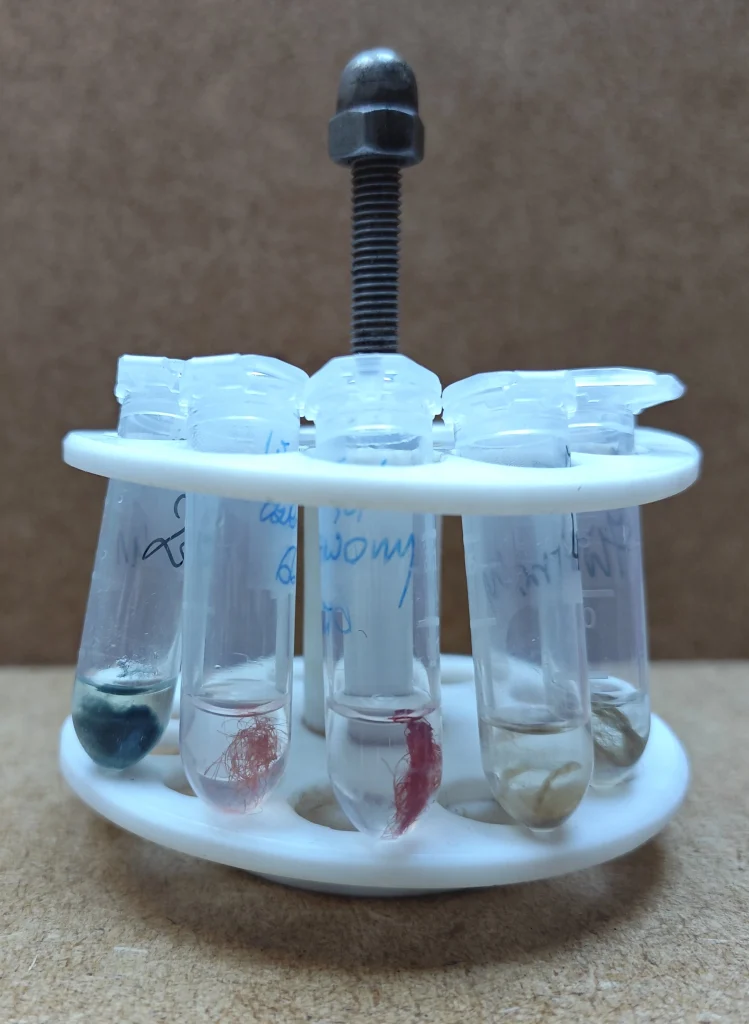
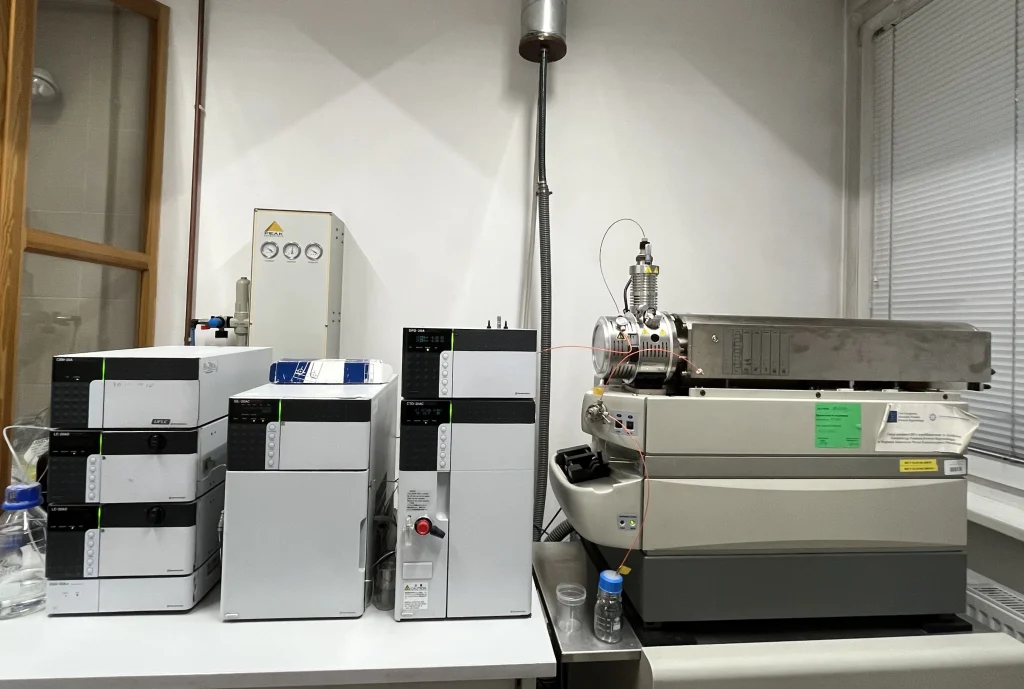
First, the chemists prepare the sample. The first stage involves separating the dye from the fabric; to do this, the fibres are treated with acid and heated. The acid solution is then evaporated to dryness, and the dry residue is dissolved – with the aid of ultrasound – in an aqueous methanol solution. The final stage is filtration, after which the scientists are left with a small vial containing a coloured solution. Although this analysis is destructive, only very small quantities of the sample are used. The sample prepared in this way is analysed using a high-performance liquid chromatograph coupled with a tandem mass spectrometer. This extremely precise instrument separates the mixture of dyes extracted from the fabric and identifies them as single chemical compounds.
Every color in a textile corresponds to a specific group of chemical compounds. It is important to distinguish between industrial dyeing carried out in specialized workshops and domestic dyeing. In household settings, people used plants grown in home gardens, while professional dyers working in manufactories relied on plants rich in coloring compounds, cultivated on a larger scale specifically for dye production.
Yellow dyes are most commonly associated with flavonoids, particularly flavones and flavonols, found in plants such as weld (Reseda luteola L.), dyer’s broom (Genista tinctoria L.) or young fustic (Rhus cotinus L.). Reds are associated with anthraquinones – compounds found in plants or insects. The main source of true red, that most symbolic of all colours are dyer’s madder (Rubia tinctorum L.) or Lady Bedstraw (Galium verum L.). In contrast to the large number of plants that provide red dyes, the number of red dyes of animal origin is very limited.. Colours ranging from red to purple were obtained from insects like Kermes Vermilio, Polish Cochineal (Porphyrophora polonica L.), Domestic cochineal (Dactylopius coccus), Lac insects – Kerria lacca Kerr. or marine molluscs eg. Hexaplex trunculus. Blue, on the other hand, comes from indigotine, extracted from plants such as Common Indigo (Indigofera tinctoria L.) and woad (Isatis tinctoria L. ). It should be noted that the final shades were often achieved by repeatedly dipping the threads into various dye baths to obtain the desired shade.
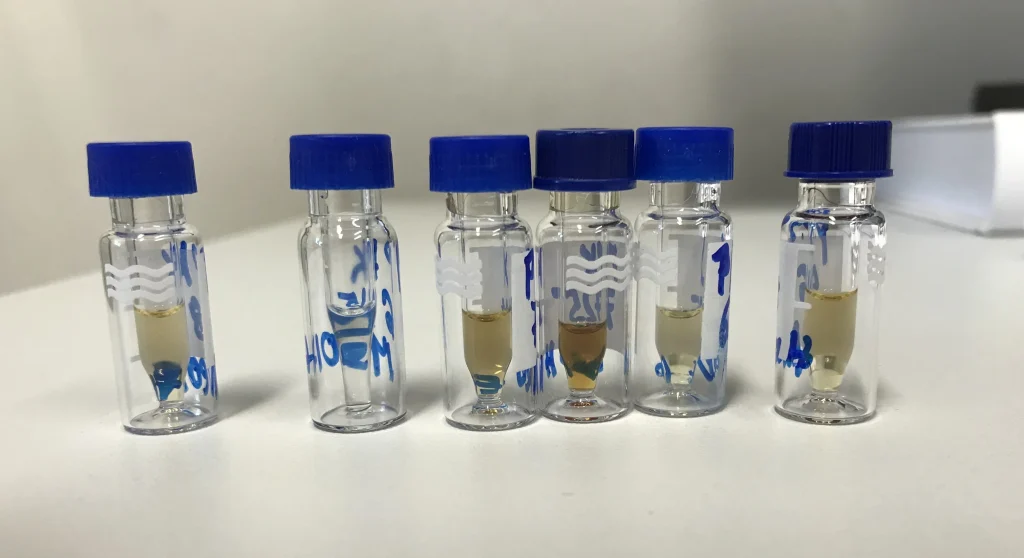
The challenge is that each of these dye groups contains dozens, sometimes hundreds of compounds. So how can one determine whether a particular yellow or red comes from a specific plant – or from an insect, or something entirely different?
Here, the experience of chemists becomes crucial. Over the years, they have built their own database of characteristic “markers”. As a result, when a mass spectrometer detects, for example, only kermesic acid, researchers can conclude that the dye originated from an insect feeding on oak trees – Kermes vermilio.
“As we were starting out, we built on a method already known in the literature. At that time, mass spectrometers were not yet widely used for this type of analysis. We began with an earlier sample-preparation method for dye analysis and then refined it to make it compatible with mass spectrometry. Around the late 1990s and early 2000s, papers on the application of liquid chromatography connected to mass spectrometry for dye detection began to appear, and that is roughly when we also started our research,” says Prof. Magdalena Biesaga from the Faculty of Chemistry at the University of Warsaw.
Years of experience also mean a growing awareness of what can go wrong. In a recently published paper, the team highlights the most common challenges and pitfalls in analyzing dyes in historical textiles – and how to avoid them.
One key issue is sample representativeness. As mentioned earlier, these objects are of immense historical value, so only tiny fragments can be taken for analysis – usually from already damaged areas, such as tears, or from sections where sampling does not affect the artefact’s integrity. These samples often come from the reverse side of the textile.
However, when a fabric has a more complex structure, matters become more complicated. Textiles are woven from two interlacing systems of threads: the warp (running lengthwise) and the weft (running crosswise). Each of these may have been dyed with different substances, which is why separate samples often need to be taken from both warp and weft in order to determine precisely which compound comes from which part.
This is also why close communication between analysts, archaeologists, art historians, and conservators is so essential. Any additional details regarding the fabric’s origin – where it was found, how it was stored, or what treatments it underwent – may affect the final result. Each specialist notices different aspects: what seems obvious to one may be missed by another. In reconstructing ancient dyeing processes, chemists effectively conduct an investigation together with researchers from entirely different fields. Only then can the story hidden in color truly be understood.
“Our work can feel like detective work. In our paper, we show very clearly how important it is not to ‘contaminate the crime scene’. The markers detected by the mass spectrometer are like fingerprints. To the naked eye, something may look yellow, but the spectrometer can reveal traces of red as well. Over time, fabrics fade and threads can acquire overlapping colors, but our method is sensitive enough to detect even very low concentrations. Still, if we find a red dye in a yellow thread, it does not mean the thread is orange – it may simply be that the red originates from the warp. And to determine that, you need the trained eye of a conservator, an art historian, or an archaeologist,” Prof. Biesaga explains.
How to repaint the past in different colors
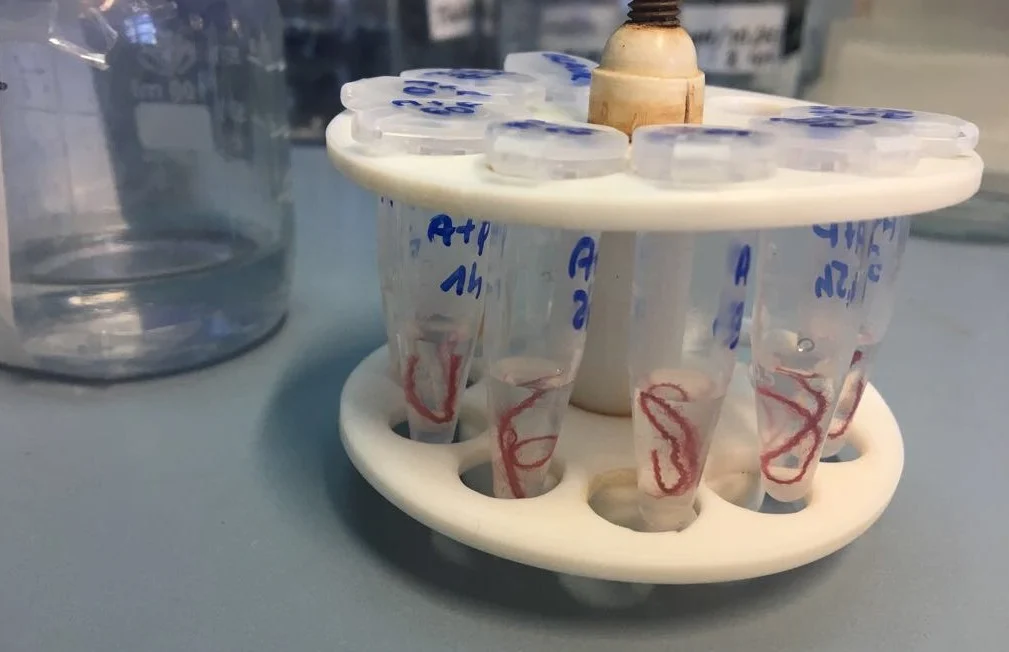
The research conducted by Prof. Magdalena Biesaga’s team not only reveals the original colors of historical textiles, but also allows their later histories to be traced. A chasuble – a long, richly decorated liturgical garment – which at first glance may appear woven from a single red thread, can in fact conceal traces of numerous alterations and repairs. Chemists are able to detect them even when they are completely invisible to the naked eye.
Such analyses are particularly valuable for cultures that left behind few written sources. In such cases, every textile becomes a precious piece of evidence – a technological, artistic, and sometimes symbolic document. As the ancient Greeks believed, truth and beauty are inseparably linked, and this idea finds a very concrete expression in the work of researchers at the University of Warsaw.
“Why do we do it? The simplest answer is: out of respect for beauty. And also, to understand how our ancestors lived and worked. Of course, in today’s world – with wars still ongoing – it can feel irrelevant. It may even seem that no one learns anything from history anymore. But our work can, for example, help archaeologists excavating in Africa understand how textiles were dyed, especially when there are no written records. We can also determine whether an object was repaired in modern times or whether it might be a forgery – that is what analytical chemistry is for,” notes the scientist.
The discovery of the Americas at the end of the 15th century brought not only new lands, but also a new shade of red. One of the major shifts in global trade was the replacement of Polish carmine scale (Porphyrophora polonica L.) with Mexican cochineal (Dactylopius coccus) – an insect producing an intense, durable red dye. It fed on prickly pear cacti and was far easier to harvest than the Polish species, whose larvae had to be laboriously extracted from the roots of the perennial knawel.
To this day, cochineal remains a widely used source of red dye, including in the food industry, while Polish carmine scale has almost completely disappeared from the landscape. Yet traces of this global shift still survive in historical textiles. By identifying characteristic molecular markers, chemists can determine which insect a dye came from – and thus provide historians with evidence of the scale and reach of this trade revolution.
The team’s expertise reaches far beyond the laboratory. Their findings are used by archaeologists working in the Egyptian necropolis of Saqqara and by specialists reconstructing historical attire, including the royal garments from Faras, recently exhibited at the Louvre and the Bode Museum in Berlin.
“Thanks to this kind of research, we can show how, in the 16th century – and almost entirely by the 17th – Polish carmine scale was replaced by Mexican cochineal. At the time, Poland lost its position as a global exporter of red dye, and there were even naval conflicts over ships carrying cochineal from the Americas,” explains the chemist.
“A good example of our collaboration with archaeologists is the project Creations of Power: Depicting the Royal Family and Clergy in Medieval Nubia – a reconstruction of garments from Faras, to which we also contributed. We analyzed textiles from Sudan, and the resulting reconstructions were based on our findings. Designers from the School of Form at SWPS University recreated dyes using exactly the same plants identified in the archaeological material. Even though our role was ultimately quite small, it was very rewarding to see it applied – especially since the reconstructions drew both on frescoes and on our research,” Prof. Biesaga adds.
The history of dyes is more than a story about color. It is a window into the world of past civilizations – revealing not only the technical skill of artisans, but also systems of power, religious symbolism, and global economic networks. Embedded in color are the lives of people, societies, and entire eras. At the same time, it invites reflection on how much our own relationship with clothing and color has changed in just a few decades.
Nothing is black and white
In the 1990s, a term emerged that has since become a symbol of one of the most environmentally damaging practices of our time – fast fashion. It refers to a model of clothing production that is rapid, mass-scale, and extremely cheap – but comes at a huge environmental cost. In 2024 alone, more than 4.5 billion parcels worth under €150 were shipped from China to European Union countries.
This way of thinking about clothing – as disposable goods – stands in stark contrast to the past. In earlier times, every colorful garment, woven from carefully dyed threads, was a marker of status and a valuable possession passed down through generations. Yet it would be a mistake to idealize that world: people in the past were not necessarily more environmentally conscious; they simply lived in a reality where every object had a clear cost and value.
“There is real respect for those old dyers – they were essentially brilliant chemists. But we should also remember that, by today’s standards, people back then were relatively ‘eco-friendly’ in how they treated clothing. colorful garments were a luxury for the wealthy, but if you had a dyed dress, you didn’t throw it away. You’d alter it for a maid, the maid would remake it for herself, and when it was no longer usable, it might be passed on to a rural family. These textiles could last for decades. Colored fabrics were a sign of wealth and power, and their owners were not thinking about environmental protection – but honestly, neither are we.”
“Just look at clothing today: something might cost 100 zł at first, then the same item drops to 5 zł, and still nobody wants it. Sometimes clothes bought for a single outfit never even make it to the wash – they go straight into the bin. That didn’t happen back then. Historical records show that well-preserved chasubles, for example, were passed from one bishop to another, and a deceased cleric might even be buried in a patched, reused vestment,” the chemist says.
Although historical dyers impress with their skill and precision, they can hardly be seen as environmental role models. Yes, we can learn from their respect for materials – from the way textiles were valued and used over generations rather than seasons. But when we look at how raw materials were obtained, it becomes clear that environmental costs were largely ignored. The history of dyeing shows that we are not so different from our ancestors when it comes to the extractive use of nature.
“One garment required around 15,000 sea snails of the Murex genus to produce Tyrian purple dye – to the point where the species was pushed to the brink of extinction. In 1464, Pope Paul II even issued a decree ordering that vestments be dyed with kermes instead of purple, simply because there were no snails left.”
“When it comes to cochineal, it took around 140,000 insects to produce just one kilogram of dye. Dyeing silk with Polish carmine scale required roughly 6–9 pounds of insects per pound of silk; kermes up to 2.5 pounds per pound of silk; and Kerria lacca around 3.3 kilograms per kilogram of silk – roughly three times as much. It clearly shows just how enormous these quantities were, how extractive the system was – and, on the other hand, how many insects had to be collected.”
“Just 350 dried Polish carmine scale insects make one gram of dye, and only 20–30 larvae could be found in the roots of a single plant – though, of course, not every plant contained them,” Prof. Biesaga explains.
The beauty of textiles dyed in deep purples and reds can still captivate us – but it always came at a cost. The history of dyeing, like cultural history more broadly, is far from straightforward: it is a story of skill and ingenuity, but also of resource extraction and social inequality. Today, we can admire the craft of historical dyeing from a distance – and with greater awareness. Thanks to the work of chemists at the University of Warsaw, we are uncovering where the colors of the past truly came from. And with them, knowledge that allows us to look at our heritage more closely – and sometimes more critically.
The text was originally published in Polish on the Serwis Naukowy UW website on August 8, 2025.