

Admiral Themistocles turned the tide of the Greco-Persian War at the Battle of Salamis in 480 BCE by taking advantage of local wind patterns. Heavy rain and deep mud helped decide the Battle of Agincourt – one of the most pivotal battles in English history – giving the English the upper hand despite being heavily outnumbered by the French. Napoleon’s army was weakened by intense heat on its march to Moscow and ultimately crushed by winter. Later, rasputitsa – the season of muddy roads – followed by temperatures plunging nearly 40 degrees below freezing, became one of the key factors that halted Hitler’s armies advancing on Moscow and Stalingrad.* Time and again, climate and weather have altered the course of history.
Historians have long debated what caused the crisis that engulfed the Eastern Roman Empire in the seventh century CE. In recent years, many scholars have argued that this turbulent period began as early as the sixth century and was driven not only by political and economic pressures but also by nonhuman forces such as climate change and epidemics. But recent archaeological research challenges this view, offering a different perspective on the fate of the empire.
What sparked the crisis?
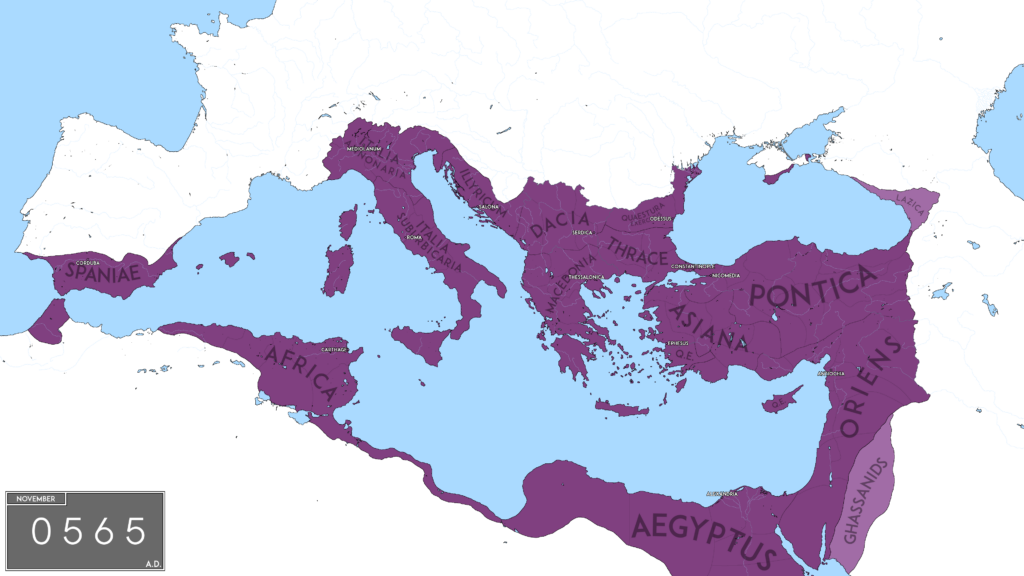
The Eastern Roman Empire was established in the fourth century CE, when Emperor Theodosius I permanently divided the Roman Empire into eastern and western halves. It encompassed the Balkan Peninsula, Asia Minor, Syria, Palaestina, Egypt, and Cyrenaica, among other regions. The empire endured until 1453, when the Ottoman Turks captured its capital, Constantinople.
The seventh century CE marked a period of profound crisis in the empire’s history. This was partly the result of the prolonged war between the Eastern Roman Empire and the Sasanian Persian Empire (602–628), which left both powers severely weakened. When Arab forces launched their attacks soon afterward, neither of the old empires was in a position to mount an effective defense. As a consequence, the Sasanian Empire collapsed, while the Eastern Romans lost vast territories, significantly diminishing their standing on the international stage, transforming into the entity known as the Byzantine Empire.
Some scholars have argued that the roots of this crisis can be traced back to the sixth century CE, pointing to environmental and epidemiological factors such as the Late Antique Little Ice Age and the Justinianic Plague. However, recent archaeological research by Haggai Olshanetsky of the University of Warsaw and Lev Cosijns of the University of Oxford challenges this view.
Drawing on archaeological evidence, the researchers argue that the Eastern Roman Empire did not experience significant demographic or economic decline in the sixth century. Instead, these downturns only became apparent in the following century, suggesting that the mid-sixth-century climatic fluctuations were not the primary cause of the later crisis. They also reassess the impact of the Justinianic Plague, proposing that its effects in this region were relatively limited in both scope and duration.
An ice age that wasn’t so cold
The climatic shifts that some researchers believe contributed to the Eastern Roman Empire’s decline are known as the Late Antique Little Ice Age (LALIA). This was a temporary period of cooling that affected much of the Northern Hemisphere, likely triggered by a series of volcanic eruptions beginning in 536 CE and continuing over the following decade.
However, the drop in temperature was far from uniform. While regions at higher latitudes cooled by as much as 2°C, the territories of the Eastern Roman Empire experienced a much milder decline of around 0.5 to 1°C. In its southernmost provinces – Egypt and Judea/Palaestina – the decrease was even smaller, averaging only about 0.25°C.
The researchers therefore argue that these climatic shifts were relatively moderate, at least from the perspective of the empire’s inhabitants. Just as importantly, their timing does not coincide with the empire’s later crisis: the cooling period preceded it by at least seventy years.
Olshanetsky and Cosijns also revisit the role of the so-called Justinianic Plague in the empire’s decline. Named after Emperor Justinian, during whose reign it first appeared (541–544 CE), the epidemic is believed to have recurred periodically over the next two centuries.
Yet recent findings suggest that its impact may have been overstated. There is little firm evidence that the plague caused widespread demographic collapse in the Eastern Roman Empire. Moreover, it remains uncertain whether all the later outbreaks were even caused by the same disease.
What can shipwrecks tell us about the past?
As Olshanetsky and Cosijns point out, earlier studies linking the crisis of the Eastern Roman Empire to climate change and epidemics tended to overlook a key source of evidence – archaeology. And there is plenty of it.
The researchers drew on both micro- and macro-scale archaeological data. At the micro level, they examined evidence from the northwestern Negev Desert as well as areas around the ancient cities of Jerusalem and Scythopolis in Judea/Palaestina. These local findings were then placed in a broader context using macro-scale studies of the Mediterranean basin, incorporating material from Israel, Egypt, Jordan, Turkey, Tunisia, Greece and Cyprus.
As part of this wider analysis, Olshanetsky and Cosijns also made use of shipwreck databases documenting vessels that sank in the Mediterranean during antiquity. These records typically include the location of each wreck, its approximate date, and the type of cargo it carried.
Although exact sinking dates are often hard to establish, approximate timeframes are usually reliable. Shipwrecks can tell us a great deal about the scale of maritime trade. Simply put, the more shipwrecks dated to a given period, the stronger the evidence for intensive trading activity at that time.
What they found challenges earlier assumptions. There is no sign of a collapse in Mediterranean trade during the sixth century CE. On the contrary, a quantitative analysis of shipwreck data suggests that trade networks remained stable. In the eastern Mediterranean in particular, maritime activity appears to have been flourishing – reaching a peak in the late fifth century and remaining strong into the early seventh.
The real downturn came only later, in the wake of the war of 602–628 and the Arab conquests that began in 636.

The timing doesn’t add up
“It appears that the Roman Empire entered the seventh century at the height of its power, population, and economic output. However, a series of miscalculations, combined with defeat at the hands of their Persian-Sasanian rivals, led to a broader regional collapse – weakening both empires and paving the way for the expansion of Islam,” notes Haggai Olshanetsky.
These findings directly challenge the view that the Eastern Roman Empire was already in crisis in the sixth century CE, or that climate change and epidemic were the primary drivers of its decline. Instead, the evidence suggests that the real demographic and economic collapse did not occur until the following century.
Reflecting on the idea that climate shaped the empire’s fate, Olshanetsky also points to a broader tendency – both in historiography and in public debate – to draw parallels between today’s climate crisis and temporary environmental changes in the distant past. Such comparisons, he argues, can be misleading and may downplay the seriousness of the situation we face today.
“Over the past 5,000 years, humans have never experienced climate changes as severe and rapid as those occurring now. The current shifts go beyond natural variability, are driven by human activity, and require urgent action,” Olshanetsky emphasizes.
* Laura Lee offers these and many other examples in her book Blame It on the Rain: How the Weather Has Changed History – Fascinating Stories of World War II, Epic Battles, and Great Leaders
The text was originally published in Polish on the Serwis Naukowy UW website on April 18, 2025.