

Life on Earth has existed for nearly 4 billion years, although the exact moment of its origin depends on how it is defined – whether by the first RNA molecules, simple organic compounds, or even self-forming carbon structures. What we do know for certain is that life began in water. It was in the oceans, surrounding ancient continents with shapes completely different from today’s, that the earliest life first flourished.
If we could travel back in time and stand in what is now Poland during the Middle Devonian, about 395 million years ago, the landscape would be unrecognizable. It is hard to imagine that where the city of Kielce stands today – about 170 kilometers south of Warsaw – there was once a shallow tropical sea with a coral reef.
Traces of this deep past are still preserved in rocks – a kind of chronicle of Earth written in stone. Unlike archaeology, geology and paleontology rarely focus on single, isolated finds from specific moments in time; instead, they reconstruct stories that unfold over hundreds of thousands or even millions of years. These disciplines allow us to peer into ancient oceans, for example through studies such as the recent reconstruction of the coral reef ecosystem at Wee Jasper. This exceptional fossil record sheds new light not only on Earth’s distant past, but also on today’s environmental challenges. What exactly did scientists discover – and why does it matter today?

More than just a discovery
Wee Jasper, in New South Wales, about 50 kilometers northwest of Canberra, Australia’s capital, has long attracted the attention of geologists. As early as the 19th century, Devonian rock formations along the shores of Lake Burrinjuck were already being described there. Fossilized fish had been known for a long time, but the reef itself – and especially the corals – largely escaped detailed scientific attention.
A team led by Prof. Mikołaj Zapalski from the Faculty of Geology at the University of Warsaw set out to fill this gap.
“The beds we examined was already known – it had simply been labeled the ‘coral beds,’ and that was it. Corals ‘suffer’ from a kind of ‘curse’: they often occur in huge numbers, so many field paleontologists tend to overlook them in search of something rarer or more spectacular. Yet corals preserve extremely valuable information about the environments in which they lived – and this is often missed. We were the first to put this environment together as a whole. This is the first study that does not focus only on selected elements, but presents the entire ecosystem,” says Prof. Mikołaj Zapalski.
In this case, the significance does not lie in the existence of the reef itself – which was already known – but in its comprehensive analysis and description, which offered an entirely new perspective.
The team describes Wee Jasper as one of the most complete known Paleozoic reefs. The Paleozoic Era spans roughly 540 to 250 million years ago and includes the Devonian Period, about 395 million years ago – a time when one of the first large coral reefs flourished and marine life diversified rapidly.
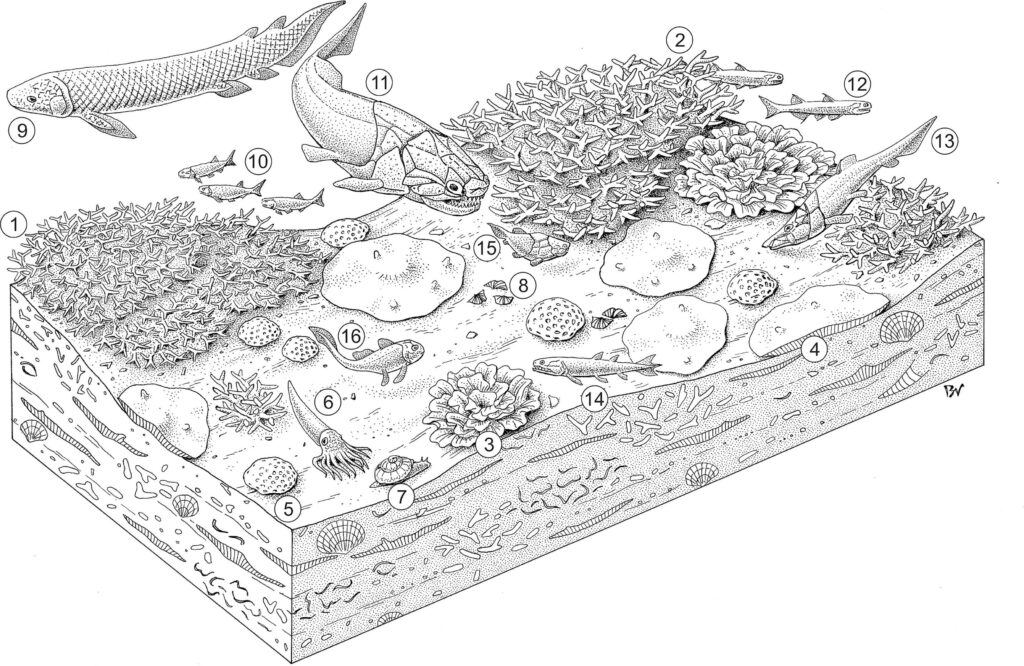
The ecosystem preserved in the Australian rocks is exceptionally complete: scientists reconstructed the fauna of a fragment of ocean that probably existed for tens of thousands of years and traced how it changed over time. Such a reconstruction was only possible thanks to unusually favorable conditions – which, as it turns out, emerged partly by chance.
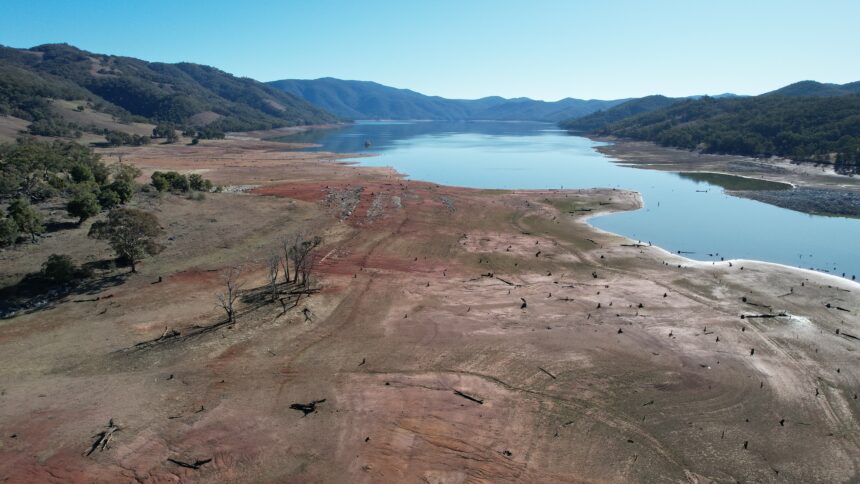
“Finding this bed was surprisingly easy; we didn’t really have to search for it. We first arrived there in 2022, and what helped us a lot was a major flood. As part of preparations for the flood wave coming from the upper watershed, water was released from the retention reservoir. As a result, the layers we studied were no longer covered by waist-high grass. The water level dropped by about two meters, exposing several dozen meters of bare rock that had previously been underwater, allowing us to examine it in great detail,” explains the geologist.
Underwater life laid bare
What does it actually mean for a reef to be “complete”? The comparison that may first come to mind is Pompeii – but scientists stress that this analogy is misleading. The completeness of a reef refers to something very different than a frozen moment in time.
“The first association that came to my mind – although I must immediately emphasize that it is completely inaccurate – was Pompeii. There we have an entire preserved world: people, houses, a specific moment in time. In the case of our reef, the equivalent would be the coral skeletons that make up the environment, but the crucial difference is that Pompeii is like a snapshot – a frozen instant. Meanwhile, the reef is an averaged record covering not one day, but at least several thousand years, and probably even several tens of thousands of years. If we were to translate this into archaeology, it would be like trying to create one coherent story from a 1950s Palace of Culture, skyscrapers from the 2000s, and a medieval peasant carrying a sack of groats. Our reconstruction of the reef can be compared to an illustration in a children’s book – a forest populated by a wolf, a deer, a badger, a squirrel, and several other animals. We know all of them live there, but the chance of seeing them all at the same moment is rather slim,” explains Prof. Zapalski.
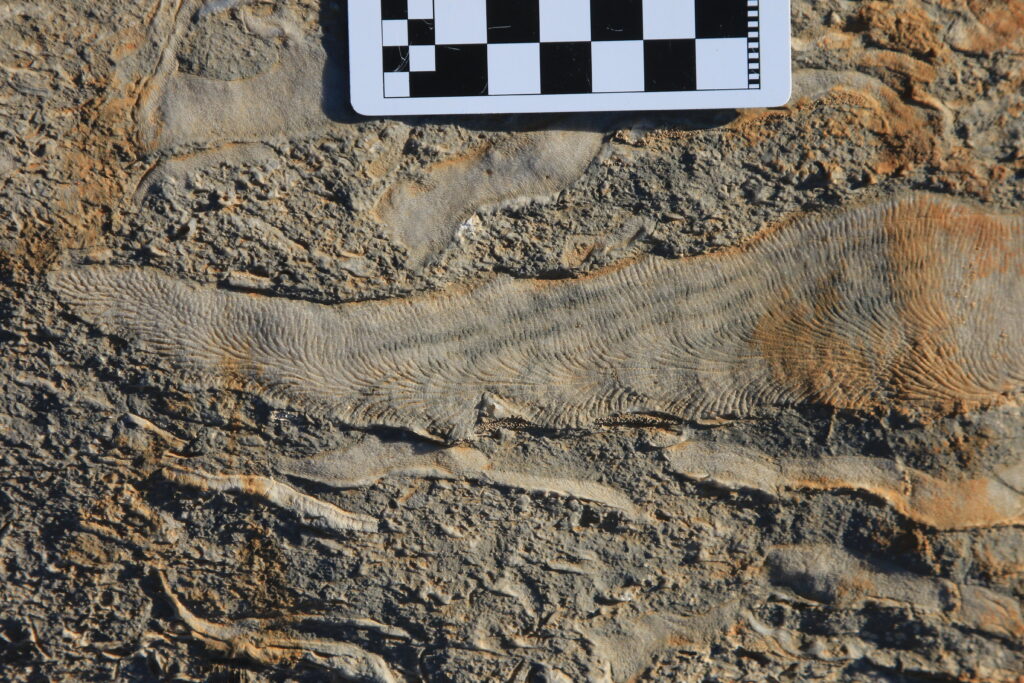
The completeness of the Wee Jasper reef rests on several key features. First, both coral and fish skeletons that lived side by side in the same environment were preserved in one place. This is remarkable in itself, as fossilized fish are extremely rare in reef deposits. It allowed scientists to reconstruct a full ecosystem model from hundreds of millions of years ago, showing how species coexisted – and sometimes competed.
Second – and perhaps even more importantly – the reef preserves evidence of widespread photosymbiotic corals, organisms that live in symbiosis with algae known as zooxanthellae. This relationship was, and still is, crucial: it is thanks to these algae that modern corals grow rapidly and build extensive reef structures.
Research shows that so-called mesophotic reefs – found at intermediate depths where light is limited – are dominated by flat coral forms. They thrive precisely thanks to the support of algae. Similar flat corals were previously described by Prof. Zapalski and Prof. Błażej Berkowski (from Adam Mickiewicz University in Poznań) at a single Silurian ecosystem in Sweden, dating back about 430 million years. The discovery of comparable forms at Wee Jasper suggests that algal symbiosis was already widespread in the Devonian, and that reef-building mechanisms similar to those seen today were established in shallow marine environments long before.
Reefs stretching almost to Warsaw!
What is particularly surprising is not only that symbiosis with algae already existed during the Devonian, but also how widespread it was. Discoveries from Wee Jasper – together with earlier finds from Gotland, the Świętokrzyskie Mountains, and Morocco – show that corals with similar structures were distributed across vast regions of the continents at that time.
“Our paper demonstrates that reef-building corals had an extraordinarily wide distribution during the Devonian. Most likely, it was thanks to symbiosis with algae that they were able to create such extensive reef structures. At that time, coral reefs reached their greatest extent in Earth’s history, stretching roughly between 45° south and 50° north latitude. It would be as if modern reefs extended almost as far north as Warsaw today,” says the scientist.
A lesson from hundreds of millions of years ago
Around 372 million years ago, near the end of the Devonian Period, one of the most severe ecological crises in Earth’s history unfolded. Nearly all coral reefs disappeared. Although this extinction event is less well known than the demise of the dinosaurs and smaller in scale than the end-Permian mass extinction, it is still counted among the “Big Five” mass extinctions.
This crisis is precisely what makes research on the Wee Jasper reef so important from a modern perspective. By studying it, scientists can better understand reef structure and functioning before the crisis, and, as a consequence, what led to the collapse of ancient reef systems – and finally, what parallels may exist with today’s climate change.
“The causes were very complex, but our earlier research suggests that a rapid rise in ocean surface temperatures played a key role. Isotope analyses allow us to reconstruct these values – and we know that tropical ocean temperatures exceeded 32°C. Today, this is considered the absolute survival limit for corals living in symbiosis with algae,” explains Prof. Zapalski.
Today, in many parts of the world – including the Red Sea, the Great Barrier Reef, and the Caribbean – sea temperatures already exceed 30–31°C, while marine heatwaves are becoming longer and more frequent. Rising temperatures strongly disrupt the symbiosis between corals and algae, causing corals to lose their ability to build reefs.
This is why reconstructing the Wee Jasper reef environment is so valuable. It not only expands our understanding of ecosystems from hundreds of millions of years ago, but also provides a reference point for modern coral reefs by showing how they functioned before major climatic disruptions. The Wee Jasper layers are several dozen million years older than the deposits linked directly to the Late Devonian extinction. They show that corals’ dependence on algae already played a crucial role in reef-building – and also reveal how sensitive these systems were to temperature change.
Even though modern science has far more advanced tools for studying climate, we still do not know exactly how rapidly changes unfolded in deep time. Fossil-based reconstructions therefore always represent averages – but they can still provide valuable insight, especially when experts from different fields work together.
“We hope that by demonstrating clear similarities between fossil reefs and modern ones, we will encourage collaboration with biologists. Joint research may allow us to reconstruct more precisely the development of reef ecosystems before extinction and the mechanisms behind the extinction itself. This, in turn, will help us better predict what may await modern reefs – how similar these processes are, and how they differ. The study of the past can become a kind of forecast – or at least a guide for those working to protect today’s reefs,” adds the scientist.
Although discovering a true “geological Pompeii” remains more of a dream than a realistic prospect, the past can still speak to us with surprising clarity.
Polish scientists are continuing their research at Wee Jasper this year, analyzing a colony of exceptionally sensitive corals. Their growth disturbances – much like tree rings – may help answer questions that remain open: how rapidly did sea temperatures rise during the Devonian, how long did the ecological crisis last, and whether there were warning signs before the mass coral die-off.
Studying the Wee Jasper fossils may help define the environmental conditions required for reef development, making it possible to better interpret younger fossil records directly linked to the Late Devonian extinction.
Understanding these processes may have profound practical significance today – acting as a barometer of what could happen in modern oceans. Perhaps millions of years of geological history still hold knowledge that can help protect the reefs of the future.

The text was originally published in Polish on the Serwis Naukowy UW website on July 15, 2025.