


At school, we learned (in simplified terms) that all of an organism’s genetic information stored in DNA is contained in chromosomes. However, there is a group of genetic elements that exist independently of them. Most often, they take the form of circular DNA molecules equipped with their own replication systems – they can multiply. These molecules, called plasmids, play an important role in the transfer of adaptive genes between microorganisms. This is particularly important for bacteria, as such genes allow cells to better adapt to changing environmental conditions and survive stressful situations. Plasmids vary greatly in size, structure, and in their mechanisms of replication and transfer. Their mobility means they can be introduced into different hosts. Once there, they often undergo genetic rearrangements that shape their specific features.
Bacterial “Cronus”
A team from the Faculty of Biology at the University of Warsaw, led by Prof. Dariusz Bartosik*, studies bacterial plasmids. The scientists have identified a special group of plasmids – so-called virulence plasmids – with unique properties. They are found exclusively in one group of bacteria: in all species of opportunistic bacteria of the genus Cronobacter. The name comes from the mythological devourer of children – Cronus. Why? Infection caused by bacteria of the genus Cronobacter is characterized by high mortality when it affects young children. Infected infants may develop blood poisoning, meningitis, or necrotizing enterocolitis.
However, the risk of infection is low, as these microorganisms are subject to food safety monitoring. Cronobacter bacteria can survive for a very long time in dry environments, such as powdered infant formula. That is why manufacturers of milk substitutes must comply with strict production standards and test their finished products for the presence of these bacteria.
The pathogenic properties of Cronobacter bacteria are largely due to the presence of virulence plasmids.
“Interestingly, research indicates that virulence plasmids have accompanied Cronobacter species since the beginning of the evolutionary history of this entire taxonomic genus. This makes them a unique model among plasmids. They are extremely helpful in studying the mechanisms that lead to their gradual domestication within bacterial cells. As a result of this process, a mobile genetic element can be transformed into a genome component that is important for bacteria and, together with the chromosome, becomes subject to common genetic regulation during the cell cycle,” explains Prof. Dariusz Bartosik.
Questions that remain
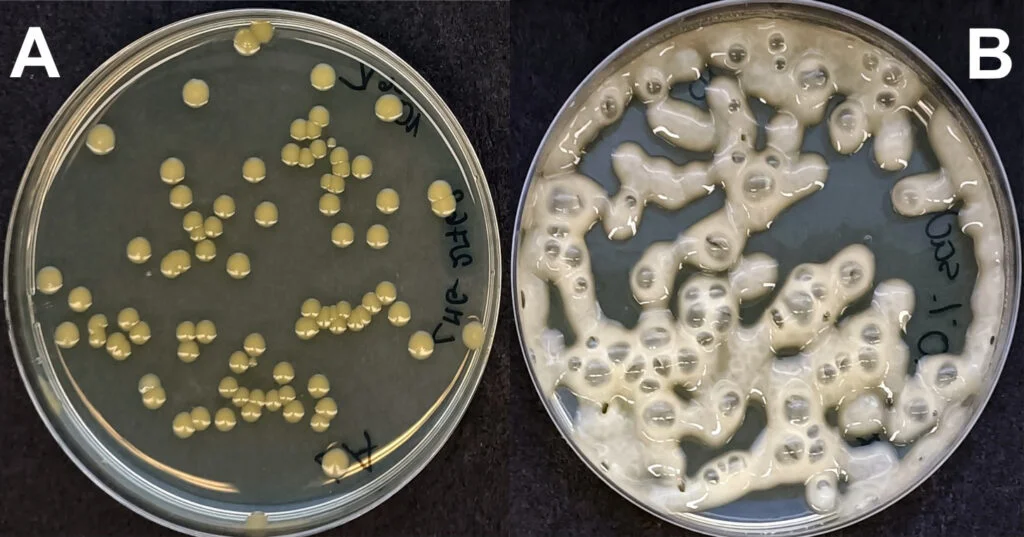
The team from the Faculty of Biology at the University of Warsaw faces many important questions, including the impact of virulence plasmids on the properties of their hosts and the biological role of the portion of plasmid genes that have remained unchanged for millions of years over the course of evolution. These genes may be involved in such crucial processes as biofilm formation – a biological structure composed of bacteria and the substances they produce – the production and extracellular secretion of polysaccharides, and adaptation to stressful conditions.
A challenge for many disciplines
Today, it is rare for a single field of science to be able to tackle new (and long-standing) issues and challenges; scientists from several areas of expertise are usually involved in solving the mysteries of the world around us, using a wide range of tools and methods. Prof. Bartosik’s team’s research will include microbiological, genomic, genetic, and bioinformatic analyses and will provide answers to questions about the evolution of virulence plasmids – why they have not been lost by cells over such a long period of time; what mechanisms led to their domestication and exclusive association with the genus Cronobacter; and finally, how they contribute to the transformation of their hosts into deadly “Cronuses” that are perfectly adapted to harsh environmental conditions.
* Research funded by the National Science Centre (OPUS; DEC-2022/47/B/NZ8/03264).
The text was originally published in Polish on the Serwis Naukowy UW website on February 13, 2025.