
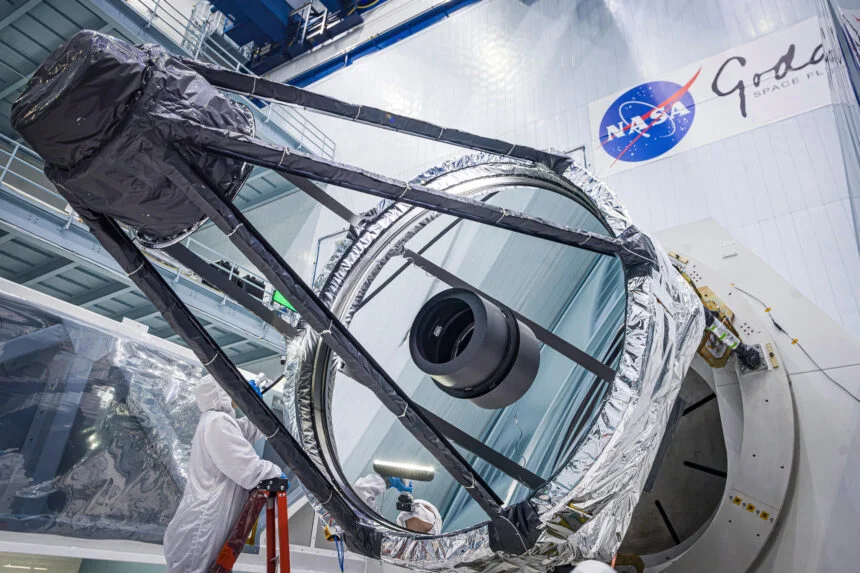
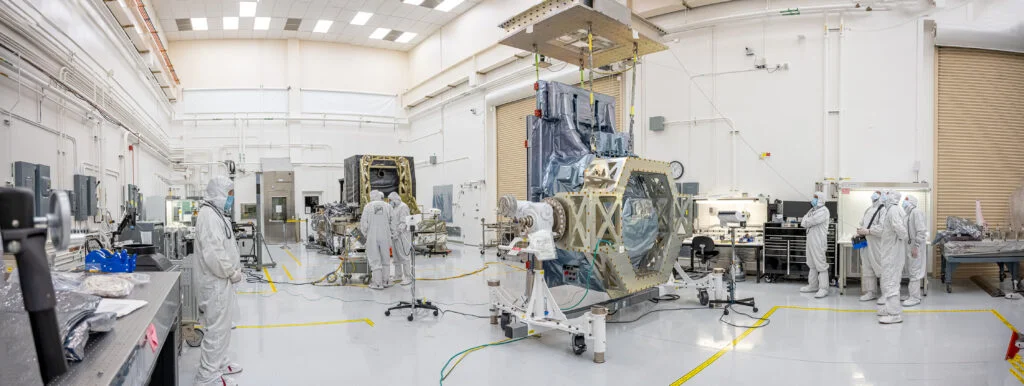
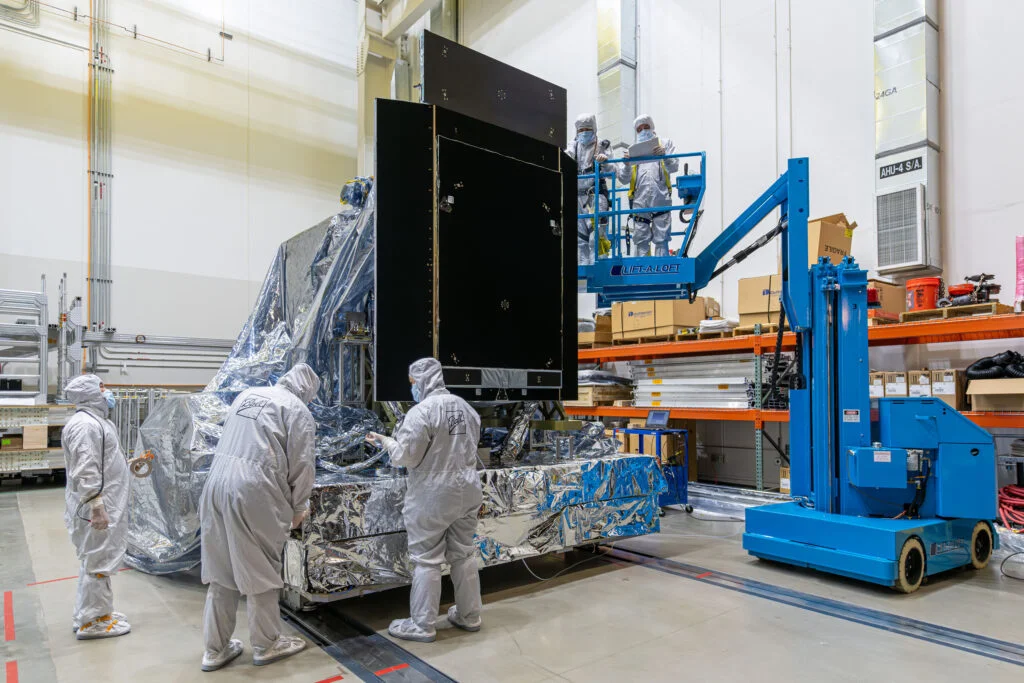
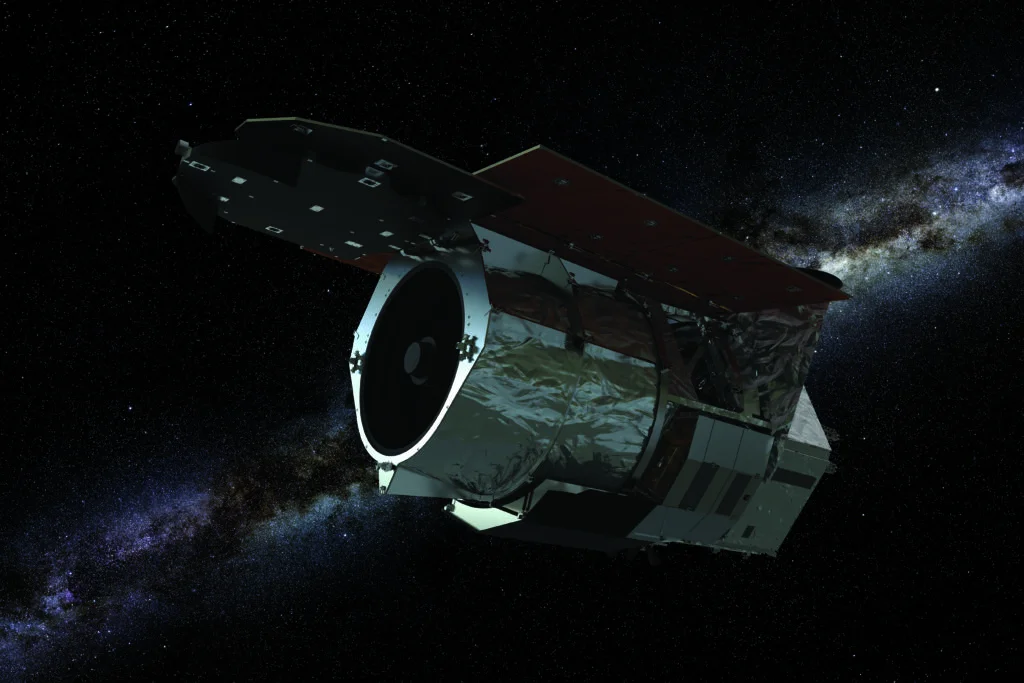
“Roman” is the shorthand name for this groundbreaking instrument. Work on the telescope – one of the flagship projects in U.S. astrophysics – began more than a decade ago. In 2020, the Wide-Field Infrared Survey Telescope (WFIRST) was renamed the Nancy Grace Roman Space Telescope in honor of the astronomer who played a key role in the creation of the Hubble Space Telescope and in building NASA’s astrophysics program.
The satellite is scheduled for launch in October 2026, with May 2027 set as the latest possible date to account for potential last-minute delays. Roman is expected to operate for five years, with the possibility of a five-year extension. With a budget exceeding $3.5 billion, it is one of the largest space science projects in the world today. Expectations are high.
What Will Roman Discover?
Roman has three primary objectives. Two focus on observing the universe on the largest scales – studying distant galaxies and exploding supernovae. The goal is to better understand dark energy and dark matter, the mysterious components that make up most of the universe but remain poorly understood.
The third objective is gravitational microlensing – specifically, using this method to search for planets. Researchers will look for both planets orbiting stars other than the Sun and free-floating “rogue” planets that are not bound to any star.
Microlensing is a specialty of scientists at the Astronomical Observatory of the University of Warsaw, who have studied the phenomenon from ground-based observatories for decades. Their expertise earned them an invitation to join the NASA team preparing the Roman mission. Dr. Przemysław Mróz and Prof. Radosław Poleski are the only Polish scientists involved in the mission’s preparation.
What is microlensing?
Light from a distant star normally travels in a straight line. But if it passes through the gravitational field of a closer star – called a lens – its path bends slightly before reaching us. As a result, the distant star appears temporarily brighter. If the lensing star has a planet, that planet can produce an additional signal detectable in the light curve.
“In short, a change in a star’s brightness can reveal that another star has a planet. That’s microlensing, and the deflection we observe is a consequence of Einstein’s theory of relativity,” explains Prof. Radosław Poleski.
Scientists predict that Roman could discover up to 2,000 planets orbiting stars, as well as several hundred rogue planets.
“Although we currently know about 6,000 exoplanets, we haven’t been able to detect any exomoons yet. Perhaps Roman will change that,” Prof. Poleski adds.
In addition to its major cosmological and microlensing programs, Roman will also carry out smaller, innovative projects.
“One idea is to attempt direct imaging of planets by blocking a star’s light and trying to see the planet next to it. This is already being attempted from Earth. We’ll see what happens when it’s done from space. For now, it’s a relatively small part of the mission, but in 50 years it may turn out to be the most important,” says Prof. Poleski.
Why Observe from Space?
What advantages does a space telescope have over instruments on Earth? In space, there is no day-night cycle, so observations can continue uninterrupted—something impossible from the ground. Roman will also conduct observations in infrared light, avoiding many of the limitations caused by Earth’s atmosphere.
“In visible light, our galaxy is largely opaque – dust and gas obscure light from distant objects. Infrared observations make the galaxy more transparent, allowing us to see many more distant stars,” explains Dr. Przemysław Mróz.
Planning a NASA mission
Building the telescope itself is only part of the challenge. Roman will have a mirror the same size as Hubble’s and a camera with a field of view 100 times larger. But developing the observation strategy and the analytical tools takes even more time – and researchers from the University of Warsaw are contributing to that effort as well.
“We’re developing conceptual plans and thinking through what the observations should look like. There’s still a lot we don’t know about our galaxy, so our strategy has to be flexible enough to account for those unknowns. NASA has a three-tier decision structure, with successive committees determining the observation plans. Our job is to quantify how results might change – for example, if we observe a given field every 22 minutes instead of 17,” says Prof. Poleski.
Selecting which regions of the sky to observe, how frequently to observe them, and which filters to use is only part of the task. The other major challenge is data analysis.
“We expect enormous volumes of data – observations of hundreds of millions of stars. We’ll need to identify the most interesting objects and study them in detail. That means developing algorithms and software capable of analyzing these massive datasets. Only then can we move on to the scientific interpretation,” Dr. Mróz adds.
Open Access to Space Data
Data collected by Roman will be publicly available through NASA’s software systems, giving astronomers worldwide access to the observations. Researchers will be able to analyze the data according to their own interests – for example, searching for comets or asteroids instead of exoplanets.
This openness also extends to competing missions, including those conducted by China. Even so, scientists are confident that Roman will represent a major breakthrough in space research.

The text was originally published in Polish on the Serwis Naukowy UW website on February 12, 2025.