

Advances in physicochemistry of materials
The ability of a material to instantly change its properties – for example, under the influence of light – is more than just intriguing; it is one of the most exciting developments in modern physicochemistry of materials. Despite rapid progress, many of the underlying mechanisms are still not fully understood. Gaining better control over how light interacts with matter could unlock a wide range of applications – from advanced displays and data storage to smart electronic systems that quietly power everyday technology.
It is hard to imagine daily life without smartphones or flat-screen TVs. Even lighting has changed dramatically – LEDs have largely replaced traditional bulbs. And storage technologies? Floppy disks (like the once-ubiquitous 3.5-inch, 1.44 MB version) are long gone, replaced by compact USB drives that can hold thousands of times more data.
What is a spin-crossover process?
To understand spin-crossover, we first need to clarify what spin actually is. Spin is a quantum property of elementary particles – such as electrons or protons – that has no direct counterpart in the macroscopic world of everyday objects like balls or stones. It can be loosely compared to angular momentum, a physical quantity describing “a kind of rotation,” or “twisting motion.”
An electron always has a spin of ½, which can take two orientations: “up” or “down,” indexed by physicists as +½ and −½. This property plays a key role in spin-crossover process because changing the spin of one or more electrons can alter the behavior of an entire atom – and even the properties of a whole material.
“Two electrons can occupy the same position in space (for example, within an atomic orbital), but in that case their spins must have opposite signs. In addition, electrons generally prefer to occupy orbitals singly when possible. This means that, given a set of electrons and available orbitals, only certain configurations are allowed. Spin-crossover (SCO) processes involve a rearrangement of electrons within a metal ion in response to changes in the surrounding environment (such as temperature) or external stimuli (such as a light pulse),” explains Prof. Katarzyna Jarzembska at the Faculty of Chemistry, University of Warsaw.
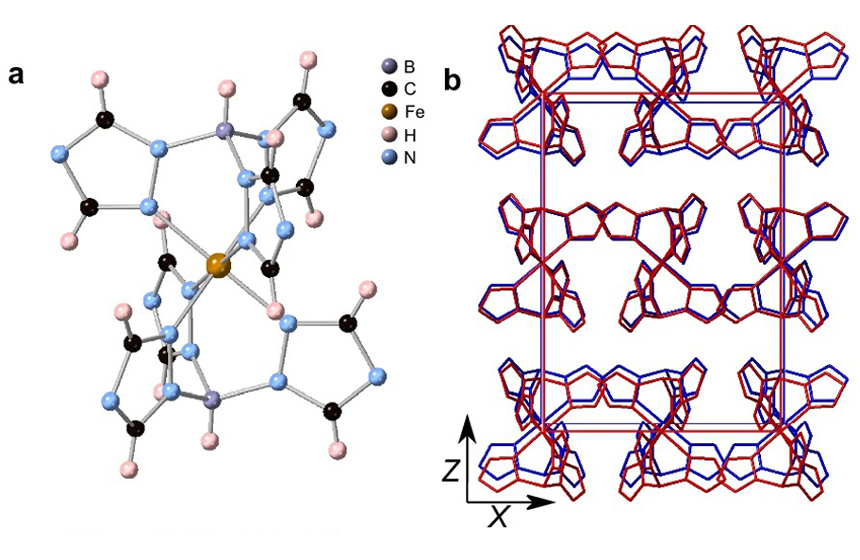
From a molecular perspective, iron-containing compounds with metal centers such as Fe²⁺ or Fe³⁺ are particularly fascinating. These iron cations are atoms that have lost two or three electrons, respectively, and they can adopt different spin states. For instance, the same iron center, Fe²⁺, can exist either in a high-spin (HS) or a low-spin (LS) state.
In the high-spin case, it has four unpaired electrons with “up” spin, whereas in the low-spin state it has none, as all electrons are paired. According to the Pauli exclusion principle, electrons with the same spin must occupy different regions of space; as a result, the Fe²⁺ ion in the HS state is larger than in the LS state. A spin-crossover transition is precisely the transformation between the HS and LS states, which can be induced, for example, by temperature or a light pulse.
In addition to changes in geometry, spin-crossover transitions primarily affect the physical properties of a material, such as its color. Iron is especially important in this context because it is abundant on Earth, relatively easy to extract, and a fundamental component of materials such as all steels. It is difficult to imagine modern civilization without it.
Tracking the chameleon’s changes
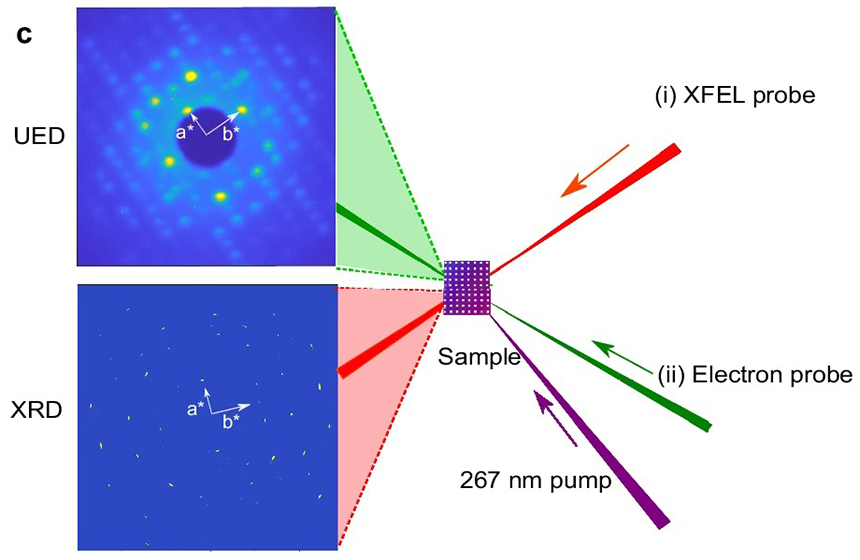
The study employed two advanced techniques: ultrafast electron diffraction (UED) and pump–probe experiments using a free-electron laser (FEL) in the X-ray range (XFEL). In the latter experiments, Prof. Katarzyna Jarzembska’s team from the University of Warsaw played a significant role.
An FEL is a unique type of laser that uses a beam of free electrons to produce extremely intense electromagnetic radiation. When it operates in the X-ray range – then called an XFEL – it allows scientists to examine the structure of matter with extraordinary precision, even tracking how atoms move. Together, these methods make it possible to capture and analyze these phenomena with remarkable precision on ultrafast timescales.
“The most surprising thing for me was the ultrafast timescale of the geometric change around the iron ion induced by the spin transition, and the fact that we were able to distinguish two stages of this process – first, an elongation of the bonds between the iron center and the surrounding atoms, and then their rotation. It is remarkable how much information can be extracted from such subtle changes in a diffraction pattern. The XFEL itself has come a long way – from an ambitious idea to a 3.4-kilometer-long facility. We have finally reached a point where research dreams are becoming reality,” says Prof. Jarzembska.

Using the studied phenomena in practice
The impact of spin-crossover transitions on a material’s physical properties – including, for example, its magnetization, color, dielectric constant, and electrical resistance – is of considerable importance in the physicochemistry of materials.
“Potential practical applications of spin-crossover materials, which exploit their switchable properties, include optical displays and data storage devices (with pixels made of SCO materials whose color or dielectric constant can be switched, for example, by localized heating or cooling, or by light exposure); switches in electronic circuits (where spin changes can trigger different functions within such systems); electroluminescent devices; and pressure sensors, where spin changes would indicate variations in the environment. The switchable paramagnetism of spin-crossover compounds may also be used in temperature-sensitive contrast agents administered during magnetic resonance imaging,” the scientist notes.
The researchers stress that real-world applications of spin-crossover materials are still some way off. Even so, research on new systems is moving fast worldwide, and we may soon see reports of these molecular switches being used in prototype devices – in practice.
“Our work is among the first to investigate the behavior of spin-crossover (SCO) materials on an ultrafast timescale. I hope it will contribute to a better understanding of the mechanisms behind these processes, as well as to future applications of SCO materials. Importantly, we also demonstrate the capabilities of molecular-structure probing methods – combining UED and XFEL – in advancing our understanding of the ultrafast dynamics of photoswitchable and, more broadly, photoactive materials,” Prof. Jarzembska concludes.

The text was originally published in Polish on the Serwis Naukowy UW website on June 6, 2025.