
Serwis Naukowy UWSerwis Naukowy UWSerwis Naukowy UW
  • Humanities
  • Social Sciences
  • Natural & Exact Sciences
  • Content Usage
Serwis Naukowy UWSerwis Naukowy UW
  • Humanities
  • Social Sciences
  • Natural & Exact Sciences
  • PL
  • Content Usage
Follow US
Copyright © 2026 Uniwersytet Warszawski

Strona główna » No other crocodile has “gone” this far: What will the reptile remains discovered in “Bełchatów” reveal?

Archaeology

No other crocodile has “gone” this far: What will the reptile remains discovered in “Bełchatów” reveal?

The discoverers are an international team of researchers co-led by scientists from the Departments of Geology and Biology at the University of Warsaw. Site of discovery: Szczerców – the western mining field of the Bełchatów Lignite Mine. Assessment of the find: groundbreaking. The newly discovered specimen, an osteoderm, is the world’s northernmost record of a Neogene crocodile (the Neogene period began approximately 23 million years ago and ended 2.6 million years ago).

Last updated: 2026/08/25
25/07/2025
8 Min Read
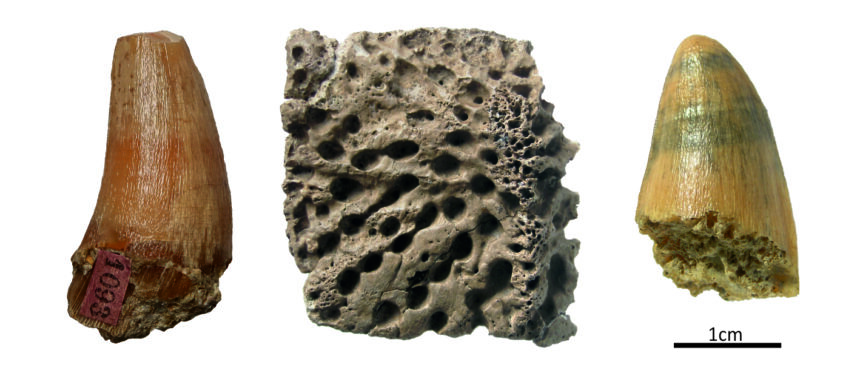
Alligator remains found: teeth from Židlochovice (left) and Pińczów (right), and an osteoderm from Szczerców (center).
Alligator remains found: teeth from Židlochovice (left) and Pińczów (right), and an osteoderm from Szczerców (center). Illustration by Dr. Marcin Górka
SHARE

In a tabloid, a headline like “Crocodile in a Mine” might at first glance sound like a silly summer story. However, we have an important scientific report. What is it about? Researchers at the University of Warsaw are seeking, among other things, an answer to the question: what do the alligator remains found in the Bełchatów Lignite Mine tell us about the climatic and geological history of our planet and its fauna?

Mysteries: The Earth’s past and future

The find itself is unassuming – measuring 29 by 32 mm. Both the front portion of the bone and the fragment located to the right of the central keel (a sharply pointed bony ridge) are missing, and the tip of the keel is also damaged. The outer surface is covered with circular pits and holes. Some of them are connected. On the other, inner side, we see a smooth surface with small holes. On the left, near the edge, there is a distinctive indentation, a trace of damage. Its origin cannot be determined today. This is hardly surprising – the described remains are approximately 17 million years old.

This is a fragment of a dorsal osteoderm, a bony structure found in the skin of certain reptiles, among others. This particular reptile was a crocodile. The remains were found in the lake sediments of the “Szczerców” Field in the Bełchatów Lignite Mine. It was quickly determined that they most likely belonged to a Diplocynodon. This is a crocodile from the alligator family, reaching a length of 1 to 3 meters. In addition to the osteoderm, the research team also described fragments of crocodile teeth from other sites.

Returning to the osteoderm – this is a valuable discovery, and it’s not just the age that makes it significant. We’re talking about the northernmost crocodile fossil among those dating back as far as 23 million years. And yet, the presence of these animals is typical of subtropical and tropical regions…
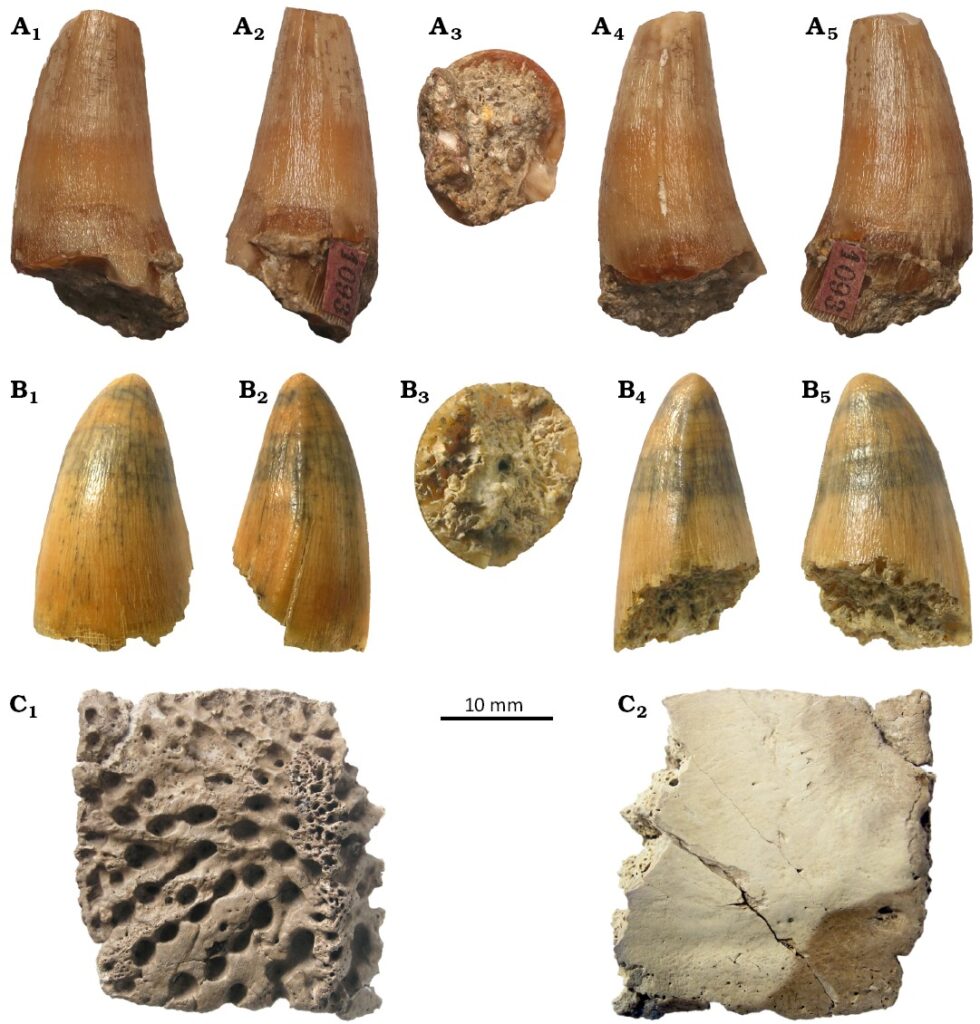
Miocene crocodile remains: A. tooth from Židlochovice (Czech Republic) B. tooth from Pińczów (Poland) C. dorsal osteoderm from the “Szczerców” mine in Poland, the northernmost Neogene crocodile described in the world.
Miocene crocodile remains: A. tooth from Židlochovice (Czech Republic) B. tooth from Pińczów (Poland) C. dorsal osteoderm from the “Szczerców” mine in Poland, the northernmost Neogene crocodile described in the world. Source: Acta Palaeontologica Polonica**

From bones to Earth’s history

Scientists from the Faculty of Geology and the Faculty of Biology at the University of Warsaw, working in National Science Centre (NCN) grant project* made this groundbreaking discovery with the participation of researchers from the Polish Academy of Science and the Moravian Museum. The goal of the project is to determine the role of the northern coast of the ancient Paratethys Sea in the exchange of fauna between Europe and Asia during the Miocene, an epoch spanning approximately 23 to 5.3 million years ago. At that time, the landscape underwent significant changes, including the uplift of new mountain ranges that affected climate and water circulation. In the Miocene, one branch of the Paratethys Sea extended into what is now southern Poland; its deposits contributed to the formation of the Carpathians, while others filled the Fore-Carpathian Basin north of the range.

[fotografia]
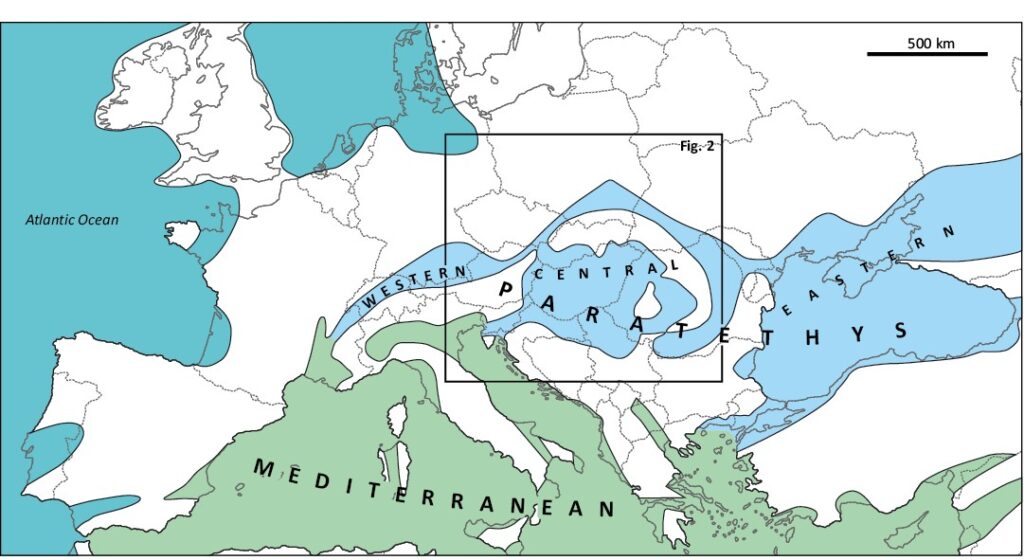
General paleogeography of Europe during the Miocene epoch. The extent of the Paratethys and the Mediterranean Sea is shown in light blue and light green, respectively. Source: Acta Palaeontologica Polonica**

The question facing scientists is: did this region serve as a major intercontinental corridor facilitating the dispersal of terrestrial vertebrates? This question is accompanied by a second one: how did the cooling of the climate that occurred in the second half of the Miocene affect the composition of thermophilic vertebrate faunas north of the Paratethys Sea (i.e., the region of today’s Carpathians, the Fore-Carpathian Basin, and Central Poland)?

What does this mean – what lies ahead?

Diplocynodon, as has been claimed so far, primarily inhabited freshwater environments. Meanwhile, some of the described finds (teeth) are closely associated with Paratethys marine sediments, which suggests the possibility that these reptiles were tolerant of seawater. In that case, the migration route enabling the spread of crocodiles northward would have included not only the freshwater basins of central Poland but also the marine Paratethys basin.
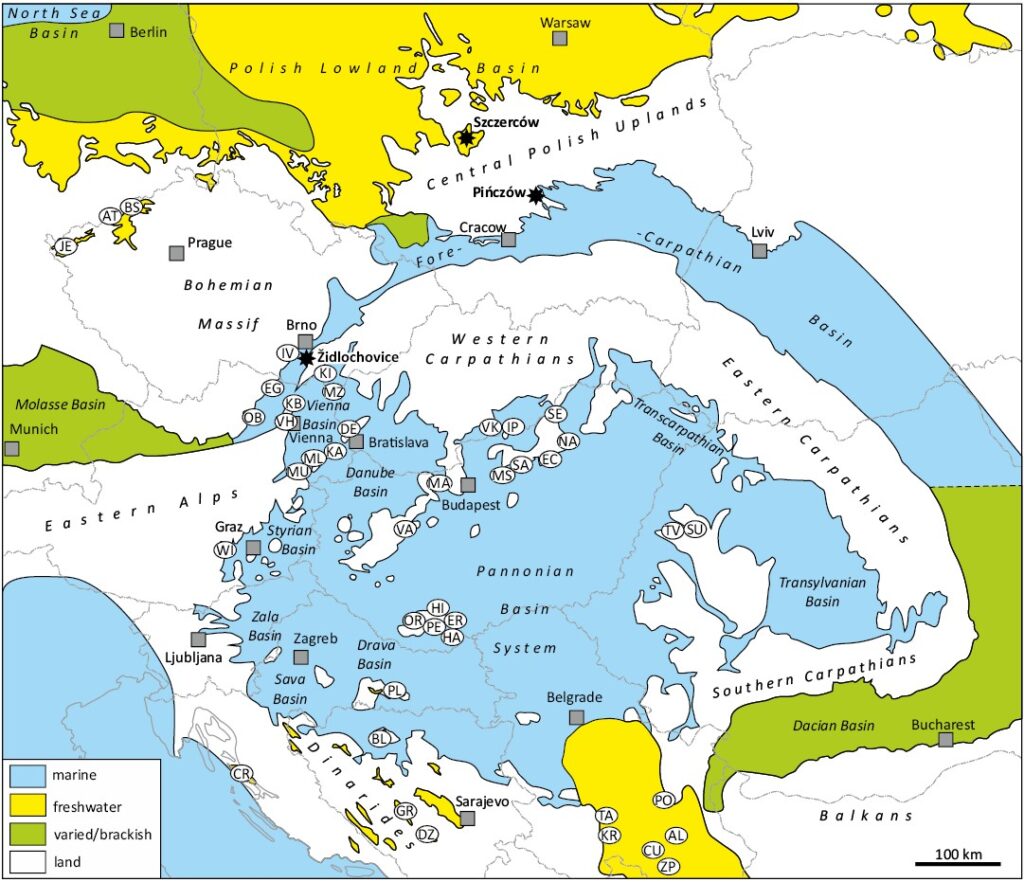
The environments of the main paleogeographic units of the Central Paratethys and adjacent areas during the Early to Middle Miocene. Crocodile sites are marked with abbreviations, and the locations of finds mentioned in the text – including the osteoderm from the “Szczerców” Field – are marked with asterisks. Source: Acta Palaeontologica Polonica**

Following the cooling of the climate that began in the Middle Miocene, the diversity and distribution of crocodilians in the Northern Hemisphere began to decline gradually. These reptiles never again exceeded their previous latitudinal limits, which are most likely marked by the recently discovered alligator remains. The Miocene was the last such warm and humid epoch in Earth’s history. It is therefore hard not to ask whether the current climate warming might mean that our freshwater and saltwater environments will once again be inhabited by reptiles similar to Diplocynodon, for example?

“Earth’s history teaches us that even if certain phenomena are long-lasting, they do not last forever. This also applies to climatic phenomena. Sooner or later, the climate in Poland will change to become favorable for the presence of these giant reptiles. When exactly will this happen, and to what extent will human activity contribute to it (human activity that has also severely depleted the global crocodile population, bringing some species to the brink of extinction…)? Given the current state of knowledge, we can only speculate.” says Dr. Marcin Górka of the Faculty of Geology at the University of Warsaw.
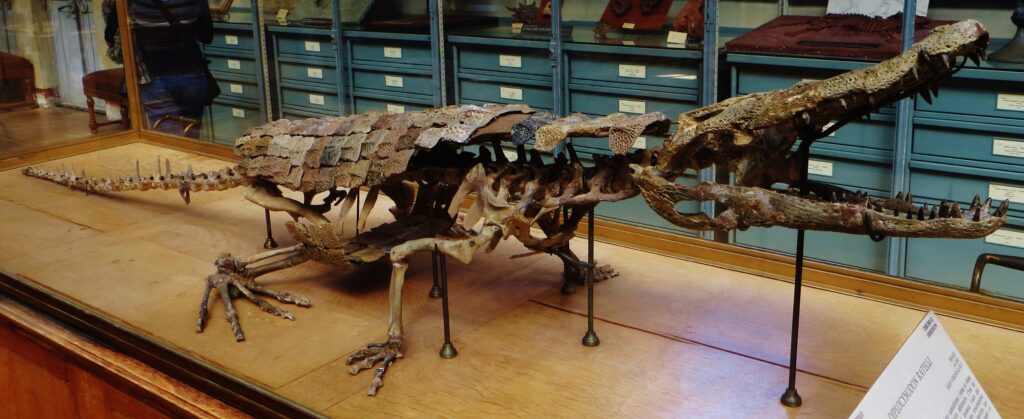
Fossilized remains of a Diplocynodon at the Natural History Museum in Paris. Photo: Ghedoghed/Wikimedia Commons

*“New Miocene land vertebrates from the northwestern Paratethys shores and their implications for Eurasian faunal exchange”

** Link to the article: Crocodylian remains from the Miocene of the Fore-Carpathian Basin and its foreland – including the world’s northernmost Neogene crocodylian

The text was originally published in Polish on the Serwis Naukowy UW website on July 25, 2025. It was updated in June 2026.

The turbulent fate of a psalter book: Scientists uncover a thousand years of history written on parchment strips
The revolutionary who loved plants: Rosa Luxemburg’s herbarium
What goes on in a player’s mind? Gamebooks as a window into cognition
Museums you can listen to: How podcasts helped revolutionize the art world during the pandemic
Silkworms, preserves, and menageries: How people cared for animals in old Poland
TAGGED:Bełchatów lignite minediplocynodondorsal osteodermFaculty of BiologyFaculty of GeologyParatethys SeaSzczerców FieldUniversity of Warsaw
Previous Article Eye-tracking research at an exhibition of medieval Nubian garments at the Bode-Museum in Berlin. Seeing the past in a new light: Eye-tracking in archaeology
Next Article Mound K8 as viewed through the treetops. Twice buried: A forest barrow cemetery at the crossroads of belief
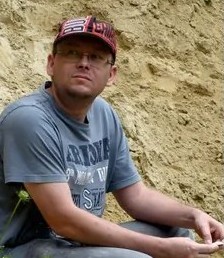
dr Marcin Górka

is an assistant professor in the Department of Sedimentary Basin Geology at the Faculty of Geology, University of Warsaw. His current research focuses on Miocene terrestrial and marine vertebrates of the Central Paratethys. His most recent publications include First occurrences of Trionychidae (Testudines, Cryptodira) from the Miocene of Poland: Detailed cranial anatomy and biogeographic implications (co-authored; January 2026) and Crocodylian Remains from the Miocene of the Fore-Carpathian Basin and Its Foreland—Including the World’s Northernmost Neogene Crocodylian (co-authored; May 2025).

UW Science Daily

Center for Cooperation and Dialogue, University of Warsaw

Office: ul. Dobra 56/66, 00-312 Warsaw

Tel.: +48 609635434 • redakcja@uw.edu.pl

Facebook Linkedin Instagram

About us

UW Home page

logotyp-IDUB-PL-poziom-inv

Accessibility statement

Cookie privacy policy

Site map

Copyright © 2026 University of Warsaw

Copyright © 2026 Uniwersytet Warszawski
Manage Consent
To provide the best experiences, we use technologies like cookies to store and/or access device information. Consenting to these technologies will allow us to process data such as browsing behavior or unique IDs on this site. Not consenting or withdrawing consent, may adversely affect certain features and functions.
Functional Always active
The technical storage or access is strictly necessary for the legitimate purpose of enabling the use of a specific service explicitly requested by the subscriber or user, or for the sole purpose of carrying out the transmission of a communication over an electronic communications network.
Preferencje
Przechowywanie lub dostęp techniczny jest niezbędny do uzasadnionego celu przechowywania preferencji, o które nie prosi subskrybent lub użytkownik.
Statistics
The technical storage or access that is used exclusively for statistical purposes. Przechowywanie techniczne lub dostęp, który jest używany wyłącznie do anonimowych celów statystycznych. Bez wezwania do sądu, dobrowolnego podporządkowania się dostawcy usług internetowych lub dodatkowych zapisów od strony trzeciej, informacje przechowywane lub pobierane wyłącznie w tym celu zwykle nie mogą być wykorzystywane do identyfikacji użytkownika.
Marketing
Przechowywanie lub dostęp techniczny jest wymagany do tworzenia profili użytkowników w celu wysyłania reklam lub śledzenia użytkownika na stronie internetowej lub na kilku stronach internetowych w podobnych celach marketingowych.
  • Manage options
  • Manage services
  • Manage {vendor_count} vendors
  • Read more about these purposes
View preferences
  • {title}
  • {title}
  • {title}