
Serwis Naukowy UWSerwis Naukowy UWSerwis Naukowy UW
  • Humanities
  • Social Sciences
  • Natural & Exact Sciences
  • Content Usage
Serwis Naukowy UWSerwis Naukowy UW
  • Humanities
  • Social Sciences
  • Natural & Exact Sciences
  • PL
  • Content Usage
Follow US
Copyright © 2026 Uniwersytet Warszawski

Strona główna » Nanomachines of the future: Teaching molecules to rotate on command

Chemistry

Nanomachines of the future: Teaching molecules to rotate on command

“I am a robot, forged and strong, by electric currents steered along,” wrote Stanisław Lem in "Fables for Robots". Today, powering robots with electricity is nothing unusual. The real challenge lies in shrinking them while maintaining precise control over their motion. That is exactly what so-called molecular motors aim to achieve – machines as small as individual molecules, studied by Dr. Wojciech Danowski and Dr. Joanna Jankowska at the University of Warsaw’s Faculty of Chemistry.

Last updated: 2026/05/06
19/05/2025
6 Min Read
Milli-, micro-, nano-, pico-, and femto- – these prefixes help us describe objects at extremely small scales. Scientists are making remarkable advances in this microscopic world.
Milli-, micro-, nano-, pico-, and femto- – these prefixes help us describe objects at extremely small scales. Scientists are making remarkable advances in this microscopic world. Photo: Freepik
SHARE

Thousands of tiny molecular machines – each just a few nanometers in size – are constantly at work inside every living organism. They drive the fundamental biological processes that together make up what we call life. Take myosins, for example: they are responsible for muscle contraction, moving along actin filaments in sarcomeres, the functional units of muscle tissue, and generating the force that powers movement in the body. Scientists have been working on building synthetic versions of these molecular machines for only about 20 to 30 years. And while we are still at the beginning of this journey, the first major breakthroughs are already here. One of them is the development of an artificial molecular machine that operates more efficiently than its biological counterpart,” says Dr. Wojciech Danowski.

The power of molecular motors

Although this field is still in its early stages, its potential applications are becoming increasingly clear. One of the most promising is the precise delivery of drugs and active compounds to specific sites in the body – for example, directly to cancer cells – while leaving healthy tissue unharmed. Other possible uses include smart materials, membranes, absorbents, and thin-film filters designed for energy-efficient separation processes such as molecular sieving.
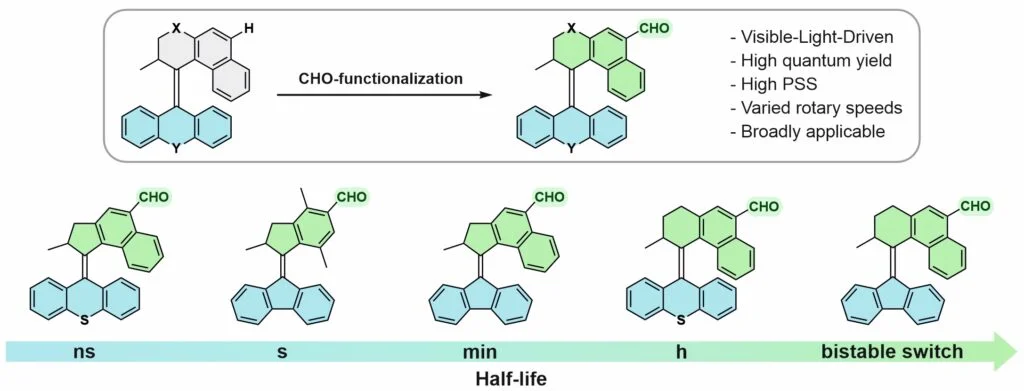
 A strategy for increasing the rotational efficiency of molecular motors powered by visible light.
A strategy for increasing the rotational efficiency of molecular motors powered by visible light. Source: Faculty of Chemistry, University of Warsaw

An innovative way to control molecular motors

A molecular motor works on a simple principle: one part rotates relative to another around an axis. The stationary component, known as the stator, is typically anchored to a surface, while the moving part – the rotor – rotates freely. The axis connecting them is a fragment of the molecule, such as two carbon atoms connected by a double bond (an alkene). Until recently, these nanoscale motors were driven mainly by UV light. Now, Dr. Wojciech Danowski shows they can also be powered effectively by radiation in the visible light range.

“Replacing UV light with visible light significantly extends the lifetime of molecular machines, improves their efficiency, and, in biological applications, reduces toxicity while allowing light to penetrate tissues more safely. Anyone who has ever spent too much time in the sun knows how harmful UV radiation can be,” says the University of Warsaw researcher.

Another milestone in unlocking the full potential of molecular machines is expanding their functionality to include remote control of their operation. In her research based on quantum chemical simulations, Dr. Joanna Jankowska has shown that an external electric field can steer the direction of a molecular motor’s rotation. This effect is tied to chirality – a property of molecules whose mirror images cannot be superimposed – like left and right hands.

“This is a major step forward because changing chirality is not something chemistry easily allows. It usually requires full-scale chemical intervention – adding a reagent, carrying out a quantitative reaction, and then removing it. In our work, we redesigned the motor so that its direction of rotation can be switched with an electric field pulse. This is the first time it has been achieved without chemical modification,” emphasizes Dr. Jankowska.
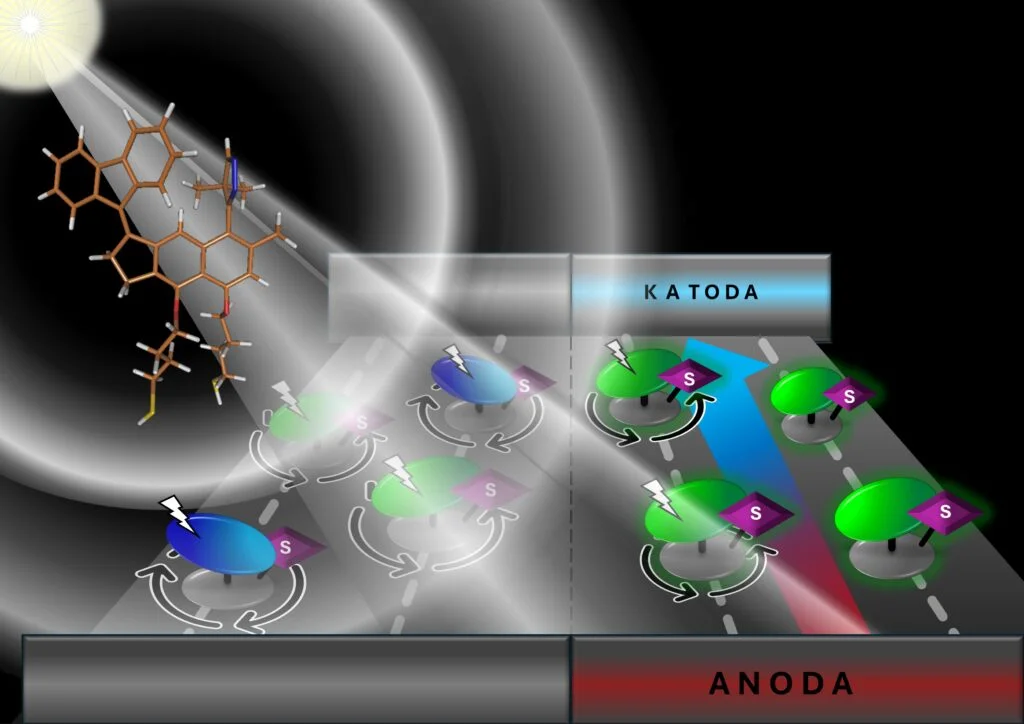
Schematic of the pulse-induced electric field used to switch the direction of molecular motors.
Schematic of the pulse-induced electric field used to switch the direction of molecular motors. Source: Faculty of Chemistry, University of Warsaw

The groundbreaking research

Using physical stimuli to control molecular motors opens up entirely new prospects for their practical applications. Light-driven motors differ significantly from chemically controlled ones, primarily due to the irreversible nature of photochemical processes at the microscale. In contrast, classical chemical reactions tend to be reversible and governed by equilibrium, which makes it more difficult to design unidirectional nanomachines. Photochemical processes are not subject to these limitations, enabling exceptionally high unidirectionality and precision of motion – only one error in tens of millions of rotations.

“Still, the biggest hurdle is moving this technology beyond the lab and into real-world use. For now, we mainly work under tightly controlled conditions, but the potential applications are broad – from medicine and materials science to smart energy systems. We’re only at the very beginning of this path, but the direction is clear,” says Dr. Danowski.

The ability to reverse the rotation of a molecular motor using an electric field is a genuine breakthrough, allowing fast, remote control without any physical contact or chemical intervention.

“If something rotates clockwise, the natural question is: can we make it rotate counterclockwise instead – just as you would with a toy or a machine? That curiosity was really the starting point for this work: a sense that it simply had to be possible somehow. Scientifically, it turned out to be challenging, but I believe we managed to achieve it,” concludes Dr. Jankowska.

The text was originally published in Polish on the Serwis Naukowy UW website on May 19, 2025

Podhale Goralian put to the test: Can the local dialect still be saved?
Belief in magic: how long-term unemployment changes our psychological state?
Picasso in the business world: Corporate art collections
Building resilience against disinformation: The international SAUFEX project
Ethiopian homilies preserved for centuries: What they might tell us about a world long gone
TAGGED:Computational Spectroscopy Research GroupFaculty of ChemistryLaboratory of Technology of Organic Functional Materialsmolecular motorsquantum chemistryUniversity of Warsaw
Previous Article For final-year medical students, emigration is becoming an increasingly less attractive option each year. Still, their decisions will likely depend on how they evaluate the Polish healthcare system once they’ve experienced it as full-time employees. Do future doctors want to leave Poland? New research from the University of Warsaw’s Centre of Migration Research
Next Article A view of the excavation site. In the foreground is the edge of the Dry Moat; in the background is the Step Pyramid; between them are the remains of the tombs of the Lower Necropolis (on the right) and the pits where the burials of the Upper Necropolis were located. The mysteries of Saqqara: What can this ancient necropolis reveal about us today?
dr inż. Wojciech Danowski

is a chemist conducting his research at the University of Warsaw’s Faculty of Chemistry, in the Laboratory of Technology of Organic Functional Materials. He earned his PhD in the Netherlands under the supervision of Nobel laureate Prof. Ben L. Feringa, with whom he continues to collaborate. His research interests include molecular switches, molecular machines, and porous materials.

dr Joanna Jankowska

is a theoretical chemist conducting her research in the Computational Spectroscopy Research Group at the University of Warsaw’s Faculty of Chemistry. Her work focuses on the photochemistry of functional molecular systems and materials for harvesting and storing solar energy. She has a particular passion for exploring new applications of molecular devices.

UW Science Daily

Center for Cooperation and Dialogue, University of Warsaw

Office: ul. Dobra 56/66, 00-312 Warsaw

Tel.: +48 609635434 • redakcja@uw.edu.pl

Facebook Linkedin Instagram

About us

UW Home page

logotyp-IDUB-PL-poziom-inv

Accessibility statement

Cookie privacy policy

Site map

Copyright © 2026 University of Warsaw

Copyright © 2026 Uniwersytet Warszawski
Manage Consent
To provide the best experiences, we use technologies like cookies to store and/or access device information. Consenting to these technologies will allow us to process data such as browsing behavior or unique IDs on this site. Not consenting or withdrawing consent, may adversely affect certain features and functions.
Functional Always active
The technical storage or access is strictly necessary for the legitimate purpose of enabling the use of a specific service explicitly requested by the subscriber or user, or for the sole purpose of carrying out the transmission of a communication over an electronic communications network.
Preferencje
Przechowywanie lub dostęp techniczny jest niezbędny do uzasadnionego celu przechowywania preferencji, o które nie prosi subskrybent lub użytkownik.
Statistics
The technical storage or access that is used exclusively for statistical purposes. Przechowywanie techniczne lub dostęp, który jest używany wyłącznie do anonimowych celów statystycznych. Bez wezwania do sądu, dobrowolnego podporządkowania się dostawcy usług internetowych lub dodatkowych zapisów od strony trzeciej, informacje przechowywane lub pobierane wyłącznie w tym celu zwykle nie mogą być wykorzystywane do identyfikacji użytkownika.
Marketing
Przechowywanie lub dostęp techniczny jest wymagany do tworzenia profili użytkowników w celu wysyłania reklam lub śledzenia użytkownika na stronie internetowej lub na kilku stronach internetowych w podobnych celach marketingowych.
  • Manage options
  • Manage services
  • Manage {vendor_count} vendors
  • Read more about these purposes
View preferences
  • {title}
  • {title}
  • {title}