

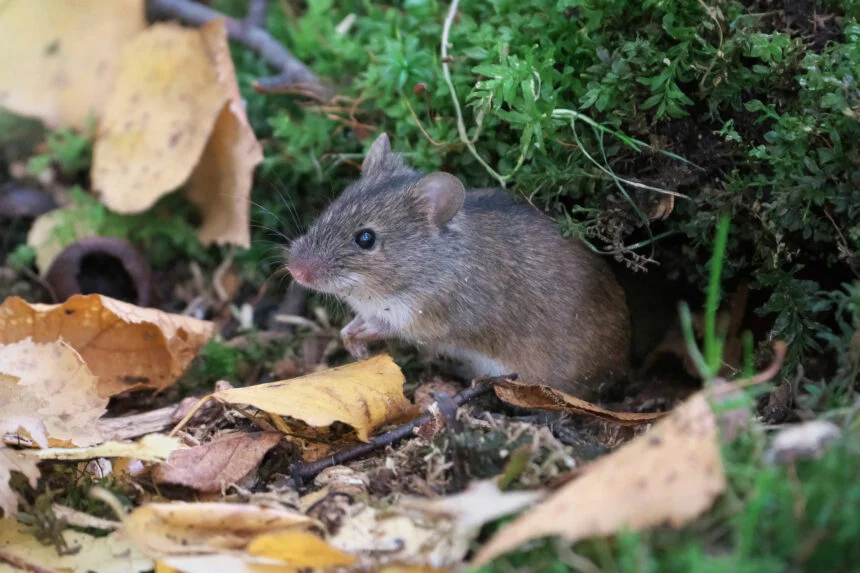
Behavioral deception involves sending false information or concealing the truth. The goal? To benefit the sender while disadvantaging the receiver. This type of deception occurs in many animal species. In most cases, such behaviors are instinctive, genetically determined or learned. But not always.
Some animals, when deceiving others, employ flexible and creative tactics. Researchers refer to this as tactical deception. It is rare. It has been documented mainly among primates and corvids (a group of highly intelligent birds that includes crows, ravens, and jays). The most advanced form of this phenomenon is intentional deception: behavior that appears intended to mislead an opponent.
Among rodents, behaviors that may qualify as intentional tactical deception have so far been documented only in squirrels and rats. According to a study co-authored by Prof. Piotr Bębas and Dr. Marcin Chrzanowski from the Faculty of Biology at the University of Warsaw, this list may now include another group: free-ranging mice.
How do you study deception in free-ranging mice?
The observations were conducted as part of a project investigating how two free-ranging mice species – black-striped mouse (also known as striped field mice; Apodemus agrarius) and the yellow-necked mouse (also known as yellow-necked field mice; Apodemus flavicollis) – respond to competition for food when predator scents are present.
The experiment took place under natural conditions next to a forest outside Warsaw. Researchers installed free-access laboratory-style test chambers – wooden boxes with a floor and a single entrance or exit. Each day, the chambers were stocked with food attractive to free-ranging mice. The animals could visit at any time they wished.
Their behavior was monitored remotely using infrared cameras.
“We were observing the social interactions of free-ranging mice competing for food – both within the same species and between species. That’s when we noticed a previously undocumented defensive behavior displayed by one of the species: deceptive evasion of a pursuer. In short, a free-ranging mouse pretends to flee and tricks the pursuing individual,” the researchers explain.
More precisely, scientists identified two variants of this behavior.
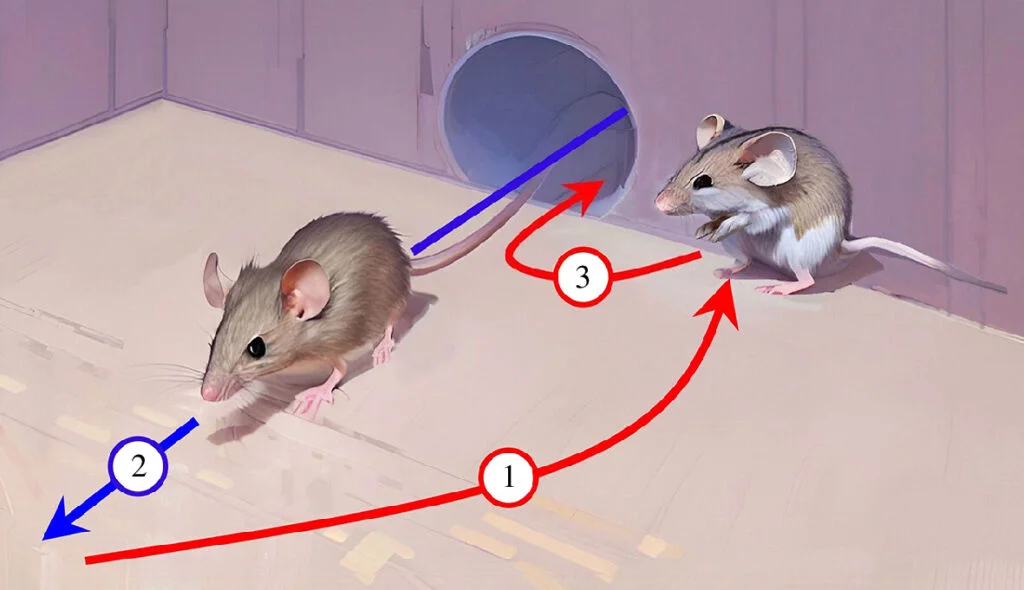
In the first scenario, a free-ranging mouse being chased by another appears to run into the chamber. In reality, it stops just inside the entrance and hides by standing sideways along the wall near the opening – the only entry and exit point. The animal freezes completely, remaining silent and motionless so that the pursuer cannot detect it. When the chasing free-ranging mouse runs past, the hidden individual seizes the opportunity to escape in the opposite direction.
In the second scenario, a free-ranging mouse already inside the chamber detects an approaching rival. It then performs a similar maneuver in order to leave the chamber without encountering the intruder – using the same tactic of freezing near the entrance and slipping away when the pursuer is distracted.
In other words, the pursued animal uses deceptive evasive maneuvers, flexibly adjusting its escape strategy to the situation.
According to the researchers, both types of behavior fit the criteria for intentional tactical deception – a phenomenon rarely documented in animals and never before reported in free-ranging mice.
Proving intentions is difficult
There is, however, an important caveat. as the researchers emphasize, interpreting this behavior as intentional tactical deception is not a proven fact but rather a hypothesis strongly supported by observations.
Drawing conclusions about animals’ mental states is always risky. Intentionality cannot be directly demonstrated – not only in free-ranging mice but in any non-human organism. In fact, the same theoretical limitation applies to humans as well. Intentions can only ever be inferred from behavior and therefore remain, strictly speaking, hypothetical.
“Anthropomorphism can be misleading,” says Prof. Piotr Bębas. “But rejecting it outright can sometimes create a barrier that is too rigid – one that prevents us from recognizing the depth and complexity of animals’ cognitive abilities. Our work opens that door just a little and shows that even small mammals – in this case, free-ranging mice – can surprise us, despite their rather poor reputation.”
“Until recently, hardly anyone even considered the possibility that animals like mice might possess elements of a theory of mind – the ability to attribute mental states to others. We’re beginning to explore that idea,” he adds.
The scientists stress that this is basic research. Yet its implications may extend beyond academic debates about animal cognition. If people begin to recognize how sophisticated animal behavior can be, it may also influence how we treat other species.
“This kind of discovery changes how we see the world,” explains Prof. Bębas. “Humans are not the only beings capable of acting with intention. That raises an important question: if other mammals can act purposefully, should we still treat them merely as objects? Perhaps our findings will encourage a broader discussion about how humans relate to animals.”
The text was originally published in Polish on the Serwis Naukowy UW website on March 7, 2025.