

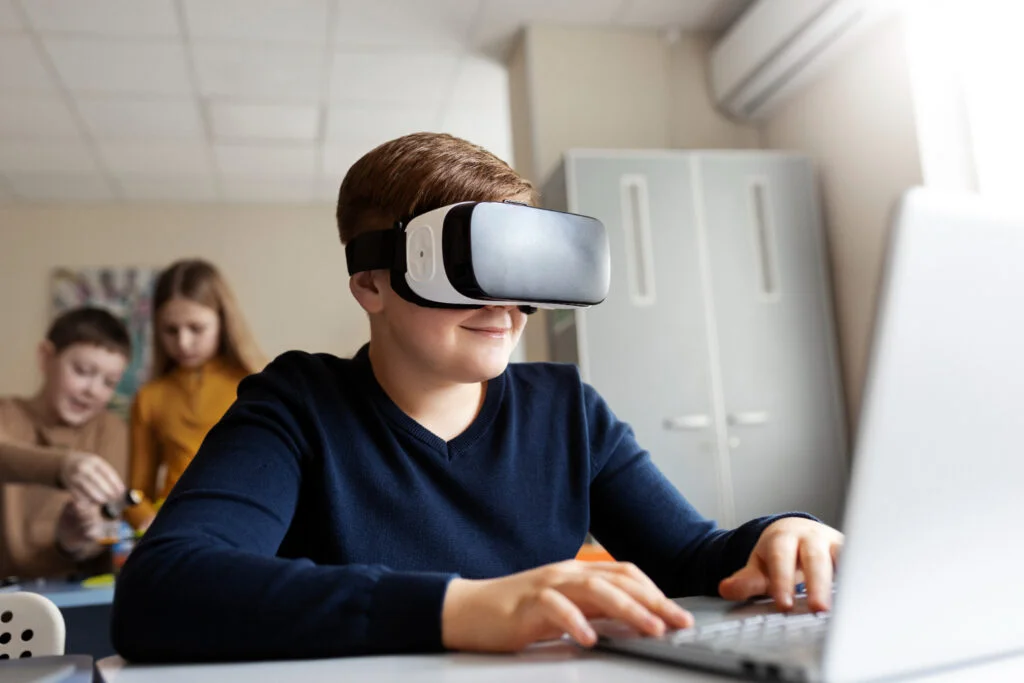
Virtual reality technology enables the creation of immersive environments – settings in which natural sensory input is replaced by artificial, computer-generated stimuli. By putting on a VR headset, users can step into a simulated world that feels almost as real as the physical one. VR is widely seen as the future of entertainment, offering entirely new experiences, particularly for gamers. Yet its applications extend far beyond gaming: the technology is already used in the military, aviation, and medicine. Now, it is steadily making inroads into areas once reserved for traditional education.
Despite growing interest in VR as a teaching tool, its actual effectiveness remains unclear. Would students learn more about, say, the structure of the heart by exploring it in a virtual environment rather than hearing about it in a classroom? What technological and pedagogical challenges might such solutions entail? A research team from the University of Warsaw, led by Dr. Karolina Brylska, set out to answer these questions. Their findings not only shed light on the effectiveness of VR in education but also underscore the importance of properly preparing both students and teachers to use new technologies.
Lessons in virtual reality
Seventy-five students participated in the study and were divided into two groups. The first attended a “traditional” biology lesson, where the teacher used multimedia presentations and students completed worksheet exercises. The second group took part in a VR-based lesson. Both groups covered the same material on the eyes, heart, and intestines.
However, the time allocated to each format differed. The traditional lesson lasted 40 minutes, while the VR session ran for 14 minutes (with no fixed time limit for completing the game-based experiment). Afterward, all participants took the same knowledge test and completed a survey evaluating their experiences. This allowed researchers to assess both learning outcomes and student perceptions of the two formats.
Average test scores were similar in both groups: students in the traditional class scored 16.36 points, compared with 16 points for those in the VR group (out of a maximum of 20). This suggests that VR-based learning may be more time-efficient. Still, it comes with drawbacks – the shorter duration and the inability to revisit earlier content made it harder to retain certain information. By contrast, traditional lessons, though less engaging, offered better control over pacing.
Our study highlights one of the most important pieces of the puzzle – the role of the teacher,” says Dr. Karolina Brylska. “Although we limited the teacher’s interaction with students during the experiment – for example, she could not answer questions that might provide additional knowledge – her presence still proved crucial. Even within these constraints, she effectively guided students through the learning process, providing structure and a sense of security. This shows that even the most advanced educational technologies cannot replace a competent educator; they can only complement one.”
The devil is in the details
Despite similar average scores, results varied depending on the type of material. VR proved particularly effective for topics requiring spatial reasoning. It allows students to explore complex structures – such as the anatomy of the eye, heart, or intestines – from multiple angles and in fine detail, closely mimicking real-life experience.
However, the experiment also revealed a downside. Students in the VR group struggled to retain information presented while they were simultaneously listening to narration and performing interactive tasks – such as catching bacteria in the intestines or navigating the heart. Their attention shifted toward interaction and device control rather than the instructional content.
Traditional lessons, meanwhile, were more effective for acquiring theoretical knowledge. Students in this group performed better on questions requiring the recall of detailed information, such as the names of biological structures or specific mechanisms. This may be because traditional classes allow for note-taking, asking questions, and revisiting key material (although teachers were instructed not to expand beyond the planned content to ensure consistency across both formats).
“It’s worth noting that strong test results after traditional lessons may reflect not only the method’s effectiveness but also students’ habits,” Dr. Brylska explains. “For our participants, VR was still a novelty, which likely influenced how they absorbed information. As the technology becomes more widespread, these results may change. The takeaway? VR has enormous potential – it clearly boosts engagement and motivation – but simply immersing students in a virtual environment is not enough. Teacher support and thoughtful integration into a well-designed curriculum are essential.”
It makes you want to learn
Despite its limitations, VR lessons are undeniably more exciting than traditional ones. Students who experienced VR were more likely to express interest in participating in similar classes in the future.
Interestingly, the technology had the strongest impact on students who initially approached it with caution. These “tech skeptics” performed well, while VR enthusiasts were more likely to struggle with concentration and effective learning. One possible explanation is that enthusiasts treated the experience more as entertainment than education, focusing on exploring the virtual environment rather than absorbing the material. Skeptics, less distracted by the novelty, approached VR more as a task to be completed.
Digital exclusion?
Performance in the VR group was also shaped by technological proficiency. Although participants had grown up surrounded by digital tools, many found VR difficult to navigate. Virtual environments require a different set of skills than traditional screens, and for many students, this was their first exposure to such technology.
During pilot sessions, frustration and tension arose when students struggled to understand how the system worked. Some felt overwhelmed by the unfamiliar environment, had difficulty following instructions, or struggled with tasks such as picking up virtual objects or navigating the interface. Misclicks and improper use of controls disrupted the lesson and required intervention.
To address these issues, researchers introduced the The Lab app as a preparatory step before the actual lesson. This brief training session helped reduce the technological barrier and allowed participants to engage more effectively with the learning material.
VR: Yes, but…
The study suggests that virtual reality is not a one-size-fits-all solution capable of replacing traditional teaching. While visually compelling, VR works best as a supplement rather than a substitute. It excels at visualizing complex processes – such as how the human body functions – but cannot replace interaction with a teacher.
To fully realize its potential, both educators and students must be properly prepared, and high-quality educational applications need to be developed. Future research should focus on optimizing learning processes and reducing technological barriers.
“Existing research shows that immersive technologies are highly effective for developing manual and procedural skills – VR is already used to train surgeons and pilots,” Dr. Brylska notes. “It also supports cognitive functions such as spatial reasoning and visual perception. However, when it comes to acquiring theoretical knowledge, the picture is more complex. Where memorization is key, traditional teaching methods still have the advantage.”
According to the researchers, combining virtual simulations with teacher-led instruction may offer the most effective approach. VR has the potential to become a powerful motivational tool, increasing engagement by allowing students to explore complex concepts in an interactive way. Its adaptability also makes it suitable for learners with different abilities and styles.
The future of education, then, may lie not in choosing between innovation and tradition, but in striking the right balance between the two.
The text was originally published in Polish on the Serwis Naukowy UW website on March 24, 2025.