

How has Earth’s climate changed over the past hundreds of thousands of years? It’s a question that matters more than ever – not only for understanding the planet’s natural climate cycles, but also for predicting the effects of global warming.
In their search for “climate archives,” scientists turn to a variety of sources – from ice cores and seafloor sediments to cave formations. Now, an international team of researchers from the Faculty of Physics at the University of Warsaw, the University of Florida, and the Institute of Earth Sciences in Orléans has identified another intriguing archive: solution pipes – vertical channels carved into limestone. They published their findings in the prestigious journal Physical Review Letters.
A drop hollows out the stone
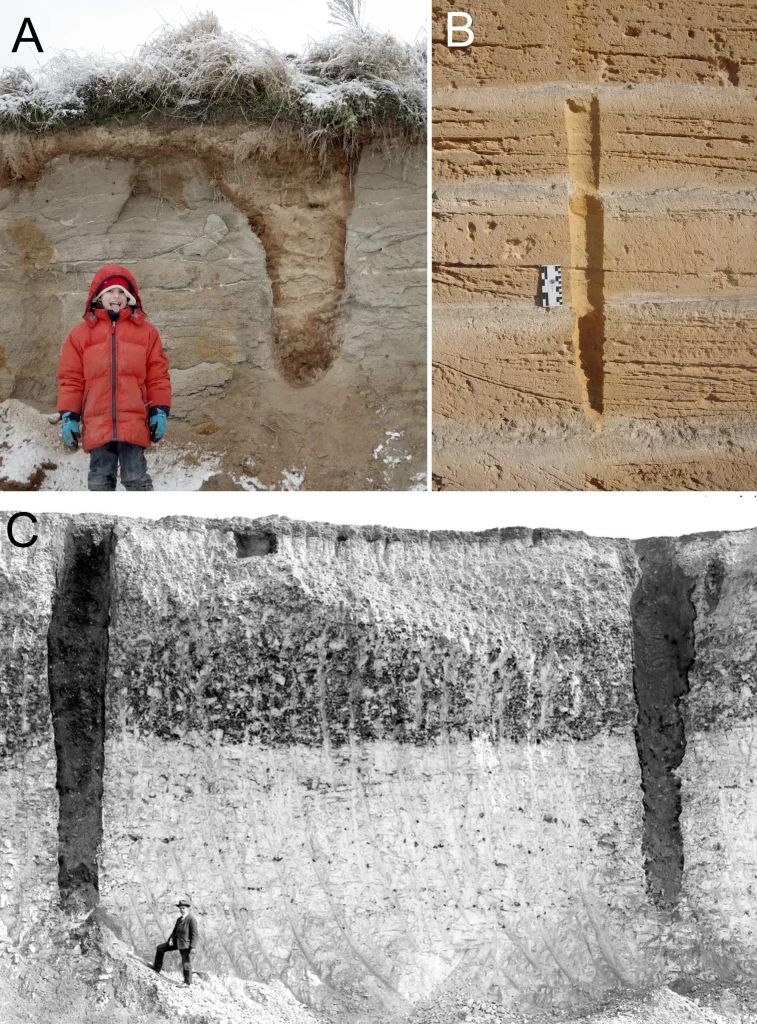
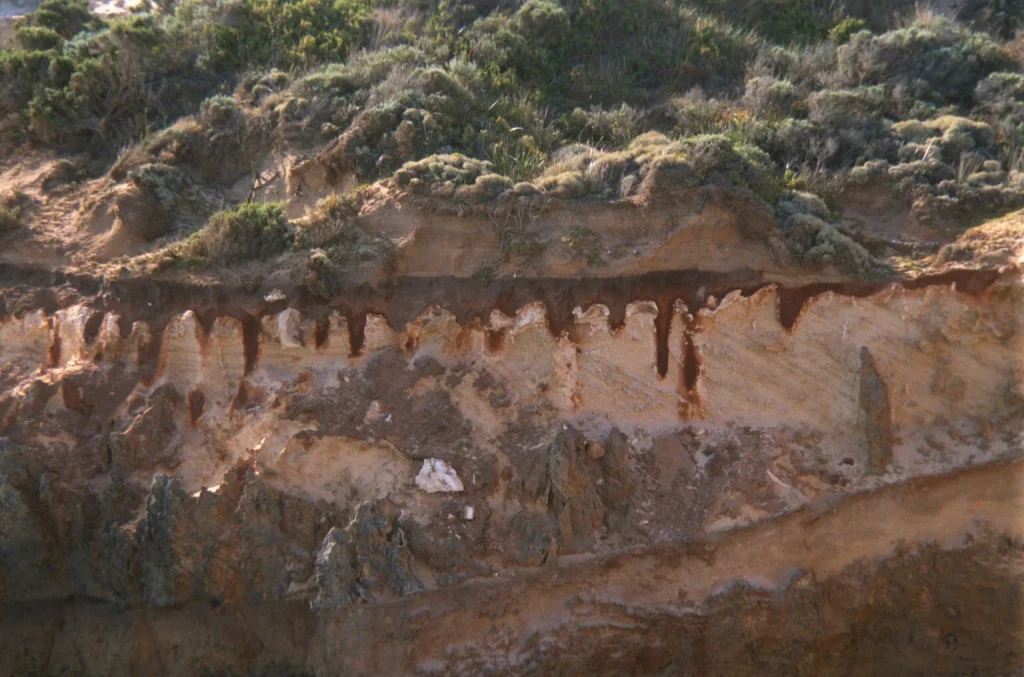
Water reshapes the Earth’s surface slowly but relentlessly, carving out gorges, caves, and karst sinkholes. It also leaves subtler traces: vertical channels known as solution pipes, etched into limestone.
What makes them so intriguing? Their shape barely changes as they grow. The channel simply stretches longer and longer, preserving the same distinctive form it had from the start. And that remarkable consistency could turn these formations into time capsules of the conditions under which they formed – especially the amount of precipitation at the time.
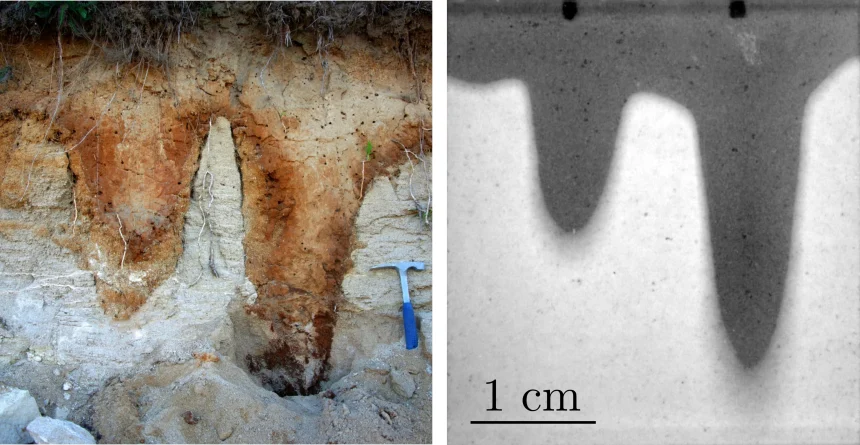
To investigate this process, the researchers conducted microfluidic experiments using gypsum. They made small cuts in the sample and then allowed water to flow through them.
“Although the dissolution process was chaotic at first, eventually only a few channels kept growing. Each developed a stable, distinctive shape and then continued to grow without changing it. If we trace the channel boundaries at successive stages and overlay them so that their tips coincide, the outlines fall on top of one another – the shape has remained unchanged from the very beginning. Solution pipes in nature behave in exactly the same way,” the researchers explain.
“It is as though an ideal form were sinking slowly into the rock as if into wax, keeping its shape all the way down and leaving behind a hole with a characteristic outline,” says Dr Stanisław Żukowski, first author of the Physical Review Letters paper.
Nature’s pattern
But how can we extract information about the climate from hundreds of thousands of years ago from these ancient channels? The key was to construct a mathematical model of their evolution.
“Capturing the unchanging form required the use of advanced mathematical tools combining fluid dynamics and reactive transport. This allowed us to model how rainwater infiltrates limestone and shapes solution pipes,” explains Prof. Piotr Szymczak from the Faculty of Physics at the University of Warsaw, the corresponding author of the publication.
According to the researchers’ findings, heavy rainfall favors the formation of elongated channels, whereas with lighter rainfall, the channels are wider and more rounded. In other words, the shape of solution pipes serves as a record of past climatic conditions that we can interpret today. Furthermore, as the researchers point out, understanding the mechanisms behind the formation of dissolution channels in rocks also has practical significance – it may help optimize processes such as underground CO₂ storage or oil extraction.
The text was originally published in Polish on the Serwis Naukowy UW website on September 17, 2025.