

Serwis Naukowy UWSerwis Naukowy UWSerwis Naukowy UW
  • Humanities
  • Social Sciences
  • Natural & Exact Sciences
  • Content Usage
Serwis Naukowy UWSerwis Naukowy UW
  • Humanities
  • Social Sciences
  • Natural & Exact Sciences
  • PL
  • Content Usage
Follow US
Copyright © 2026 Uniwersytet Warszawski

Strona główna » Lending books, giving hope: The importance of libraries in the refugee crisis

Communication studiesMedia

Lending books, giving hope: The importance of libraries in the refugee crisis

What, besides books, can refugees find in libraries? An international team—including researchers from the University of Warsaw – set out to explore the new roles these institutions have taken on since the outbreak of the war in Ukraine. The conclusion is clear: it’s time to move beyond the outdated image of libraries as quiet reading rooms. Today, libraries are modern hubs of information, integration, and support – sources of hope and places where a sense of everyday life can be restored.

Last updated: 2026/05/06
03/04/2025
5 Min Read
Researchers emphasize a role rooted in the ethos of libraries as inclusive spaces accessible to all.
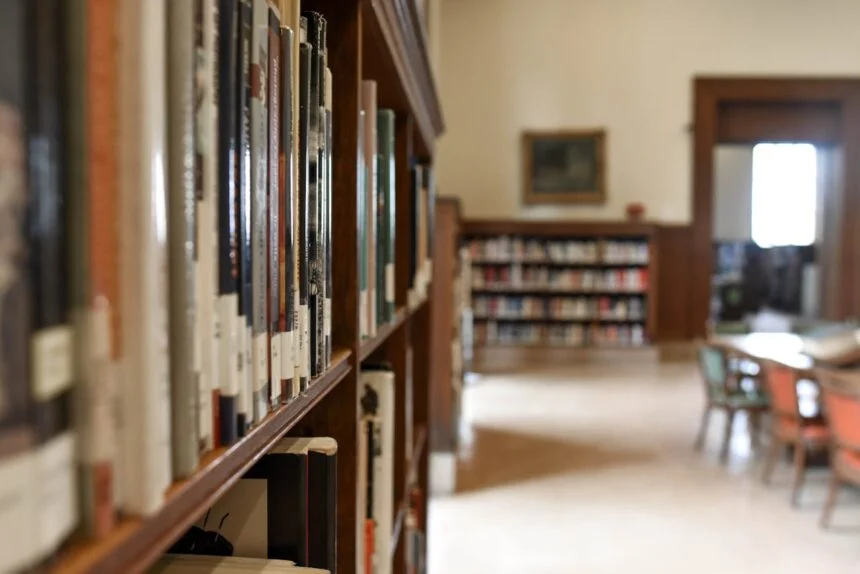
Researchers emphasize a role rooted in the ethos of libraries as inclusive spaces accessible to all. Photo by Element5 Digital/Pexels
SHARE

Providing effective assistance to migrants is a complex challenge that requires coordination across institutions at multiple levels. Support must be offered not only systemically – in the form of refugee-friendly legal frameworks – but also by nongovernmental organizations and at the local level. It is at this local level that libraries have begun to play a significant role.

Many libraries have launched a wide range of initiatives to support people fleeing the war in Ukraine. Researchers from an international team led by Prof. Jamie Johnston of Oslo Metropolitan University* set out to examine the new roles these institutions have assumed in recent years. The Polish part of the study is led by Prof. Anna Mierzecka from the Faculty of Journalism, Information, and Book Studies at the University of Warsaw.

Support in Ukrainian

The study examined the role libraries played during the influx of war refugees from Ukraine. Initially, the research focused on Poland and Hungary. In the first quarter of 2023, interviews were conducted with library directors and librarians at several institutions in both countries.

Respondents in both countries reported that, in the early stages of the war, libraries served as key information points, advising refugees on where to seek help. They provided access to computers and the internet, as well as printing, copying, and phone-charging facilities. Reading rooms and lending areas were adapted into spaces for rest and respite, offering an alternative to the often crowded and overcrowded apartments where many refugees were staying.

Libraries also organized psychological consultations – especially for children – and made information available in Ukrainian.

Support for immigrants extended to traditional library services as well. Although the Ukrainian book market faced serious disruption after the outbreak of the war, including the breakdown of existing distribution channels, libraries were still able to ensure access to books in refugees’ native language for both children and adults.

Sensitivity to migration

“Our findings show that library resources are being used in remarkably broad ways, but their role goes beyond simply supporting migrant communities. It’s important to move beyond viewing the library solely as a physical space. A public library – and perhaps above all its staff – operates within the broader local community, understood as a social, cultural, and educational environment. In this context, it is only natural that libraries respond flexibly to community needs and support local development. This calls for a highly diverse and multifaceted approach,” says Prof. Anna Mierzecka.

In the context of a migration crisis, such efforts may also include raising awareness among local residents about the challenges faced by refugees and the realities of displacement.

A new kind of library

During the refugee crisis, libraries transformed into multifunctional centers – offering shelter and support ranging from emergency assistance to educational programs such as language classes, while also facilitating cultural integration.

However, their role did not end with meeting the immediate needs of migrants from Ukraine. Nor did the work of the international research team examining these changes.

“Our extended study now includes Croatia, Denmark, Estonia, Finland, Germany, Hungary, Iceland, Lithuania, Norway, Poland, and Sweden. We are also drawing on experiences from other parts of the world. One clear trend is that public library services are becoming so diverse that it is increasingly difficult to define universal standards. In Scandinavian countries, for example, local communities often take the lead in shaping library activities. Elsewhere, libraries are involved in mediating relations between citizens and the state or in creating spaces for political dialogue that strengthen democratic principles. In the United States, libraries are engaged in efforts to combat addiction and to support people experiencing homelessness. In all cases, library services are shaped by locally relevant needs,” Prof. Mierzecka emphasizes.

Researchers stress the crucial role libraries play in supporting vulnerable individuals and communities – a role deeply rooted in the long-standing ethos of libraries as inclusive spaces open to all.

*The project is led by Prof. Jamie Johnston of OsloMet University. The Polish research team is headed by Prof. Anna Mierzecka, with contributions from Prof. Małgorzata Kisilowska-Szurmińska and Dr. Magdalena Paul of the Faculty of Journalism, Information, and Book Studies, University of Warsaw.

The article was originally published in Polish on the Serwis Naukowy UW website on April 3, 2025.


Trolling: How to spot digital provocation
Headsets instead of backpacks: Will VR replace traditional education?
When AI writes a book: The future of authors in the era of artificial intelligence
Revolution in progress: Are Polish university libraries ready for artificial intelligence?
What goes on in a player’s mind? Gamebooks as a window into cognition
TAGGED:and Book StudiesFaculty of JournalismInformationlibrariesrefugees from Ukrainesocial communication
Previous Article Team members Andrés Rea and Dr. Lorena Pérez Yarza at the epigraphic exhibition in Aachen. A stone more enduring than the Roman Empire: Could this open the door to a new understanding of change in Ancient Europe?
Next Article The LIGO detector control center at Hanford. Photo: Tobin Fricke/Wikimedia Commons The “sound” of the Universe: A new era of gravitational-wave astronomy
dr hab. Anna Mierzecka, prof. UW

Anna Mierzecka, prof. UW, is an information scientist affiliated with the Faculty of Journalism, Information, and Book Studies at the University of Warsaw and a member of the Laboratory of Media Studies UW research team. She specializes in information behavior, the use of digital information technologies in scholarly communication, digital exclusion and digital inclusion, and the functioning of libraries from a user perspective. She is a member of the Association for Information Science and Technology and the Polish chapter of the International Society for Knowledge Organization.

UW Science Daily

Center for Cooperation and Dialogue, University of Warsaw

Office: ul. Dobra 56/66, 00-312 Warsaw

Tel.: +48 609635434 • redakcja@uw.edu.pl

Facebook Linkedin Instagram

About us

UW Home page

logotyp-IDUB-PL-poziom-inv

Accessibility statement

Cookie privacy policy

Site map

Copyright © 2026 University of Warsaw

Copyright © 2026 Uniwersytet Warszawski
Manage Consent
To provide the best experiences, we use technologies like cookies to store and/or access device information. Consenting to these technologies will allow us to process data such as browsing behavior or unique IDs on this site. Not consenting or withdrawing consent, may adversely affect certain features and functions.
Functional Always active
The technical storage or access is strictly necessary for the legitimate purpose of enabling the use of a specific service explicitly requested by the subscriber or user, or for the sole purpose of carrying out the transmission of a communication over an electronic communications network.
Preferencje
Przechowywanie lub dostęp techniczny jest niezbędny do uzasadnionego celu przechowywania preferencji, o które nie prosi subskrybent lub użytkownik.
Statistics
The technical storage or access that is used exclusively for statistical purposes. Przechowywanie techniczne lub dostęp, który jest używany wyłącznie do anonimowych celów statystycznych. Bez wezwania do sądu, dobrowolnego podporządkowania się dostawcy usług internetowych lub dodatkowych zapisów od strony trzeciej, informacje przechowywane lub pobierane wyłącznie w tym celu zwykle nie mogą być wykorzystywane do identyfikacji użytkownika.
Marketing
Przechowywanie lub dostęp techniczny jest wymagany do tworzenia profili użytkowników w celu wysyłania reklam lub śledzenia użytkownika na stronie internetowej lub na kilku stronach internetowych w podobnych celach marketingowych.
  • Manage options
  • Manage services
  • Manage {vendor_count} vendors
  • Read more about these purposes
View preferences
  • {title}
  • {title}
  • {title}