


In the early 20th century, Gertrude Stein, an American writer and poet, moved to Paris with her brother Leo. The French capital, renowned for its bohemian atmosphere, attracted artists, writers, and poets from all over the world. Shortly after their arrival, the Stein siblings began buying works of art from artist friends for the equivalent of a few dozen dollars. Decades later, the value of paintings by Pablo Picasso, Henri Matisse, and Paul Cézanne purchased at that time ran into the millions.
In the late 1960s, a syndicate formed on the initiative of David Rockefeller, an American industrialist, purchased the Stein collection, which consisted of 47 paintings by Picasso and Juan Gris. The syndicate comprised six art collectors. Some of the works from this collection were later donated by David and Peggy Rockefeller to the Museum of Modern Art (MoMA) in New York. Rockefeller himself is a figure associated with the early development of corporate art collections. As early as the 1950s, the American tycoon began collecting works of art for one of his banks, Chase Manhattan Bank.
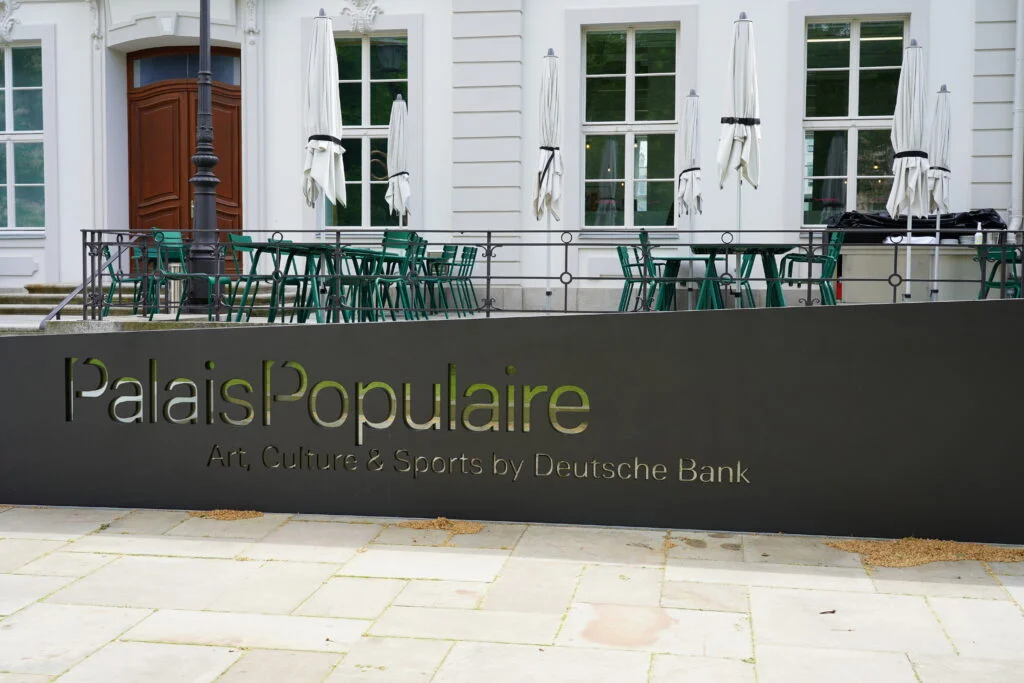
Since then, large corporations have increasingly turned their attention to the art world. Today, some of the world’s largest companies – including Microsoft, Statoil, BMW, Samsung, Pfizer, and Saatchi & Saatchi – boast art collections of varying sizes. Some have created dedicated galleries for their collections, while others display them at their headquarters. Take Deutsche Bank, for example, which has one of the world’s largest collections of drawings and photographs created after 1945. The bank’s headquarters, known as the Deutsche Bank Twin Towers, is located in Frankfurt am Main. Each floor of the twin towers is dedicated to works by a single artist, and the works are organized according to the regions from which the featured artists originate.
In places like Deutsche Bank’s headquarters, the worlds of art and business intersect. But why is business so eager to engage with the art world? What do large corporations need works by Pablo Picasso, Andy Warhol, or Jackson Pollock for? Prof. Alicja Waszkiewicz-Raviv of the Faculty of Journalism, Information and Book Studies at the University of Warsaw examines the reasons for art’s appeal to the business sector, as well as the ways in which corporations harness its potential.

Why do large corporations need art?
On the website dedicated to Deutsche Bank’s art collection, we find the following statement: “Today the corporate collection is as global as Deutsche itself.” The bank’s collection, which previously was “a trip through German art history after 1945,” now includes works from around the world: Europe, Asia, the Pacific, the Americas, the Middle East, and Africa. The company’s global expansion, with offices in various parts of the world, is reflected in an art collection that has embraced global art. Deutsche Bank’s collection thus mirrors the company’s development.
Over the past few decades, large corporations have recognized art as an effective tool for marketing communication. Art – understood as prestigious and sophisticated – can be used to shape a company’s image. Using it in communication helps ensure that the corporation is perceived in line with that image. Furthermore – as the example of Deutsche Bank shows – large companies can use art to communicate the values they hold dear.”
“Corporate art collections are an interesting phenomenon in marketing communication because they offer an engaging experience that primarily appeals to the visual sense. They represent commercial organizations creating spaces where people can experience beauty and enjoy them as residents, tourists, or citizens – not necessarily as customers. It is a form of advanced public relations practiced by socially and economically conscious institutional actors. It is advanced visual public relations,” emphasizes Prof. Waszkiewicz-Raviv.
Art can also benefit from the collaboration between these two worlds. By organizing exhibitions, corporations provide artists with a platform to present their work. This is particularly important for companies that invest in young, lesser-known artists, for whom such exposure can be a chance to gain visibility. A good Polish example is Ergo Hestia and its Hestia Artistic Journey Foundation. Ergo Hestia owns the largest corporate art collection in Poland, and through the foundation established in 2014, it supports initiatives promoting Polish art. One of these projects is a grant program that helps artists organize exhibitions focused on the theme of “responsibility for the world in which we live.”
Location matters
Building a corporate image is not the only reason corporations acquire works of art. Prof. Waszkiewicz-Raviv points out that, for many corporations, collecting is primarily a low-risk investment. In this case, economic considerations determine where such collections are displayed. As a result, countries whose regulations offer tax incentives for the art market are often preferred. Another factor may be personal motivation. As the researcher notes, corporate leaders often want to signal that art is among their interests. In such cases, art collections are displayed at company headquarters.
In a recent 2025 article, Prof. Waszkiewicz-Raviv analyzes – using the example of the collection owned by Grażyna Kulczyk, Poland’s most prominent art collector –how the shift from corporate ownership to a private collection by one of its founders affects both the choice of exhibition venue and the role the collection plays.
Grażyna Kulczyk, co-founder of Kulczyk Holding (Kulczyk Investment), was one of the first people in Poland to begin building corporate art collections. Her company acquired works of art, while the Art Stations Foundation – also founded by Kulczyk – was responsible for exhibiting them and organizing cultural events. The foundation’s headquarters, as well as the venue for these exhibitions, was the Shopping, Arts and Business Center “Stary Browar” in Poznań, which at the time was owned by Kulczyk.
The guiding principle of the venue and initiative was the “50/50” formula, designed to balance commercial and artistic use of the space: 50% business, 50% art. Over time, however, the concept of a shopping center as a place where customers engage with art ran its course – at least for Grażyna Kulczyk herself. The patron decided to house the collection in a space specifically designed for that purpose: a museum. Initially, it was to be located in Poznań, but the idea did not receive support from city officials and other stakeholders. A similar situation occurred in Warsaw. What was the reason for the project’s failure?
“One reason was the widespread concern that the corporation was pursuing its own goals rather than acting in the public interest. This meant that a corporate investor, especially an individual one (Mrs. Grażyna Kulczyk), did not necessarily receive broad support for her plans to create a public space for displaying the collection. Moreover, the initiative was perceived at the time not so much as an institutional project, but rather as a private one (that of an art collector and entrepreneur, rather than an institution and a collection). Such an attitude certainly dampens the motivation to act, as the media noted in the case of the Stary Browar collection,” explains the researcher.
From a shopping mall to a former monastery
Consequently, Grażyna Kulczyk decided to relocate. The collection became her private property. The patron chose to house and display it in a private museum in Susch, Switzerland, a small town in the eastern part of the country, home to just over 200 people. Kulczyk thus exchanged the post-industrial space of an urban shopping mall, frequented by visitors not necessarily interested in art, for the austere architecture of a former monastery situated in a picturesque Swiss valley. As the researcher notes, the move to Switzerland was motivated not only by financial considerations (tax benefits), but likely also served as a form of commentary directed at Polish society, which had not supported Kulczyk’s efforts.
With the change in location, the visibility and accessibility of the Kulczyk Collection also changed dramatically, along with its audience. Previously, the collection was open to any visitor to the Poznań shopping center. Now it is located in a remote setting and is visited primarily by dedicated art connoisseurs. Interestingly, as the researcher notes, this shift also enhanced Grażyna Kulczyk’s standing as an art patron, as evidenced by ARTnews and Artnet including her on their list of the 200 most significant private art collectors.
And what does the future hold for art as a tool of marketing communication? According to the researcher, large corporations will increasingly turn to it.
“This is due, among other things, to the fact that society is becoming wealthier and large companies are accumulating ever greater amounts of capital. This is a trend linked to broader economic development. In addition, there is marketing. In the case of financial and insurance corporations, which struggle to differentiate their offerings in a saturated media environment, image-building increasingly relies on prestige. Prestige, in turn, is provided by art, which proves to be an effective communication channel for institutions with large budgets. Polish society is also evolving. Expectations are growing that companies will share their accumulated wealth as part of corporate social responsibility, and this may be linked to greater investment in the arts,” concludes Prof. Waszkiewicz-Raviv.
The text was originally published in Polish on the Serwis Naukowy UW website on April 16, 2025.