

Serwis Naukowy UWSerwis Naukowy UWSerwis Naukowy UW
  • Humanities
  • Social Sciences
  • Natural & Exact Sciences
  • Content Usage
Serwis Naukowy UWSerwis Naukowy UW
  • Humanities
  • Social Sciences
  • Natural & Exact Sciences
  • PL
  • Content Usage
Follow US
Copyright © 2026 Uniwersytet Warszawski

Strona główna » Tracking HPV: How mathematics helps medicine

Mathematics

Tracking HPV: How mathematics helps medicine

Poland has one of the highest cervical cancer incidence and mortality rates in Europe, as well as one of the lowest five-year survival rates. The five-year survival rate is commonly used as a measure of treatment outcomes and, indirectly, of curability, which depends on several factors, including the stage of the disease, its microscopic characteristics, and lymph node metastases.* Cervical cancer is strongly linked to human papillomavirus (HPV): virtually all cases are caused by persistent infection with oncogenic HPV types. In the fight against this virus, medicine now has a new ally – mathematics.

Last updated: 2026/06/23
23/06/2025
5 Min Read
Human papillomavirus (HPV). HPV particles (pink-colored) collected from a cell culture, as seen under an electron microscope. Image taken at the NIAID Integrated Research Facility (IRF) in Fort Detrick, Maryland, USA. Photo: NIAID/Flickr
SHARE

How brilliant minds and computers detect HPV

There are more than 200 known types of human papillomavirus (HPV). Infections are very common and often produce no symptoms. While some cause benign skin lesions such as warts, others can lead to the development of malignant tumors that pose serious risks to health and life.

This is why HPV DNA testing – analyzing genetic material to detect the presence of the virus and precisely determine its type – is so important. It plays a key role in preventing cancerous changes and, when such changes do occur, in ensuring that appropriate treatment can be introduced as early as possible.

HPV is a major risk factor for cervical cancer. Persistent infection with oncogenic HPV types can also lead to cancers of the vulva, vagina, anus, and rectum. It is also associated with cancers of the mouth and throat, particularly oropharyngeal cancers. Globally, HPV caused an estimated 620,000 cancer cases in women and 70,000 in men in 2019. In absolute numbers, this represents a substantial patient population, which is why researchers are working intensively on faster and more accurate methods for detecting viral genetic material.

Human papillomavirus (HPV). HPV particles (magenta) collected from a cell culture, as seen under an electron microscope. Source: National Institute of Allergy and Infectious Diseases. Photo: NIAID/Flickr

Overcoming challenges

Among the scientists working to address this problem is Dr. Marek Nowicki of the Interdisciplinary Centre for Mathematical and Computational Modelling (ICM UW) at the University of Warsaw. Together with his colleagues, he developed HPV-KITE, a sequence-analysis tool that can detect HPV genotypes from virtually any DNA and RNA next-generation sequencing datasets.

“Viruses in the HPV family vary in length – up to about 8,000 nucleotides, or ‘characters.’ In sequencing data, we virtually never see the complete viral sequences. But if enough fragments are present, we can classify the sample as HPV-positive, indicating the presence of HPV infection,” explains Dr. Marek Nowicki.

Accurately identifying HPV genetic sequences comes with three major challenges. First, HPV is not a single virus but a large group of more than 100 closely related types. Like close relatives, they are genetically similar yet distinct, and these subtle differences make precise identification difficult. Second, biological samples contain large amounts of non-viral DNA, which significantly increases both data volume and processing time. Finally, HPV shows substantial genetic diversity and sequence variability.

The algorithm developed by researchers at the ICM UW is designed to handle all of these challenges with remarkable effectiveness.

Idea + computing power = success

The method relies on analyzing k-mers – short sequences of length k made up of the letters A, C, T, and G, which represent the nucleotides in DNA. To determine whether a given sequence is a variant of HPV DNA, the algorithm computes the Tversky index, a measure of similarity between the tested sequence and a known reference template. The process is sped up by distributing the calculations across multiple computers working in parallel.

“Most existing solutions run on a single machine or, at best, across multiple processing threads. In our solution, computations can be carried out on a single computer, a network of machines, or larger infrastructures such as computing clusters, the cloud, or a supercomputer. This is handled automatically, with load balancing, in order to obtain results as quickly as possible in terms of wall-clock time,” explains Dr. Nowicki, describing the parallel computing method used.
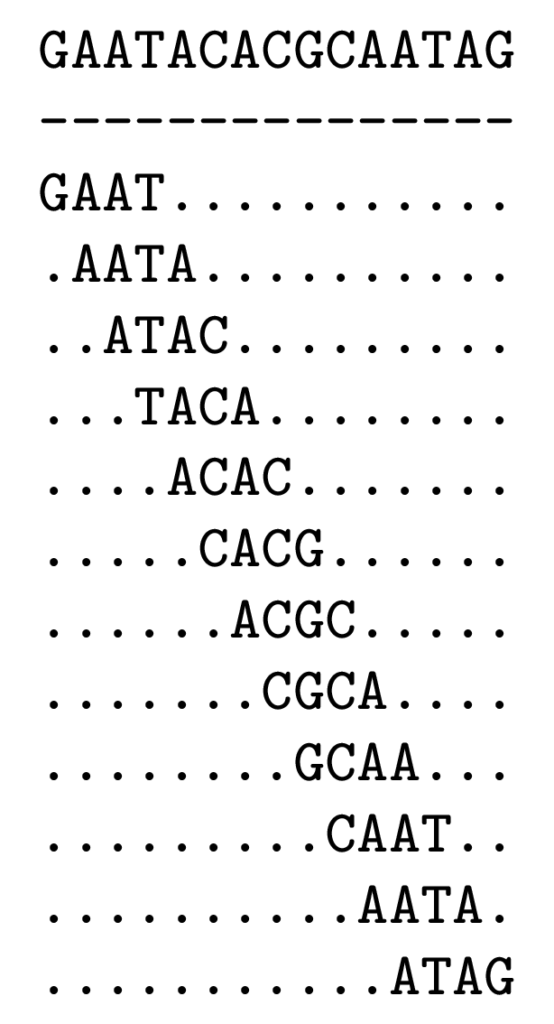
Illustration showing the construction of four-character k-mers from a study conducted by the ICM UW team. Source: Interdisciplinary Centre for Mathematical and Computational Modeling, University of Warsaw

Not Just HPV

Researchers at the ICM UW have shown that their algorithm is among the fastest, most accurate, and easiest-to-use tools for detecting HPV genotypes in next-generation sequencing data. Importantly, it is also highly scalable – its performance improves as additional computational resources, such as processors, are added.

Beyond HPV research, the method has broader applications. It can also be used effectively to detect the DNA of a wide range of other microorganisms.

Read more:
https://heap-exposome.eu/2021/03/31/the-heap-interview-piotr-bala-talks-metagenomics/

https://icm.edu.pl/blog/2025/04/16/szybkie-wykrywanie-sekwencji-wirusow-hpv

https://academic.oup.com/bib/article/26/2/bbaf155/8109669

* Data from the Polish National Cancer Registry (onkologia.org.pl)

The text was originally published in Polish on the Serwis Naukowy UW website on June 23, 2025.

Did climate change and epidemics trigger a crisis in the Eastern Roman Empire? New research offers answers
In physics, sensitivity is key: A conversation with Prof. Michał Parniak
Building resilience against disinformation: The international SAUFEX project
Research University: Five questions for Physicist Professor Michał Parniak
The “sound” of the Universe: A new era of gravitational-wave astronomy
TAGGED:cervical cancerHPVhuman papillomavirusIBM Research Laboratory in ZurichICM UWInterdisciplinary Centre for Mathematical and Computational Modellingk-mersmathematicsmedicineNicolaus Copernicus University in ToruńUniversity of Warsaw
Previous Article Prof. Jacek Jemielity “I’m pleased I noticed something that turned out to be a dark horse.” We talk to Prof. Jacek Jemielity, chemist
Next Article The Pilchowice Dam on the Bóbr River. Photo: Tauron press materials People and water: What is blue anthropology?
Dr. Marek Nowicki

was an assistant professor at the Interdisciplinary Centre for Mathematical and Computational Modelling, University of Warsaw and is now an assistant professor at the Faculty of Mathematics and Computer Science, Nicolaus Copernicus University in Toruń. He also worked at the IBM Research Laboratory in Zurich. His main research interests focus on parallel computing in Java. He oversees the development of the PCJ (Parallel Computing in Java) library and its applications, particularly in the field of bioinformatics data processing and analysis.

UW Science Daily

Center for Cooperation and Dialogue, University of Warsaw

Office: ul. Dobra 56/66, 00-312 Warsaw

Tel.: +48 609635434 • redakcja@uw.edu.pl

Facebook Linkedin Instagram

About us

UW Home page

logotyp-IDUB-PL-poziom-inv

Accessibility statement

Cookie privacy policy

Site map

Copyright © 2026 University of Warsaw

Copyright © 2026 Uniwersytet Warszawski
Manage Consent
To provide the best experiences, we use technologies like cookies to store and/or access device information. Consenting to these technologies will allow us to process data such as browsing behavior or unique IDs on this site. Not consenting or withdrawing consent, may adversely affect certain features and functions.
Functional Always active
The technical storage or access is strictly necessary for the legitimate purpose of enabling the use of a specific service explicitly requested by the subscriber or user, or for the sole purpose of carrying out the transmission of a communication over an electronic communications network.
Preferencje
Przechowywanie lub dostęp techniczny jest niezbędny do uzasadnionego celu przechowywania preferencji, o które nie prosi subskrybent lub użytkownik.
Statistics
The technical storage or access that is used exclusively for statistical purposes. Przechowywanie techniczne lub dostęp, który jest używany wyłącznie do anonimowych celów statystycznych. Bez wezwania do sądu, dobrowolnego podporządkowania się dostawcy usług internetowych lub dodatkowych zapisów od strony trzeciej, informacje przechowywane lub pobierane wyłącznie w tym celu zwykle nie mogą być wykorzystywane do identyfikacji użytkownika.
Marketing
Przechowywanie lub dostęp techniczny jest wymagany do tworzenia profili użytkowników w celu wysyłania reklam lub śledzenia użytkownika na stronie internetowej lub na kilku stronach internetowych w podobnych celach marketingowych.
  • Manage options
  • Manage services
  • Manage {vendor_count} vendors
  • Read more about these purposes
View preferences
  • {title}
  • {title}
  • {title}