
The first attempt was a false start. The initial water sample simply bloomed with microbial growth. Fortunately, it was too small to ever serve as a reference material anyway. Even then, however, it was already clear that creating a Polish certified reference standard matching the composition of lake-water matrix would be no easy task.
A reference material is a carefully characterized sample that laboratories use as a benchmark to check whether their measurements are reliable. Laboratories analyze such a sample to verify whether their instruments and methods correctly detect and measure the elements present in water. This ensures that results can be compared against the same benchmark – whether the analysis is carried out in Warsaw, Kraków, or any other laboratory.
The project, led by the University of Warsaw Biological and Chemical Research Centre, aims to provide Polish laboratories with their own modern standard for water testing. Such a reference material is essential for ensuring reliability and demonstrating the consistency of results. This innovative solution will make it possible to monitor water quality in line with legal requirements and the highest research standards, while also being tailored to local needs.
Elements in a bottle
Strengthening cooperation between the Central Office of Measures and scientists was the main goal behind the launch of the Polish Metrology 2 program. The idea was to increase the production of Polish-certified reference materials, as most of these products are currently imported.
One such material is being developed by a team led by Prof. Jakub Karasiński. It is a matrix material derived from strawberry leaves and fruit (as we have already reported), which may find applications in food safety research.
The final product of the Multifunctional Polish Natural Waters project can, however, be bottled. It is water designed to act as a matrix material for environmental laboratories carrying out analytical testing.
Certified reference materials (CRMs) are now a laboratory standard. They allow scientists to verify whether a given method works correctly – in food testing, pharmaceuticals, medical diagnostics, or environmental monitoring. In the latter field, certified water reference materials are particularly important.
After analyzing the material and obtaining results consistent with its certificate, a laboratory can demonstrate to supervisory authorities that it is capable of accurately measuring a given parameter.
“All laboratories involved in environmental monitoring, including environmental inspectorates, sanitary services, and private labs, are required to demonstrate their competence, for example to the Polish Centre for Accreditation. Laboratories use reference materials as one of the tools for demonstrating that their analytical procedures produce reliable results. Agreement with certified values provides evidence that a method is performing correctly,” says Dr. Anna Ruszczyńska from the Faculty of Chemistry at the University of Warsaw, who leads the project.
The quality of surface waters such as rivers and lakes is regularly monitored in line with both national and EU legal requirements. The material being developed at the University of Warsaw will help meet regulatory standards in environmental testing – but not only that. It will also be useful for determining the composition of different types of water, including drinking water.
“Our laboratory is also accredited for elemental analysis in water. We use reference materials that are not drinking water, but surface samples. By working with lake samples, we confirm our competence, which later allows us to assess drinking water quality,” explains Dr. Ruszczyńska.
In the European Union, the quality of drinking water is regulated by Directive (EU) 2020/2184, which sets limits for the permissible concentrations of selected substances and elements.
“Our material can be used by analytical laboratories working on elemental composition, as it is characterized in terms of elemental concentrations. Laboratories performing elemental analysis may examine well water, groundwater, water for animal consumption, filtered samples, as well as mineral water,” says the chemist.
The aim is to characterize as broad a range of elements in the certified water as possible, as this increases the material’s versatility. The more parameters included in the certificate, the more useful the reference material becomes for laboratories carrying out different types of analyses. If one material certifies 20 elements and another only 10, laboratories are more likely to choose the one that allows them to verify a wider set of measurements.
“Research needs are highly diverse and constantly evolving alongside advances in analytical methods and changes in regulatory frameworks. Uranium is a good example: earlier Polish regulations did not include uranium as a chemical parameter in the same way. The EU Drinking Water Directive introduced a parametric value of 30 ug/L, now also reflected in the updated Polish regulatory framework. Including this element in the reference material therefore significantly increases its practical value for laboratories,” Dr. Ruszczyńska emphasizes.
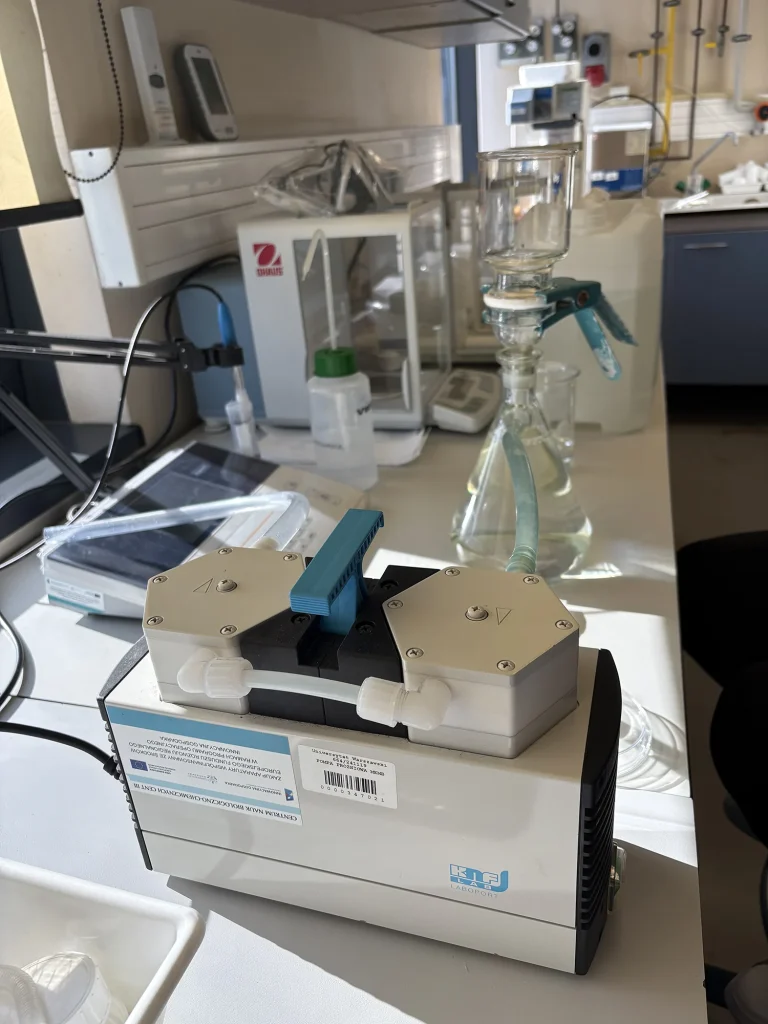
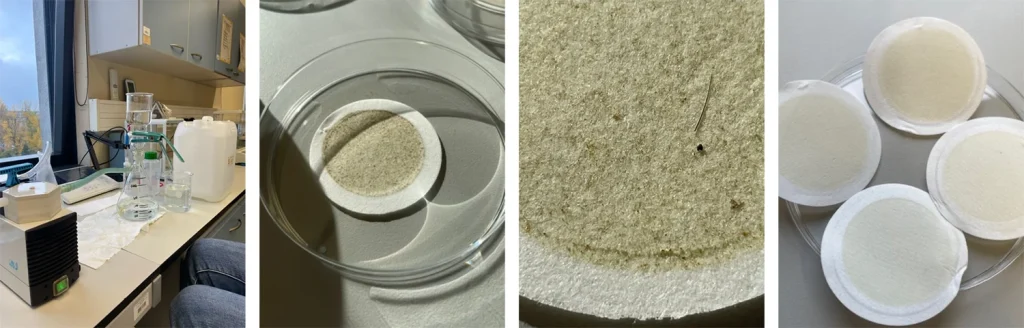
podpis: Producing a certified water reference material involves extensive research, including initial filtration steps.
Not to clog the capillaries
In order for reference materials to fulfil their role, they must be produced in line with strict quality standards. Their production is governed by ISO 17034, which specifies requirements for the competence of reference material producers; ISO/IEC 17025, which regulates the operation of testing and calibration laboratories; and ISO 33401, which defines the information that must be included in certificates and documentation for such materials.
Of course, regulatory requirements are important, but just as crucial is whether the reference material can be used safely and reproducibly in analytical instruments employed in laboratories. This is why the choice of water source and its preparation method were so significant.
“Such a material must be homogeneous, stable, and sufficiently free of suspended matter. In spectrometric analysis, the sample is introduced into the instrument through very narrow parts of the inlet system, so particles, algae, or sediment could interfere with measurements and even clog capillaries or the nebulizer. It is equally important that every portion of the material has the same composition. Only then can a laboratory reliably compare its results with the certified value,” explains the chemist.
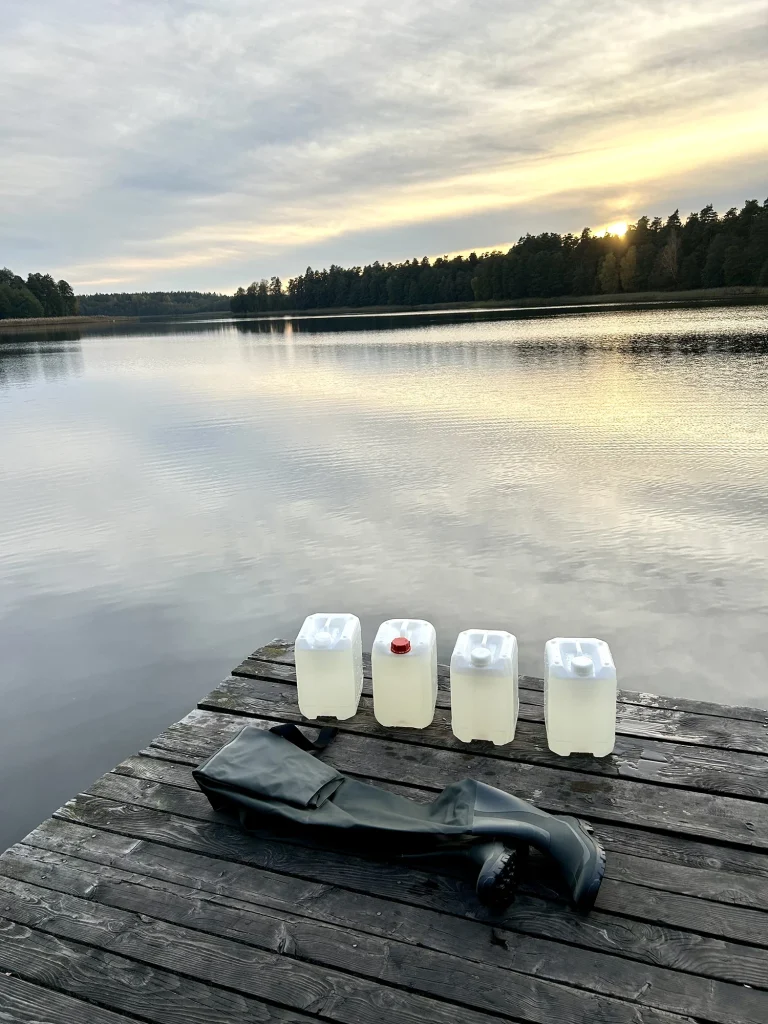
The water used in the project comes from one of the Masurian lakes, selected for its favorable properties, good quality, and low levels of suspended matter and biomass. This was crucial for further preparation of the reference material, particularly filtration, stabilization, and ensuring sample homogeneity.
“We wanted natural lake water, but one that could still be effectively prepared for laboratory use. Water bodies surrounded by intensively farmed land are more exposed to inputs of biogenic compounds that promote algal blooms. We therefore selected a lake in a forested area, where the water contained less biomass and fewer suspended particles, making filtration significantly easier,” the scientist emphasizes.
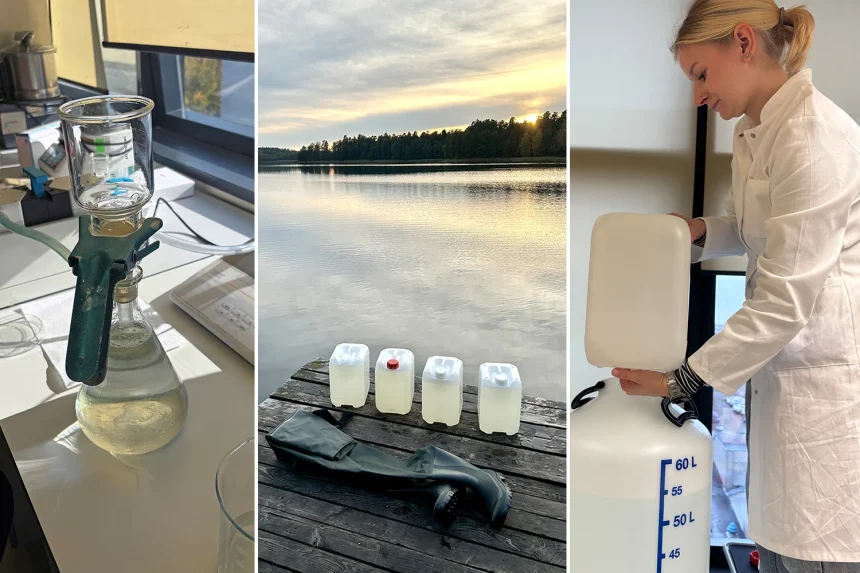
Choosing relatively clear lake water was essential, as it facilitated further processing. The first step was triple filtration: The water was progressively cleared of suspended matter, sand, algae and much of the biological material.
After filtration, the team analyzed the elemental composition to identify elements present at concentrations too low for reliable measurement in many laboratories – and it soon proved far from an easy task.
“I’ll be honest, at this point I’d just buy bottled water. I’m joking, of course – we never considered taking any shortcuts. From the very beginning, we were determined to keep this matrix truly lake-derived. But it turned out that in lake water, some elements are present in extremely low concentrations,” says Dr. Ruszczyńska.
The researchers were able to determine this using sensitive elemental analysis techniques available at the University of Warsaw Biological and Chemical Research Centre. The laboratory is equipped with instrumentation offering a level of sensitivity unavailable in many similar facilities.
Rebellious mercury
The next step was to enrich the lake water by adding solutions of the missing elements. The mixture then had to be thoroughly stirred and its elemental composition checked again.
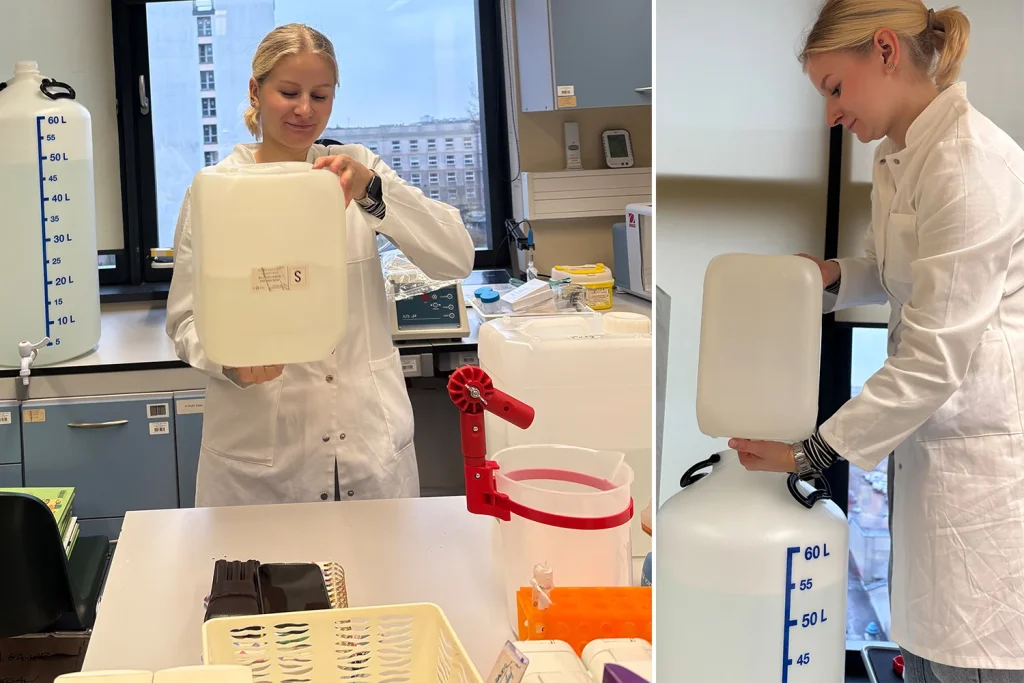
Ensuring homogeneity was also crucial – each part of the container had to contain water of identical composition. To achieve this, argon was bubbled through the water to mix the bulk material. As a chemically inert gas, it does not introduce elemental contamination into the sample.
“According to EU regulations, drinking water must contain no more than 10 μg/L of arsenic. Arsenic was present, if at all, at levels too low to be reliably detected, we had to verify whether the target concentration was achieved after spiking it. As mentioned earlier, a competing commercial material is also expected to include uranium. We had to add it, because in our waters it occurs, if at all, only in trace amounts that are undetectable for some laboratories,” the chemist explains.
Finally, the water had to be preserved by acidification, which prevents the growth of any remaining microorganisms. The water was acidified with high-purity nitric acid to suppress biological growth and help keep trace elements stable in solution during storage. As always, however, there are exceptions.
“We added mercury out of curiosity, but unfortunately its concentration varies significantly between individual bottles. At such low concentrations and under these storage conditions, mercury can adsorb onto the container walls – it literally sticks to the surface,” Dr. Ruszczyńska says.
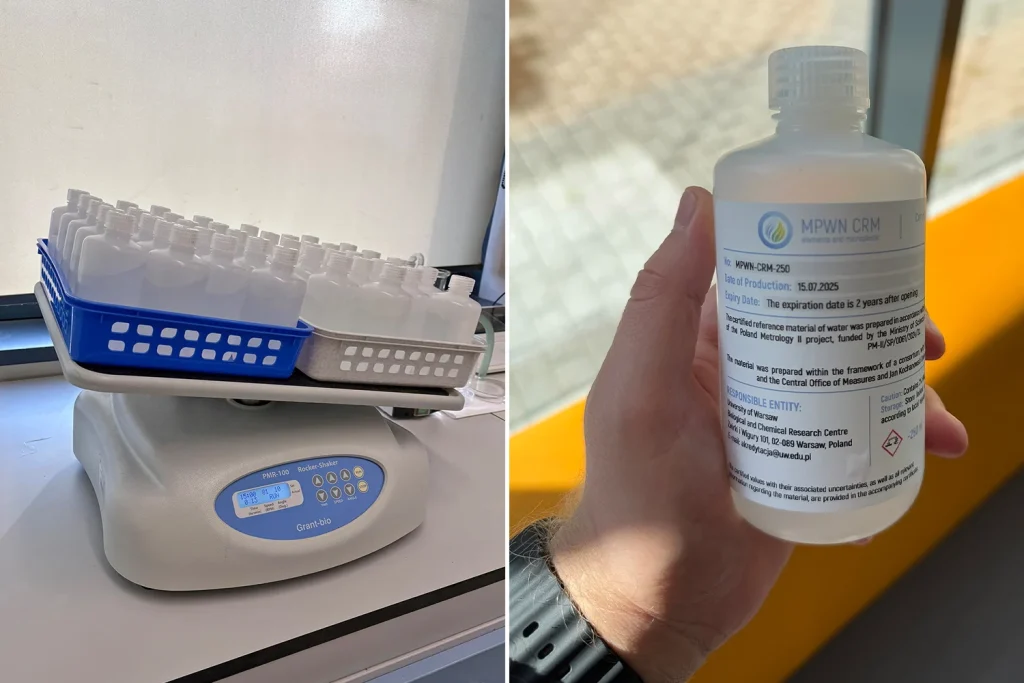
The material was then transferred from a 60 L tank into 250 mL plastic bottles. Wouldn’t glass have been safer? In trace analysis, the choice of container is critical, as even very small changes in sample composition can affect measurement results.
“Glass works well in everyday use, but in chemical laboratories it is not always the best option. Acidified samples can leach trace amounts of certain elements from glass. While such quantities are irrelevant for human health, even extremely small changes in concentration matter in a reference material. If the sample composition shifts during storage, laboratories can no longer reliably compare their results with the certified values,” explains the scientist.
After bottling, the material still requires verification of homogeneity and stability. Samples from selected bottles and different portions of the material are analyzed to ensure that each has the same elemental composition. The tests are repeated after a defined period, allowing scientists to assess stability over time and determine proper storage conditions.
Reference materials are generally designed for long-term stability, but their shelf life and conditions of use after opening are specified individually by the producer.
Challenging microplastics
The project has reached the certification testing stage, carried out with the participation of several independent laboratories. However, getting there required a series of complex technological decisions.
The first, small batch of water collected from another Masurian lake proved completely unusable due to rapid microbial growth.
Microplastics turned out to be a separate challenge. Initially, the team considered developing a single material that could be used both for elemental analysis and for microplastic particle testing. It quickly became clear, however, that these two objectives could not be combined in a single bottle.
“When it comes to microplastics, a stable and homogeneous distribution of particles throughout the entire volume of the material is essential. In practice, this may require adding surfactants to prevent particle aggregation. However, such additives are undesirable in materials used for elemental analysis, as they can interfere with instrument performance and measurement quality. Combining both purposes in a single material proved impractical,” emphasizes Dr. Ruszczyńska.
Microplastics are increasingly seen as a potential threat to human health, although science is still working to determine the scale of the risk. As a result, reliable tools for monitoring their presence in environmental samples are becoming ever more important.
Here, however, the project has delivered an important lesson: a single all-purpose bottle for every type of analysis is not always realistic. Elements and microplastics require different storage conditions and entirely different measurement approaches. The University of Warsaw team has already been working on adapting methods for analyzing microplastics, but developing a dedicated water reference material for this purpose will require a separate effort.
The text was originally published in Polish on the Serwis Naukowy UW website on May 26, 2026.