

A few years ago, media outlets across Poland reported on a spectacular discovery: fragments of a book more than a thousand years old had been found in the C. Norwid Library in Elbląg. This was the same book whose fragments had been turning up across Europe since the 1960s. Parts of the so-called ‘N’ Psalter were first identified in 1968 at Pembroke College Library, Cambridge. A few years later, another fragment was discovered in Haarlem, the Netherlands. In 1997, yet another was found in the Schlossmuseum in Sondershausen, Germany. Thanks to the Polish discovery, and the recent finds in the Netherlands, however, the search for the remaining parts of the manuscript is no longer a matter of chance.
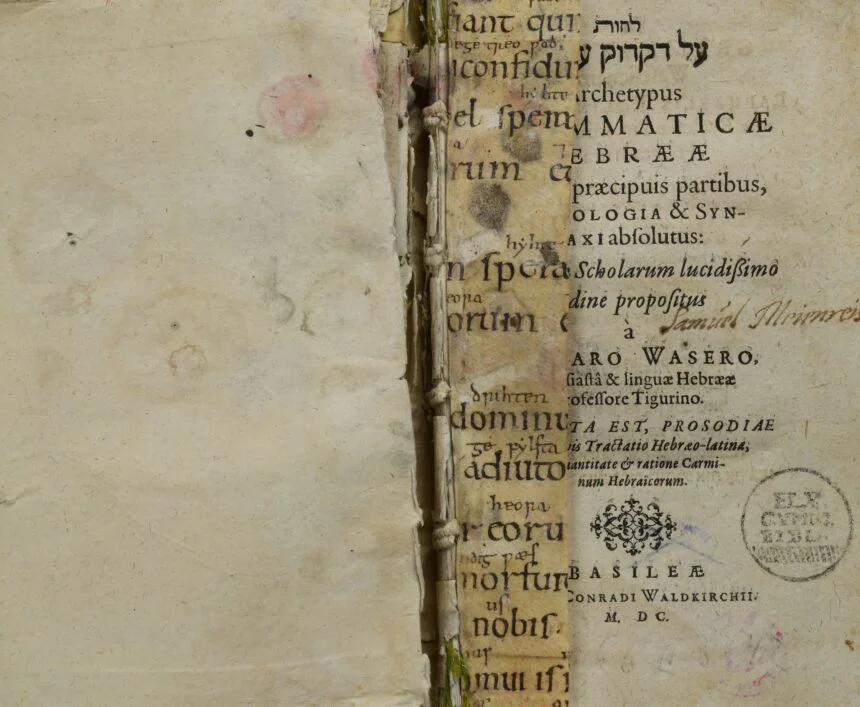
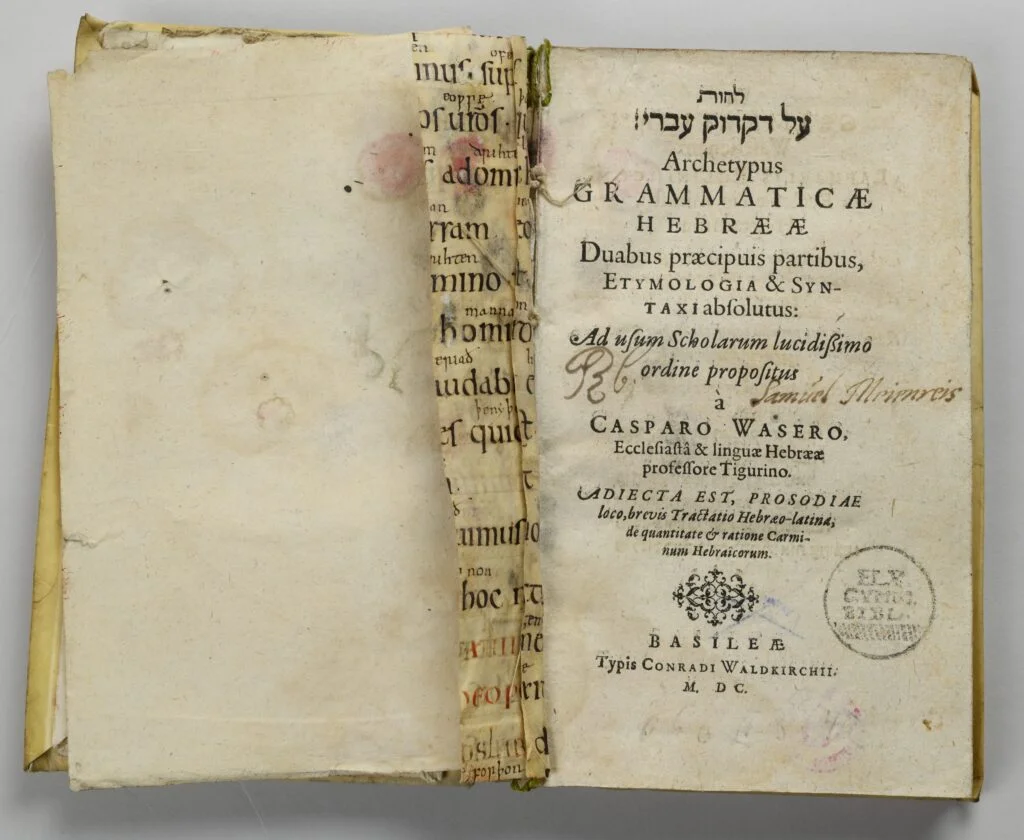
The “Polish” fragments of the ‘N’ Psalter had been incorporated into the binding of an early printed book held in the library – a Hebrew grammar textbook by Caspar Waser. Strips cut from the early medieval manuscript were used as endleaf guards, reinforcing the connection between the book block and the cover. A slightly faded gold-tooled supralibros on the front cover, along with the owner’s handwritten signature, revealed that the Hebrew grammar textbook had belonged to Samuel Meienreis, a theologian and bibliophile from a prominent Elbląg family. Meienreis’s biography and his book collection enabled researchers to reconstruct part of the manuscript’s early modern history.
A Book Within a Book
Before that, however, scholars had to determine the origin of the parchment strips. A team led by Prof. Monika Opalińska from the Faculty of Modern Languages at the University of Warsaw examined the fragments from the Elbląg library. The team included Prof. Barbara Wagner (University of Warsaw); Prof. Piotr Targowski, Dr Dorota Jutrzenka-Supryn, and Dr Magdalena Kowalska (Nicolaus Copernicus University); Dr Paulina Pludra-Żuk (Polish Academy of Sciences); and Dr Ewa Chlebus.
The analysis demonstrated that the two strips found in the book’s cover were continuous fragments of the same page, containing part of Psalm 113 and the beginning of Psalm 114. How did the research proceed?
“We began with palaeographical analysis, focusing on the size and type of the Latin and Old English scripts. I then analyzed the language and the text, comparing it with other English psalters from the same period. This allowed us to determine its origin and its relationship to other known fragments of the ‘N’ Psalter. We then moved on to editing and conducting a philological and linguistic analysis of the fragments,” explains Prof. Opalińska.
Subsequently, a team of chemists led by Prof. Barbara Wagner from the Faculty of Chemistry at the University of Warsaw and physicists led by Prof. Piotr Targowski from the Faculty of Physics at Nicolaus Copernicus University carried out extensive examinations. Their aim was to verify the philological hypothesis regarding the manuscript’s dating and to provide a comprehensive overview of the object’s physical characteristics, including the ink and pigments used. All methods employed were safe for the objects – non-invasive and non-destructive – and yielded detailed information about the fragments’ material composition.
Among the techniques used was modern optical coherence tomography (OCT), which made it possible to image the parchment surface in areas where ruling lines had been drawn above and below the Latin text. The time-consuming measurements – sometimes involving several researchers and taking dozens of hours – allowed scholars to determine how the parchment sheets had been prepared for writing.
“In early medieval manuscripts – that is, up to around the eleventh century – such ruling lines were made with a dry stylus. On this basis, among other things, we can date the manuscript to around 1050–1075. Independent analysis of the handwriting and language confirmed this dating,” says Prof. Opalińska.
An Old English Gloss
Let us turn to the text itself. What makes the ‘N’ Psalter unique is that the Latin psalms are accompanied by a continuous Old English gloss. This Old English text likely served an educational purpose: those praying with the Psalter could simultaneously read it in both languages and develop their Latin. Today, thanks to the same gloss, we can learn more about Old English. The Psalter is a jewel of the early medieval English manuscript tradition.
So how significant is this discovery for Poland?
“It’s very significant,” says Prof. Monika Opalińska. “First and foremost, it is an extremely valuable artefact. Naturally, Polish collections do include medieval manuscripts, but they are usually from later periods. Moreover, until now we have not had any manuscripts written in Old English, although there are manuscripts and single pages produced in medieval England. More broadly, our discovery may shed light on the role bilingual psalters played in medieval religious culture. It is also a unique testimony: while fragments of Latin manuscripts are commonly found in bindings, those in vernacular languages are much rarer.”
As Prof. Opalińska notes, each newly discovered fragment generates excitement not only among Old English specialists. Every additional piece expands our knowledge of the Old English language and helps reconstruct the fate of the original manuscript and its fascinating – sometimes turbulent – history.
Medieval Puzzles
Each year, the number of identified fragments continues to grow. Thanks to the team’s work and their careful examination of bindings, eight further fragments were discovered in the binding of another volume from the Elbląg Library in 2023. Furthermore, in the same year, Dr Thijs Porck from Leiden University and his team found as many as twenty-one previously unknown fragments in the Regional Archive in Alkmaar, the Netherlands. Once again, they were discovered in books whose bindings resemble those of the seventeenth-century books from Elbląg. Both teams of researchers – from Poland and the Netherlands – have been collaborating almost from the start.
The bindings themselves may help explain how the parchment fragments ended up in Poland. This brings us back to Samuel Meienreis, an Elbląg citizen who built his collection during numerous journeys to Europe’s leading academic centres. He purchased the Hebrew grammar textbook in Leiden, most likely in 1602. Indeed, Leiden – with its vibrant book and antiquarian market – provides another crucial clue in tracing the dispersed fragments of the Psalter.
Why Judge Books by Their Covers?
In the early modern period, old manuscripts were commonly reused to reinforce the bindings of printed books. The sixteenth and seventeenth centuries saw a boom in printing (and binding), and parchment – made from animal skins – was expensive. Bookbinders therefore repurposed medieval handwritten books. These were manuscripts that, at the time, had lost their value: perhaps they were difficult to read or considered too conservative for the Reformation era.
Scholars studying the ‘N’ Psalter believe its fragments found their way into printed books that were bound and sold in the seventeenth-century Netherlands, most likely in Leiden. They attribute the subsequent dispersal of these fragments and their host volumes across Europe to the city’s cosmopolitan character. At the time, Leiden was one of the wealthiest and most important cities in the Netherlands, attracting students from across Europe. It remains a quintessential university town to this day and is home to the oldest university in the Netherlands.
Scraps of History
In recent decades, the study of manuscript fragments has developed into a dynamic and significant field known as fragmentology. Recovered fragments offer a chance to fill gaps in the record of works that are otherwise lost or scattered.
“Such historical resources are, in a sense, open-ended. There is always a possibility of unexpected and spectacular discoveries, like the one in Elbląg – especially when it comes to fragments hidden in bindings. Current estimates suggest that one in five early printed books contains parchment fragments in its binding. This represents a vast field for further research and discoveries,” says Prof. Opalińska.
Today, Polish scholars, together with the Leiden University team, are working collaboratively to reconstruct the complete history of the Psalter.
This interdisciplinary research team – comprising linguists and language historians, literary scholars, conservators, archivists, specialists in book and printing history, physicists, chemists, and experts in bookbinding – employs cutting-edge digital, physical, and chemical methods to trace the manuscript’s provenance.
We hope that further research will shed light on its more obscure chapters. Many mysteries are still unresolved. For example, how did a seventeenth-century Leiden bookbinder come into possession of an early medieval English manuscript? For now, two hypotheses have been put forward.
And What of the Princess?
The first hypothesis suggests that, around the mid-sixteenth century, large numbers of medieval English books were transported to the continent by ship and sold to bookbinders. These were the “fortunate” volumes.
Many others that remained in the British Isles were destroyed during the Dissolution of the Monasteries under Henry VIII, when monastic property was plundered and countless books were burned. Perhaps the ‘N’ Psalter was among those manuscripts that survived by being shipped abroad.
There is also a more romantic – though historically unconfirmed – possibility. Some scholars speculate that the codex may once have belonged to Gunhild of Wessex, the youngest sister of Harold II, the last Anglo-Saxon king of England. Harold died at the Battle of Hastings in 1066 – according to legend, struck in the eye by an arrow – less than a year after ascending the throne. We know that Gunhild soon sought refuge at the monastery of St Donatian in Bruges. She offered a Psalter with Old English glosses, along with other valuables, to her Flemish benefactors. Whether Gunhild’s Psalter and the N-Psalter were one and the same book cannot be ascertained. If this hypothesis were ever confirmed, the manuscript would prove to be not only ancient, but also royal.
Will the strips of early medieval parchment – now painstakingly reunited – reveal the story of the last days of the Anglo-Saxon princess?
“We cannot say for certain, but our research continues. Perhaps that story, too, is hidden within these thousand-year-old fragments, and one day we will uncover it,” says Prof. Opalińska with a smile.
The text was originally published in Polish on the Serwis Naukowy UW website on February 6, 2025.