

When we talk about books, we usually mean their content. However, the smell of yellowed pages or, on the contrary, a freshly printed book is an integral part of the joy of reading. What happens to a book depends on who reads it and why.
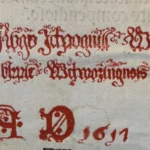
The text is only one of the many components. Apart from the text, the pages of old books, both printed and handwritten, could feature the owner’s painted coat of arms, illustrations, musical notation, diagrams, maps, or multicolored decorations with human and animal figures. The binding itself was an expensive work of art. A perfect example can be the silver book bindings from Albrecht Hohenzoller’s collection, made by goldsmiths from Königsberg.
The price range of handwritten and printed books in the 15th and 16th centuries was very wide. The value of the complete manuscript of Jan Długosz’s Annales or Chronicles of the Famous Kingdom of Poland (Roczniki czyli kroniki sławnego Królestwa Polskiego) was estimated in the 1580s at 3,000 florins, which was enough to buy a tenement house on the market square in Krakow at that time. At that time, the price of the most expensive printed books was equal to the average annual salary of a municipal official. A larger group of readers had access to the cheapest prints.
The royal courts ordered codices, which often show no signs of intensive use. In the case of books printed in the 15th and 16th centuries, a part of the print run – intended for the wealthiest recipients – was printed on parchment and covered with painted decorations. The larger print run was printed on paper and sold (without additional decorations) at a lower price. These copies often show numerous signs of active reading or interference with the content of the book. That is why the study of old Polish books can be a source of knowledge not only about old printing techniques, but also about reading habits and even the lives of readers.
In her research, Dr. Karolina Mroziewicz from the Faculty of Culture and Arts at the University of Warsaw considers old books primarily as material objects, artistic works, whose aesthetic value is important. Old books are three-dimensional objects that appeal to the senses of their readers, not only sight, but also touch and hearing.
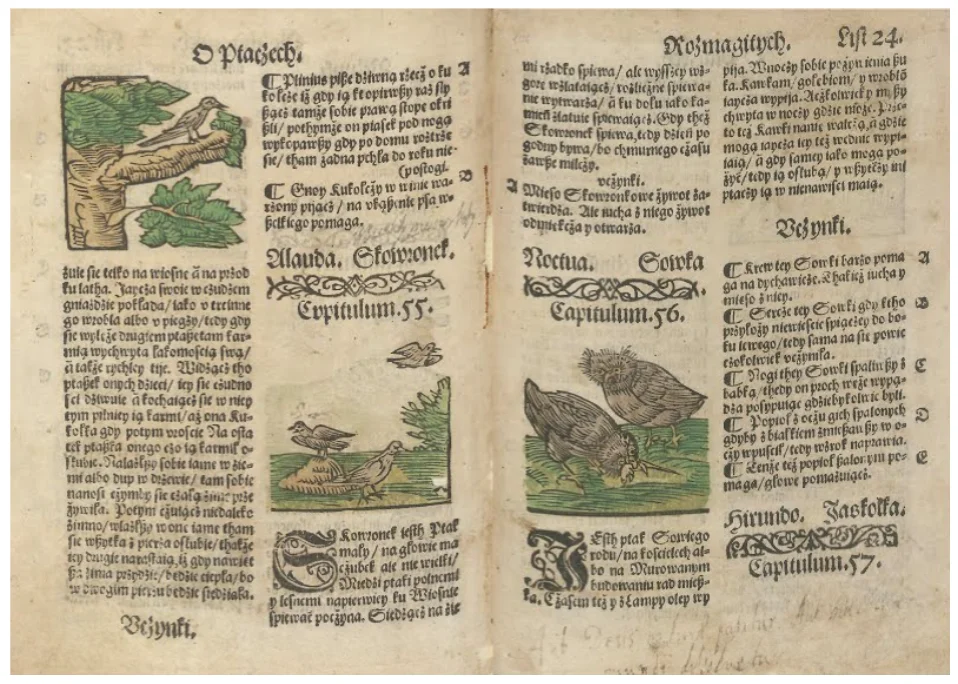
A book printed on handmade paper differed visually from one printed on vellum Each sheet of paper or parchment used to print particularly valuable books has its own texture. Running their hand over the text, readers could feel protrusions – the laid lines of handmade paper or the soft, almost satiny surface of tanned calfskin. Interaction with the book included – sometimes very lively – reactions to the text: crossings-out, underlining, or polemical notes; we find them today on the pages of various volumes. Readers also reacted to the images – scenes considered indecent were painted over, portraits of unpopular people were defaced, or other objects or figures were drawn onto the illustrations. The color was also significant. When the reader colored an engraving with red paint, it enhanced the drama of the depicted scene, such as The Last Judgment. The impact of Old Polish books on the reader’s senses made reading them a complex experience.
“The range of ways in which readers could interact with books was much wider in the past than it is today. Scissors, glue, ink, and paints were eagerly used by readers of old books to personalize the contents of their volumes. These practices, which were quite common in the 15th and 16th centuries and are now mainly limited to children’s exercise books, testify to the close relationship between the reader and their book,” Dr. Mroziewicz explains.
As books started to be mass-produced, they gradually lost their exclusive and unique character. Today’s popular e-book readers often leave us interacting only with text on a screen, losing touch with the physical object.
Readers comment and discuss
There is evidence of an extraordinary bond with books, especially those of high value, as family‑owned volumes passed down through generations.
Anonymous readers of Marcin Bielski’s Chronicle of the whole world (Kronika wszystkiego świata) not only allowed themselves to correct the text or color the illustrations, but also engaged in bold polemics with the author on the pages of the book: “Ah! That stupid author” (later someone else added: “It’s true, this author is very stupid”). Sometimes several decades passed between one such entry and the next, which to a limited extent resembles the exchange of comments on the Internet, although usually in shorter intervals. Users’ interactions with books had a very physical dimension.
“Comments left in the margins by a single reader sometimes became the subject of comments by subsequent users of the book – a phenomenon somewhat comparable to today’s online forums but the length of these comments was always limited by the space available in the margins or between lines. Reader interactions always took place within the confines of the book; they had a material dimension,” Dr. Mroziewicz adds.
Removing heretical material from book copies or obscuring indecent images always left physical traces. Tattered pages or missing sections signal a gap in the book’s content, which can be compared to the “disappearance” of controversial posts on social media.
Tell me what (and how) you read, and I’ll tell you who you are
An old book is more diverse than it might seem. What it was as an object and how it was treated depended primarily on the reader. For the king or the aristocracy, a decorated codex was a symbol of wealth and power. For Old Polish scholars, a book was a tool of their work – a source of knowledge and a laboratory in one.
“Scholars covered the margins of books with polemical notes and references to other works they used when studying specific topics. Sometimes they developed their own systems of markings that allowed them to quickly find references to specific passages or problems. The subject matter is also of key importance to the ways in which readers in the past used their copies,” Dr. Mroziewicz comments.
Bielski’s Chronicle of the whole world was primarily intended for noble readers, attached to family values and interested in national history and tradition. The chronicle’s structure allowed readers to include events from their own lives. On the other hand, Stefan Falimirz’s work On Herbs and Their Powers (O ziołach i o mocy ich) was a practical collection of knowledge, eagerly used by pharmacists, herbalists, and doctors. It contained advice on herbal medicine, cupping, and bloodletting. An important part of this publication were the illustrations, which made it easier to navigate the material and provided a source of information about the remedies described. Selected illustrations were hand-colored to make it easier to identify the plant species depicted, and next to the woodcuts readers often noted alternative variants of the plants’ names they knew.
The decision to interfere with the materiality of books could be motivated by various factors, ranging from purely pragmatic reasons to ethically-based considerations. The pages of old books contain traces of discussions that sometimes lasted for more than a century. Are we able to maintain such continuity of communication in the ever-changing space of the Internet and new media?
The text was originally published in Polish on the Serwis Naukowy UW website on January 23, 2025.