

“Remote work,” “online learning,” “e-learning,” “webinar,” “call,” or even “workation” are terms that have gained popularity since 2020. The outbreak of the COVID-19 pandemic has led to many restrictions and bans, including the closure of universities, schools, kindergartens, nurseries, restaurants, shopping malls, service establishments, and arts and culture institutions. We had to find new forms of communication, both professional and private. The pandemic has not only caused difficulties in managing companies and customer relations, but also, very often, separated families, couples, and close friends.
And although the pandemic is fortunately behind us, virtual forms of communication have remained and continue to enjoy great popularity. But are interactions in the online world really the same as those in reality? Answers to these questions can be found in the research of Prof. Joanna Rączaszek-Leonardi, a psychologist and cognitive scientist at the Human Interactivity and Language Lab, Faculty of Psychology, University of Warsaw.
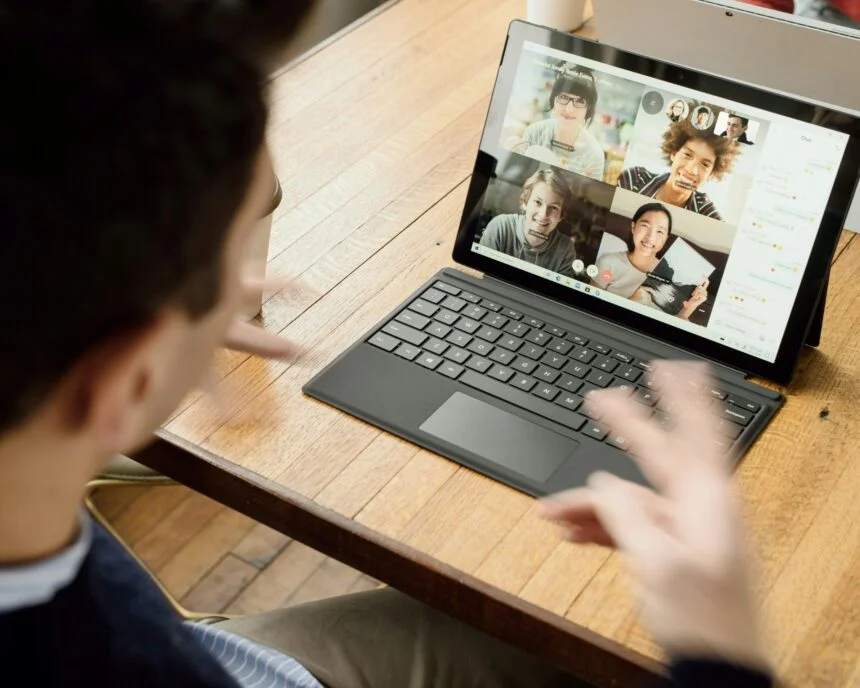
Video conferencing allow participants to receive visual cues, such as gestures, face expressions, and body posture. This is their advantage over, for example, phone calls, where the recipient only has access to the sender’s voice. Studies comparing video conferencing to audio-only communication have shown greater effectiveness in solving group problems, shorter discussion times, and stronger emotional bonds between participants. However, different media impose their own specific limitations – in the case of video calls, for example, an overload of visual information can be a problem. This is one of the problems that researchers from our university have looked into.
Gestures over words
When two people engage in dialogue, they do much more than just exchange words. The participants in the conversation “synchronize” with each other, coordinating their movements, glances, gestures, and face expressions. This unique synchronization with the interlocutor allows them to establish not only informational but also affective coupling. To put it simply, the more we are in sync, the more we like each other.
By assessing the level of coordination between interlocutors, researchers are able to determine the quality of their relationship, the degree of bonding, the empathic accuracy, the potential effectiveness of tasks performed together, and even the results of psychotherapy. The ability to coordinate movements when interacting with others develops as early as infancy and is the simplest form of bonding with others. A team led by Prof. Joanna Rączaszek-Leonardi and Dr. Julian Zubek conducted research to assess how the level of coordination changes during video-mediated and face-to-face conversations. This involved an experiment comparing the movement coordination dynamics of participants in quasi-natural dialogues in two situations: during a face-to-face conversation and during a video conversation. Furthermore, in each of these cases, the interlocutors either saw or did not see their mirror images. During the online conversation, this was a typical window with their own reflection. During face-to-face conversations, participants could simultaneously observe their faces on their phones.
Virtual gesturing
Researchers have observed that during video conversations, people tend to exaggerate certain gestures, especially nodding. In traditional conversations, subtle nodding is a natural way to express agreement, interest, or understanding. Researchers suggest that exaggerating gestures may stem from uncertainty as to whether they have been noticed by the interlocutor.
But that doesn’t mean we’re more expressive non-verbally in virtual conversations. As it turns out, the overall range of movement decreases.
“We are stuck in front of the computer, in the camera’s field of view, forced to look at a screen that does not move – it is completely different when talking in person,” says Prof. Rączaszek-Leonardi.
Another interesting aspect is the impact of the view of one’s own face, which usually remains visible in the video conference window. It would seem that viewing yourself on screen should be distracting and make conversation less natural. However, research shows that the presence of one’s own image can have a compensatory function, allowing the interlocutor to better control their gestures and facial expressions. This makes their expression less exaggerated.
Less patience for video calls
Video-mediated interactions are, for technical reasons, less stable than face-to-face interactions. Movement coordination between participants in video conferences is more dispersed and lasts shorter than in traditional conversations. According to Prof. Rączaszek-Leonardi, even a slight delay in the connection affects the quality of contact. Research by Lynn Murray and Colwyn Trevarthen in the 1980s showed that infants react with anxiety when feedback from their mother is delayed by even less than one second.
“In addition, various feedbacks or hearing one’s own voice with a delay can contribute to this lack of smoothness,” emphasizes Prof. Rączaszek-Leonardi.
This leads to an increased readiness to fix interactions and maintain heightened alertness for long periods of time.
Zoom fatigue
Since even slight delays can lead to uncertainty as to whether our gestures and words have been correctly understood, it’s no wonder this form of communication leaves us feeling frustrated and tired. In research, this even has a name – “zoom fatigue” – i.e., fatigue resulting from prolonged participation in video conferences.
Researchers say that during video calls, people might feel like they need to use body language in a similar way to how they would in a face-to-face conversation, but technology limits their ability to gesture naturally. This adds to the frustration and fatigue.
What does the recipient of online communication lose?
“Apart from smoothness, they also lose the natural dynamics of speaking and using eye contact, which is very important, for example, when conveying a speech: we do not look at the speaker when we do not want to be interrupted, we look when we are about to speak or to pass the turn to the other. During video conversation our looking at the interlocutor means that we are not looking at the computer camera: our gazes do not meet. Added to this is the limitation of arm and hand gestures. As Jana Iverson and Esther Thelen described it: gestures and speech in natural face-to-face conversation are like two fish fins – they complement each other, maintaining contact and the exchange of information,” says Prof. Rączaszek-Leonardi.
The most important conclusion from the research is that in video communication, the stability of movement coordination between participants is lower, which can have a negative impact on the overall quality of the interaction. So, if we value a relationship, it may be worth “logging out into reality” and meeting face to face.
The text was originally published in Polish on the Serwis Naukowy UW website on January 17, 2025.